 Nothing found for the request
Is the Casino Legal in Turkey? 2026 Gambling Laws Guide
Sologe July 10, 2026
Share:


The Legal Status of Casinos in Turkey: What the Law Actually Says
Private casinos are illegal throughout Turkey. Period.
The Turkish government enacted a comprehensive ban on casinos, slot machines, and most forms of private gambling in 1997. This wasn’t a gradual phase-out or a nuanced regulatory framework—it was a complete prohibition that shuttered all existing casino operations overnight.
Before 1997, Turkey actually had a small but growing casino industry, particularly in tourist areas like Istanbul and coastal resort towns. These establishments catered largely to international visitors and generated significant revenue. But cultural and political pressure led to the abrupt ban, and no private casino has operated legally in Turkey since.
The current legal framework governing gambling in Turkey includes several key pieces of legislation:
- Law No. 7258 establishes the regulatory framework for legal state-controlled gambling operations
- The Turkish Penal Code criminalizes illegal gambling activities and imposes penalties on operators and participants
- Law No. 5651 empowers authorities to block access to illegal gambling websites and monitor financial transactions related to offshore gambling
These laws don’t just prohibit casino operations—they create a comprehensive enforcement mechanism that targets the entire gambling ecosystem, from operators to payment processors to individual bettors.
What About Online Casinos?
Online casinos are equally illegal for Turkish citizens. The ban extends to all forms of digital gambling, including online poker rooms, virtual slot machines, and live dealer casinos hosted on international websites.
Here’s where it gets interesting. While the law prohibits online gambling, enforcement is a constant cat-and-mouse game. The Turkish government actively blocks access to unauthorized gambling sites, but new domains pop up almost as quickly as old ones get banned.
In 2024 alone, Turkey acted against 233,000 illegal gambling websites. The general directorate of the national lottery administration (MPI), affiliated with the ministry of treasury and finance, detected and requested blocking for hundreds of thousands of gambling sites. That’s not a typo—233,000 sites in a single year.
The sheer volume of blocked sites reveals the scale of demand for online gambling services among Turkish citizens, despite the legal prohibitions. Offshore operators continue to target the Turkish market through various workarounds, though accessing these sites carries legal risks for users.
History of Gambling in Turkey: How We Got Here
Understanding Turkey’s current gambling laws requires looking back at how attitudes and regulations evolved over time.
Turkey has a long, complicated relationship with gambling. Ottoman-era laws prohibited most forms of gambling based on Islamic principles, but enforcement was inconsistent, and informal gambling remained common in private settings.
The modern Turkish Republic, founded in 1923, initially maintained restrictive gambling policies. But as Turkey pursued economic development and tourism growth in the late 20th century, attitudes shifted. The government began licensing casinos in the 1980s and early 1990s, particularly in tourist destinations and five-star hotels.
The casino boom was short-lived. By the mid-1990s, concerns about gambling addiction, organized crime connections, and moral objections gained political traction. Religious and conservative groups pressured the government to reconsider its permissive stance on casino gambling.
In 1997, Prime Minister Necmettin Erbakan’s coalition government—Turkey’s first Islamist-led administration—implemented the casino ban. The decision was framed as both a moral imperative and a public health measure, addressing concerns about gambling’s social costs.
The ban wasn’t universally popular. Casino owners, tourism industry representatives, and some secular politicians argued that the prohibition would hurt tourism revenue and push gambling underground rather than eliminate it. They were partially right.
The State Monopoly Model
Rather than prohibiting all gambling, Turkey opted for a state monopoly model. Certain forms of betting remained legal—but only when operated by government-controlled entities.
This approach reflects a compromise between complete prohibition and open market regulation. The government argues it can better control social harms, prevent money laundering, and capture tax revenue through state-run operations rather than allowing private gambling businesses.
Critics counter that the state monopoly model is hypocritical, allowing the government to profit from gambling while denying citizens the choice to patronize private operators. But this system remains firmly in place as of 2026.
Legal Gambling Options in Turkey: What’s Actually Allowed
Not all gambling is illegal in Turkey. Turkish citizens can legally participate in specific state-controlled gambling activities.
These legal options operate under strict government supervision and generate significant revenue for the Turkish state. Understanding what’s permitted clarifies the boundaries of Turkey’s gambling laws.
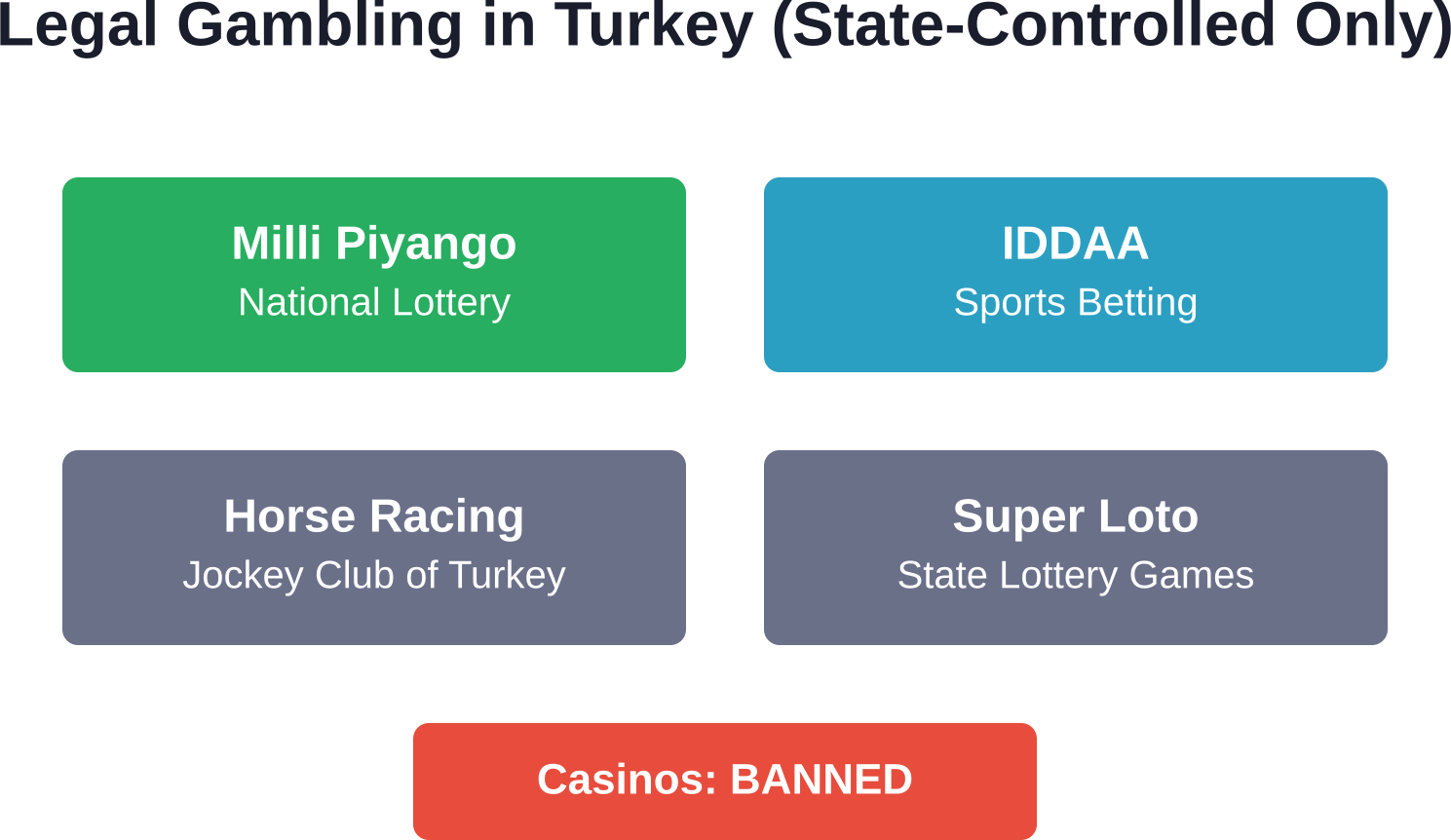
Milli Piyango: The National Lottery
Milli Piyango is Turkey’s state-run national lottery, and it’s the most visible form of legal gambling in the country. The lottery operates under government supervision and has been part of Turkish life for decades.
Turkish citizens can purchase lottery tickets at authorized retail locations throughout the country. Drawings occur regularly, with jackpots that occasionally reach substantial amounts. The lottery generates significant revenue for the Turkish government, funding various public programs.
Operators who wish to produce lottery bonuses or prizes face specific financial requirements. According to Turkish gambling regulations, permit fees are set at 15% of the total market value of bonuses, prizes, or other benefits that will be distributed through the lottery. For imported or third-party produced prizes, that fee jumps to 30%.
IDDAA: Legal Sports Betting
IDDAA is Turkey’s state-controlled sports betting operator and the only entity legally permitted to offer sports wagering services to Turkish citizens—including online betting.
IDDAA offers betting on football (soccer), basketball, and other major sports through authorized retail locations and an official website. Turkish sports fans can place bets on domestic leagues, international competitions, and various sporting events worldwide.
The Turkish Sports Toto Organisation oversees IDDAA operations, ensuring compliance with government regulations and managing the betting infrastructure. Only IDDAA is permitted to offer online sports betting services, making it the sole legal digital gambling option available to Turkish residents.
This state monopoly on sports betting represents a compromise position: the government acknowledges demand for sports wagering while maintaining tight control over operations and revenue streams.
Horse Racing Betting
The Jockey Club of Turkey operates legal horse racing betting under government supervision. Turkish citizens can place bets on horse races at designated venues, and this form of gambling has a long tradition in the country.
Horse racing betting occupies a unique position in Turkish gambling law, with roots that predate modern gambling restrictions. The government has maintained this exception, viewing horse racing as both a sporting tradition and an agricultural industry support mechanism.
What’s Not Permitted
Everything else falls into the illegal category. That includes:
- Private casinos and slot machine parlors
- Poker rooms and card clubs
- Bingo halls not operated by the state
- Online casinos, poker sites, and virtual slot machines
- Private sports betting operations
- Skill gaming platforms that involve real money wagering
The law draws a bright line: if it’s not explicitly operated by a government-authorized entity, it’s prohibited.
Discover Gaming Industry Suppliers with Sologe
Legal requirements are only one factor businesses consider when studying a gaming market. Understanding the supplier ecosystem can be equally important when evaluating technology and operational needs. Sologe brings together providers from different segments of the iGaming industry, helping businesses compare solutions across software, payments, services, and platforms.
Sologe helps businesses compare:
- Online gaming platforms
- Gaming software providers
- Sports betting solutions
- Payment solution providers
- Analytics and marketing software
- Traffic services
- Operations management services
- Company registration services
Contact Sologe to explore gaming platforms, software providers, payment solutions, and other business services available through the iGaming marketplace.
Penalties for Illegal Gambling: What You Risk
Turkey doesn’t just prohibit illegal gambling—it actively enforces these laws with financial penalties and potential criminal consequences.
Understanding the penalty structure matters for Turkish citizens considering offshore gambling sites and for operators targeting the Turkish market. The government has demonstrated willingness to pursue enforcement at multiple levels.
Individual Bettor Penalties
Turkish citizens caught using illegal gambling services face financial penalties. The Turkish government imposes administrative fines on individual bettors ranging from 5,000 TRY to 20,000 TRY (approximately $150 to $600 based on recent exchange rates) under Law No. 7258, which can be even higher depending on the specific infraction under the Misdemeanor Law.
While these fines might seem modest, they come with potential additional consequences. In some cases, individuals face possible imprisonment for repeated violations or involvement in organizing illegal gambling activities. Those facilitating transactions for illegal gambling—such as payment processors or cryptocurrency exchangers—also face legal exposure.
Enforcement against individual bettors is inconsistent. The government focuses resources primarily on blocking sites and targeting operators rather than prosecuting individual users. But the legal risk exists, particularly for high-volume or high-stakes players who attract attention.
Operator Penalties
Operating an illegal gambling business in Turkey carries severe penalties, including substantial fines and imprisonment. The Turkish Penal Code criminalizes unlicensed gambling operations, and authorities have pursued both domestic and international operators.
For international operators serving Turkish customers from offshore jurisdictions, direct legal consequences are harder to enforce. But Turkey employs several tactics to disrupt these operations:
- Blocking website access through internet service provider (ISP) orders
- Targeting payment processing and financial transaction channels
- Working with international authorities to pursue cross-border enforcement
- Imposing penalties on local agents or affiliates who promote offshore gambling sites
The 233,000 gambling websites blocked in 2024 alone illustrate the government’s aggressive enforcement approach. Turkey’s treasury and finance minister has publicly vowed to break the country’s illegal gambling sector, signaling continued pressure on unauthorized operators.
Financial Sector Restrictions
Turkey monitors financial transactions related to gambling through banking regulations and Law No. 5651. Banks and payment processors are required to flag suspicious transactions that might involve illegal gambling activity.
This financial surveillance makes it challenging for Turkish citizens to fund accounts with offshore gambling sites. Credit card transactions, bank transfers, and e-wallet payments to known gambling operators are often blocked or flagged for investigation.
Cryptocurrency has emerged as a workaround for some users, though Turkish authorities have increased scrutiny of crypto exchanges suspected of facilitating gambling transactions.
Requirements for Gambling Licensing in Turkey
While private casino licenses aren’t available, understanding Turkey’s licensing framework for permitted gambling activities reveals the regulatory environment international operators would face if laws changed.
The regulatory landscape is decentralized, with various authorities overseeing specific gambling sectors. The Turkish Sports Toto Organisation manages sports betting, the national lottery administration oversees Milli Piyango, and the Jockey Club of Turkey regulates horse racing betting.
For the limited private operators permitted in adjacent sectors (like lottery prize suppliers), requirements are substantial:
Requirement | Details
|
|---|---|
Minimum Paid-Up Capital | TRY 5 million (approximately €133,000)† |
Physical Office | Mandatory establishment in Turkey for daily operations |
License Fees | 15% of market value for lottery prizes; 30% for imported prizes |
Annual Adjustments | Application fees adjusted yearly per Tax Procedure Law revaluation rate |
These requirements demonstrate that even for permitted gambling-adjacent activities, Turkey maintains high barriers to entry and strict financial oversight.
Why International Operators Target Turkey Despite the Ban
Turkey’s gambling market presents significant opportunities despite legal prohibitions. The country has a large, young, digitally connected population with growing disposable income. Online gambling sector projections show a Compound Annual Growth Rate (CAGR) of 9% from 2023 to 2028 for the broader regional market.
Offshore operators see Turkish customers as valuable targets, leading to the proliferation of sites specifically marketed to Turkish players. These operations typically:
- Offer Turkish-language interfaces and customer support
- Accept Turkish Lira alongside other currencies
- Provide localized payment methods, including crypto options
- Sponsor Turkish sports teams and events for brand visibility (where legal loopholes allow)
The economic calculation is straightforward: the potential revenue from Turkish customers outweighs the costs of constantly changing domains and navigating enforcement measures.
Gambling Tourism: Where Turkish Citizens Go to Play
Unable to access casinos domestically, some Turkish citizens travel abroad to gamble legally. This gambling tourism represents a significant economic outflow and highlights the limitations of prohibition.
Northern Cyprus has become a popular destination for Turkish gamblers. The internationally disputed territory operates outside Turkish legal jurisdiction and hosts numerous casinos catering to Turkish clientele. Turkish citizens can travel to Northern Cyprus relatively easily and access casino gambling that would be illegal in Turkey proper.
Other popular gambling destinations for Turkish citizens include:
- European casino hubs like Monaco, Malta, and Cyprus
- Eastern European destinations with developing casino industries
- Middle Eastern locations like the United Arab Emirates (for luxury casino-resort experiences)
- Online gambling platforms hosted in international jurisdictions
This gambling tourism dynamic creates an interesting situation: Turkish law prohibits casinos domestically but cannot prevent citizens from gambling legally while abroad. Some Turkish citizens make regular trips specifically for casino gambling, and the economic impact—both in lost domestic tourism revenue and gambling expenditure leaving Turkey—is substantial.
Will Turkey Legalize Casinos? Future Outlook
The question on many minds: will Turkey ever reverse its casino ban and implement regulated gambling?
The short answer? Don’t hold your breath.
Political and cultural factors make legalization unlikely in the near term. Turkey’s current government maintains conservative positions on gambling, viewing it as socially harmful and morally problematic. President Erdoğan has publicly called for intensified efforts to combat illegal gambling, signaling that liberalization isn’t on the agenda.
Economic arguments for legalization exist. Regulated casinos could generate substantial tax revenue, create employment, boost tourism, and capture gambling expenditures currently flowing to offshore operators or neighboring countries. Some economic analysts argue that prohibition is ineffective and costly, consuming enforcement resources while failing to eliminate gambling.
But economic logic doesn’t drive this policy. Cultural values, religious considerations, and political calculations weigh more heavily in Turkish gambling policy debates.
What Would Have to Change
For casino legalization to occur, several fundamental shifts would be necessary:
- Major political change, potentially including new leadership with different views on gambling
- Significant public opinion evolution, with broader acceptance of regulated gambling
- Economic crisis severe enough to make gambling tax revenue politically imperative
- Regional trend toward legalization creating competitive pressure on Turkey’s tourism industry
None of these factors appear imminent as of 2026. Turkey’s gambling policies have remained remarkably stable since 1997, surviving multiple government transitions and leadership changes.
What’s More Likely
Rather than full legalization, incremental changes are more plausible. Turkey might expand state-controlled gambling options, introduce new lottery games, or enhance IDDAA’s digital offerings. The government could also improve enforcement technology, develop more sophisticated website blocking, or strengthen financial transaction monitoring.
International operators will continue targeting Turkish customers despite legal barriers. The cat-and-mouse game between offshore gambling sites and Turkish authorities shows no signs of ending. Technology favors the operators—VPNs, mirror sites, cryptocurrency payments, and evolving digital platforms make blocking ineffective.
The illegal market will persist until Turkish law changes. That market operates in regulatory shadows, without consumer protections, responsible gambling measures, or tax contributions. But it exists because demand exists, and prohibition alone doesn’t eliminate demand.
What This Means for Different Stakeholders
Turkey’s gambling laws affect various groups differently. Understanding these perspectives clarifies the practical implications of current policy.
For Tourists
Travelers visiting Turkey should understand that casino gambling isn’t available. Istanbul, despite being a major international tourism destination, has no legal casinos. Ankara, Antalya, and other Turkish cities likewise offer no casino gaming options.
Hotel casinos that once operated in Turkish resort destinations are long closed. Tourists seeking casino entertainment will need to travel elsewhere—Northern Cyprus is the nearest option.
Some travelers ask whether foreign visitors face different rules. They don’t. The casino ban applies to everyone in Turkish territory, regardless of citizenship.
For Turkish Citizens
Turkish residents face limited legal gambling options: state lottery, IDDAA sports betting, and horse racing. These government-controlled services operate with restricted offerings compared to commercial gambling markets in other countries.
Many Turkish citizens access offshore gambling sites despite legal risks. This creates a tension between law and practice—the government prohibits online gambling, but enforcement against individual users is limited. Still, the legal risk exists, and users face potential fines.
Banking restrictions complicate offshore gambling. Turkish citizens often struggle to fund accounts or withdraw winnings from international gambling sites due to transaction monitoring and payment processor restrictions.
For International Operators
Turkey represents an attractive but challenging market. The large population and growing digital economy create significant customer potential, but legal barriers and aggressive enforcement make operations risky.
Operators targeting Turkey face constant domain blocking, requiring frequent site migrations and mirror domains. Marketing is complicated—traditional advertising channels are unavailable, and operators must rely on affiliate networks, word-of-mouth, and digital channels that evade Turkish oversight.
Payment processing is the biggest operational challenge. Establishing reliable funding and withdrawal methods for Turkish customers requires workarounds that may violate Turkish law and expose operators to legal action.
Some international gaming companies have decided Turkey isn’t worth the compliance risk and have withdrawn from the market entirely. Others continue operations, calculating that potential profits justify legal and operational challenges.
Comparing Turkey to Regional Gambling Laws
How do Turkey’s gambling laws compare to neighboring countries and regional peers?
Turkey stands out as particularly restrictive in its region. While many countries regulate gambling, few implement Turkey’s level of comprehensive prohibition on private casino operations.
Country | Casino Legal Status | Online Gambling | Regulatory Approach
|
|---|---|---|---|
Turkey | Banned (state monopoly only) | Illegal (state betting only) | Prohibition |
Greece | Legal with license | Legal with license | Regulated market |
Georgia | Legal with license | Legal with license | Open regulation |
Northern Cyprus | Legal with license | Legal with license | Liberal policy |
United Arab Emirates | Banned | Banned | Religious prohibition |
Lebanon | Legal (Casino du Liban) | Restricted | Limited licensing |
Greece, Turkey’s western neighbor, operates a regulated gambling market with licensed casinos and online gambling platforms. Georgian casinos, particularly in Tbilisi and Batumi, attract international tourists and operate under clear licensing frameworks.
This regional variation creates opportunities for gambling tourism and cross-border online gambling. Turkish citizens can easily travel to Greece, Georgia, or Northern Cyprus for casino access, and many do.
Turkey’s restrictive approach mirrors countries like the United Arab Emirates, where religious and cultural considerations drive prohibition. But Turkey’s hybrid model—state gambling permitted, private gambling banned—differs from the UAE’s comprehensive prohibition on all gambling forms.
The Underground Gambling Economy
Prohibition creates black markets. Turkey’s underground gambling economy operates outside legal and regulatory frameworks, creating risks for participants and challenges for authorities.
Illegal gambling in Turkey takes several forms. Underground poker rooms and card games operate in private locations, typically accessible through personal connections. These venues move frequently to avoid detection and operate with limited security or consumer protection.
Offshore online gambling represents the largest segment of illegal activity. Hundreds of international gambling sites target Turkish customers, offering casino games, sports betting, poker, and other services that Turkish law prohibits. These operations exist in legal grey areas—the sites operate legally in their home jurisdictions but service Turkish customers illegally.
Informal betting networks handle sports wagering outside IDDAA’s state monopoly. These operations offer better odds, more betting options, and larger stake limits than legal channels but carry significant legal and financial risks for participants.
Risks of Illegal Gambling
Participating in Turkey’s underground gambling economy carries multiple risks beyond legal penalties:
- No consumer protection or dispute resolution mechanisms
- Operators may refuse to pay winnings without recourse
- Personal and financial information security risks
- Potential involvement in money laundering or organized crime networks
- No responsible gambling safeguards or addiction support
When disputes arise with offshore gambling operators, Turkish citizens have limited options. They can’t pursue legal remedies through Turkish courts (since the underlying activity is illegal) and often lack practical recourse through the operator’s home jurisdiction.
The black market scale is difficult to measure precisely, but the government’s enforcement efforts provide clues. Blocking 233,000 gambling websites in a single year suggests millions of Turkish citizens access illegal gambling services regularly.
Common Misconceptions About Turkish Gambling Laws
Several misconceptions about gambling legality in Turkey persist among tourists, expats, and Turkish citizens. Let’s clear those up.
Misconception: Five-Star Hotels Have Casino Exemptions
Some people believe luxury hotels in Turkey can operate casinos or that special exemptions exist for resort properties. This is false.
Before 1997, some five-star hotels did host casino operations. But the 1997 ban eliminated all such operations without exceptions for luxury properties or tourist zones. No hotels in Turkey legally operate casinos today.
Misconception: Foreign Citizens Can Gamble Legally
Another common belief: Turkey’s gambling laws only apply to Turkish citizens, and foreign tourists can access casino gambling.
Wrong. The ban applies to everyone within Turkish territory, regardless of citizenship. A tourist from Europe or the United States has no special gambling privileges in Turkey.
Misconception: Northern Cyprus Is Part of Turkey’s Legal System
While Turkey is the only country that recognizes Northern Cyprus as an independent state, the territory operates its own legal system. Casinos are legal in Northern Cyprus but remain illegal in Turkey proper.
Turkish citizens can travel to Northern Cyprus and gamble legally there—it’s not a loophole but a consequence of jurisdictional separation. Activities legal in Northern Cyprus aren’t automatically legal in Turkey.
Misconception: VPNs Make Online Gambling Legal
Using a VPN to access blocked gambling websites doesn’t change the legal status of online gambling. Turkish law prohibits online gambling regardless of technical access methods.
VPNs help users bypass website blocks, but they don’t provide legal protection. If Turkish authorities detected online gambling activity, using a VPN wouldn’t constitute a legal defense.
Practical Advice for Navigating Turkish Gambling Laws
What should different groups understand about operating within Turkey’s gambling legal framework?
For Visitors
Don’t expect casino entertainment during a Turkish vacation. Plan accordingly if gambling is an important part of travel experience—consider adding Northern Cyprus or another destination to the itinerary.
IDDAA sports betting is accessible to visitors who want to place legal bets on sporting events. Look for authorized retail locations throughout Turkish cities.
Avoid involvement in any informal or underground gambling activities. As a foreign visitor, legal complications are particularly unwelcome.
For Residents
Turkish residents should understand legal options (Milli Piyango, IDDAA, horse racing) and the risks associated with illegal alternatives. Banking restrictions make offshore gambling challenging even when users are willing to accept legal risks.
Gambling addiction resources exist in Turkey despite limited legal gambling options. The existence of state gambling operations has prompted development of some support services. Anyone struggling with gambling problems should seek professional help.
For Businesses
International gaming companies considering the Turkish market must weigh significant legal and operational risks against potential rewards. Legal counsel familiar with Turkish gambling law is essential.
Technology companies and payment processors should understand their potential exposure. Facilitating illegal gambling transactions can create liability under Turkish law, and authorities monitor financial flows for gambling-related activity.
Tourism operators marketing to Turkish outbound travelers might consider gambling tourism packages to legal destinations, but should be cautious about marketing approaches that might trigger enforcement attention in Turkey.
Frequently Asked Questions
Are there any legal casinos in Istanbul?
No. There are no legal casinos in Istanbul or anywhere else in Turkey. Private casino gambling has been banned since 1997. The only legal gambling options are state-controlled products such as the Milli Piyango national lottery and IDDAA sports betting.
Can tourists gamble in Turkey?
Tourists may participate in legal state-operated gambling, including purchasing lottery tickets and placing sports bets through IDDAA. Casino gambling is prohibited for both tourists and Turkish citizens, with no exceptions based on nationality.
What happens if I access an online casino from Turkey?
Using online casinos from Turkey is illegal. Individuals may face administrative fines and, in some cases, more serious penalties for repeated violations. Turkish authorities also monitor gambling-related financial transactions, making deposits and withdrawals through offshore gambling sites increasingly difficult.
Is IDDAA the only legal way to bet on sports in Turkey?
Yes. IDDAA is the only legal sports betting operator in Turkey. It operates under state supervision through the Turkish Sports Toto Organisation and offers betting online and through authorized retail outlets. All other sports betting operators are illegal.
Why did Turkey ban casinos in 1997?
Turkey banned private casinos in 1997 due to concerns about gambling addiction, organized crime, and broader social impacts. The decision was also influenced by political and cultural factors and has remained in force ever since.
Can Turkish citizens gamble in Northern Cyprus legally?
Yes. Turkish citizens may legally gamble while visiting Northern Cyprus, where casino gambling is permitted under its separate legal system. However, operating, promoting, or participating in casino gambling within Turkey remains prohibited.
Will Turkey legalize casinos in the future?
As of 2026, casino legalization appears unlikely. Turkey has maintained its casino ban since 1997, and current government policy continues to focus on combating illegal gambling rather than expanding legal gambling opportunities.
Conclusion: Understanding Turkey’s Firm Stance on Casinos
The answer to “Is the casino legal in Turkey?” is definitively no. Turkey maintains one of the strictest gambling regulatory environments in Europe and the Middle East, with a comprehensive ban on all private casino operations that has stood firm since 1997.
This prohibition isn’t simply regulatory oversight—it’s near-total prohibition with limited exceptions for state-controlled operations. Milli Piyango, IDDAA, and horse racing represent the only legal gambling options available to Turkish citizens and visitors, and these government-monopolized services operate with far more restrictions than commercial gambling markets elsewhere.
The government backs its prohibitionist stance with active enforcement. Blocking 233,000 illegal gambling websites in 2024 alone demonstrates Turkey’s commitment to maintaining gambling restrictions despite obvious demand. Financial penalties, transaction monitoring, and criminal consequences create real risks for both operators and users.
Yet prohibition hasn’t eliminated gambling—it’s pushed it underground. Offshore operators continue targeting Turkish customers, informal networks handle illegal betting, and thousands of Turkish citizens access prohibited gambling services despite legal risks. The government faces an unwinnable enforcement battle against evolving technology and persistent demand.
For tourists, Turkish citizens, and international operators, understanding these legal realities is essential. Casino gambling isn’t coming to Turkey in the foreseeable future. Those who want casino access must look elsewhere—Northern Cyprus, Greece, Georgia, or other jurisdictions where gambling is legal.
Turkey’s gambling policy reflects a broader cultural and political stance that prioritizes prohibition over regulation. Whether this approach serves the country’s interests remains debatable, but the policy itself is clear, consistent, and unlikely to change without fundamental political transformation.
If you’re planning to visit Turkey or considering the country’s gambling market, now you know exactly where things stand. Casinos are banned, online gambling is prohibited, and the government actively enforces these restrictions. Plan accordingly, understand the legal boundaries, and make informed decisions about participating in Turkey’s limited legal gambling options or risking the consequences of illegal alternatives.
Related Articles

September 3, 2026Is the Casino Legal in Denmark? 2026 Guide

September 3, 2026Is the Casino Legal in Angola? What the 2026...