 Nothing found for the request
Is the Casino Legal in Uruguay? 2026 Laws & Regulations
Sologe July 10, 2026
Share:


The Legal Foundation: State Monopoly on Gambling
Uruguay’s gambling laws establish clear state authority over all gaming activities. According to parliamentary records, Article 1 affirms that the State exercises monopoly on all games of chance, betting, lotteries, and similar activities open to the public.
This doesn’t mean private operators are completely excluded. But it does mean every legal gambling operation requires state authorization through the General Directorate of Casinos (Dirección General de Casinos or DGC), which operates under the Ministry of Economy and Finance.
The DGC serves as both operator and regulator—running state-owned casinos while also supervising licensed private venues. This dual role creates a mixed-market framework where government-run and privately-operated casinos coexist under strict oversight.
Land-Based Casinos: Regulated and Operating
Physical casino venues are fully legal across Uruguay. The country operates multiple land-based casinos through both state ownership and private concessions.
State-run casinos have operated for decades. Historical records show that in 1988, the parliament passed legislation establishing administrative compensation structures for state casino employees, indicating a well-established industry even then.
Private operators can obtain concessions to run casinos, but these agreements come with substantial obligations. Tax rates on gross gaming revenue depend on the specific concession terms.
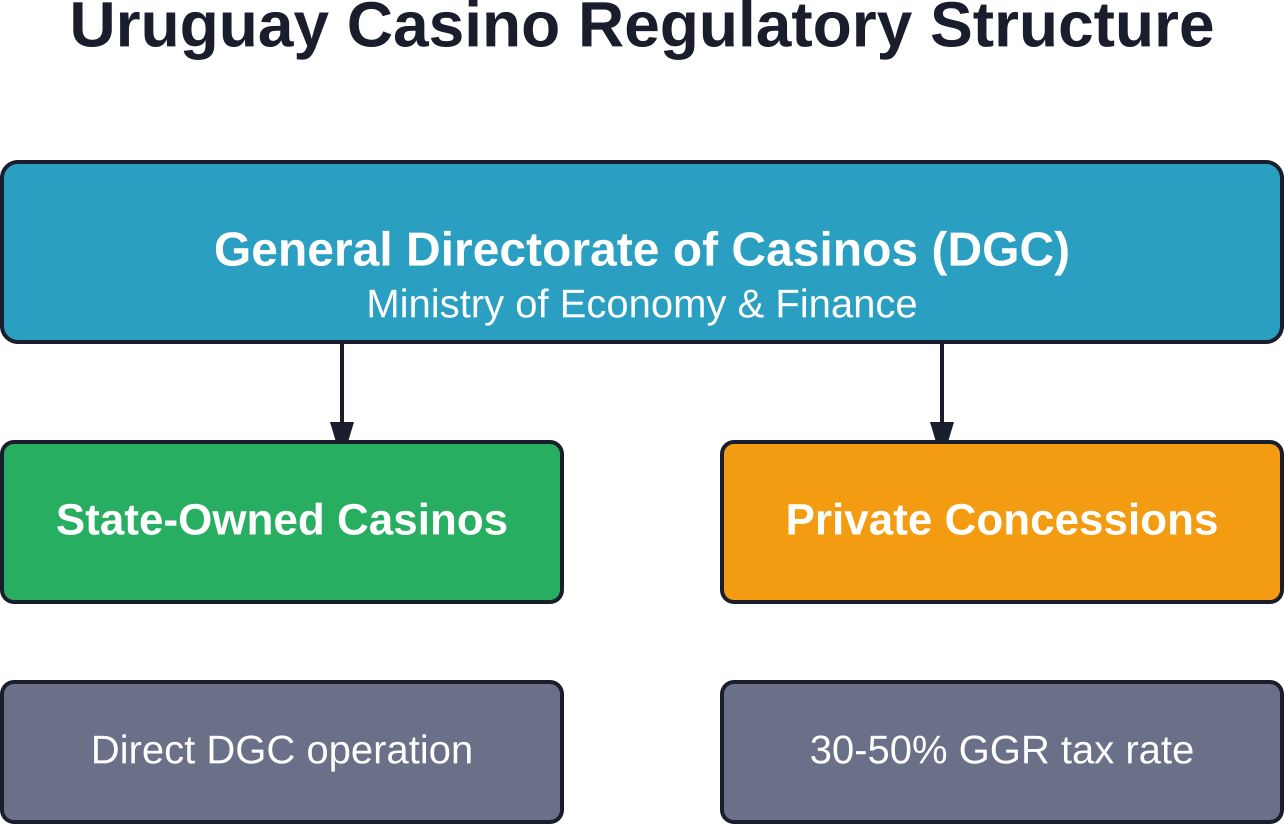
Here’s the thing though—land-based casino licensing isn’t readily available to just anyone. Concessions are limited and typically awarded through government processes that prioritize established operators with significant capital.
Online Casinos: A Complicated Picture
The online gambling situation is where things get murky. Online casinos exist in a complex legal landscape that’s still evolving.
According to parliamentary records, on 22 November 2021, the government submitted a bill to authorize the DGC to regulate online casino games. The Senate approved the bill on 16 August 2022 (file No. 588/2021), with related regulations published shortly after.
This legislative timeline shows that Uruguay has been working toward regulated online gambling for several years. However, as of mid-2026, a comprehensive law fully authorizing private online casino operations has not yet been finalized. The current framework remains limited, primarily allowing state-controlled or state-authorized platforms.
Real talk: Most international online casinos operating in Uruguay without local licenses remain in a legal gray zone. The government has intensified enforcement against unauthorized platforms, issuing warnings and imposing heavy fines on operators, users, and even those who advertise unlicensed gambling sites.
The tax structure for electronic gambling in authorized venues currently applies a low rate of 0.75% per bet — significantly lower than the rates for land-based casinos — which could make regulated online licensing more attractive to private operators if the market is further opened.
Explore iGaming Options with Sologe
Legal research is only one part of understanding a gaming market. Businesses may also need to evaluate the technologies and business categories available across the iGaming industry. Sologe is a B2B iGaming marketplace where companies can explore suppliers across software, payments, platforms, and operational categories.
Sologe can help businesses:
- Compare online gaming platforms
- Review sports betting software
- Explore payment solution categories
- Assess operations management options
- Find certification-related services
👉Contact Sologe to explore payment solutions, platform options, sports betting software, and other B2B services for gaming businesses.
What Players Need to Know
For Uruguayan residents wondering where they can legally gamble, the answer depends on the format.
Land-based casinos are unambiguously legal. Players can visit state-run or licensed private casinos without any legal concerns.
Online gambling through state-authorized platforms is legal. But accessing unauthorized international casino sites enters questionable territory. While enforcement traditionally targets operators rather than individual players, the regulatory stance has tightened.
Gambling Type | Legal Status | Regulatory Body |
|---|---|---|
State-owned land-based casinos | Fully legal | DGC |
Licensed private casinos | Fully legal | DGC |
State-authorized online platforms | Fully legal | DGC |
Unauthorized online casinos | Prohibited | DGC enforcement |
Sports betting (licensed) | Legal | Various authorities |
The regulatory framework prioritizes consumer protection and tax revenue. State control ensures gambling revenue contributes to public finances rather than flowing entirely to private international operators.
Licensing Requirements for Operators
Operators interested in entering Uruguay’s casino market face substantial barriers. The licensing process requires navigation of both DGC requirements and broader financial regulations.
Key requirements typically include:
- Significant capital reserves demonstrating financial stability
- Detailed business plans and operational procedures
- Background checks on all principals and key management
- Technical infrastructure meeting DGC standards for game fairness and security
- Tax compliance and reporting systems
The concession model means operators don’t simply “get a license”—they negotiate agreements with specific terms on duration, tax rates, game offerings, and operational standards.
For online operators specifically, the framework remains in development. While legislation authorizing online casino games has passed, the DGC has not widely opened licensing to international operators as of mid-2026.
The Broader Context: Uruguay’s Tech-Forward Approach
Uruguay’s cautious-but-progressive stance on casino regulation fits within the country’s broader economic strategy. The nation has cultivated a reputation as a regional fintech and tech hub.
According to Uruguay XXI, more than $41 million in fintech capital was invested as of 2024, demonstrating investor confidence in Uruguay’s regulatory environment. The government has worked to create frameworks that encourage innovation while maintaining oversight.
This same philosophy applies to gambling. Rather than completely prohibiting online casinos or throwing doors wide open, Uruguay has opted for controlled liberalization—starting with state platforms and potentially expanding to vetted private operators.
Enforcement and Penalties
Uruguay doesn’t just prohibit unauthorized gambling on paper—enforcement actions have real teeth.
Operators running unlicensed gambling platforms face substantial fines. Advertisers promoting unauthorized sites also face penalties, creating a compliance burden across the entire ecosystem.
While individual players historically faced less direct enforcement, the regulatory tightening means even users accessing prohibited platforms may face consequences. The legal risk may be lower than for operators, but it’s not zero.
Frequently Asked Questions
Are land-based casinos legal in Uruguay?
Yes. Land-based casinos are fully legal in Uruguay. The country operates both state-owned casinos managed by the General Directorate of Casinos and privately operated casinos that function under government concession agreements.
Can I legally play at online casinos in Uruguay?
Yes, but only through state-authorized online casino platforms. International online gambling websites that operate without authorization are prohibited under Uruguayan law and do not provide the protections available through licensed services.
Who regulates casinos in Uruguay?
Casino gambling in Uruguay is regulated by the General Directorate of Casinos (Dirección General de Casinos), which operates under the Ministry of Economy and Finance and oversees licensing, supervision, and enforcement.
How much tax do casinos pay in Uruguay?
Land-based casinos generally pay between 30% and 50% of gross gaming revenue in taxes, depending on the terms of their concession agreements. Electronic and automated gambling in authorized venues is also subject to a 0.75% tax on each wager.
Can foreign operators get casino licenses in Uruguay?
Yes. Foreign companies may obtain concessions to operate land-based casinos, subject to government approval and investment requirements. As of 2026, access to online casino licenses for private international operators remains limited.
When did Uruguay authorize online casino gaming?
Uruguay approved legislation regulating online casino gaming on August 16, 2022. The law authorized the General Directorate of Casinos to operate online gambling platforms, although a broad licensing system for private operators has not yet been introduced.
What penalties exist for unauthorized gambling operations?
Uruguay imposes significant penalties on operators that provide unauthorized gambling services, as well as on businesses that promote illegal gambling platforms. Enforcement has increased in recent years to protect the country’s regulated gambling system.
Looking Forward: A Regulated Future
Uruguay’s casino landscape continues evolving. The legislative foundation for expanded online gambling exists, but implementation has proceeded cautiously.
For players, the options remain state-authorized platforms and established land-based venues. For operators, patience and substantial capital are prerequisites for market entry.
The framework demonstrates Uruguay’s characteristic approach: progressive enough to embrace new technologies, conservative enough to maintain regulatory control. Casinos are legal in Uruguay—but only under rules designed to balance market opportunity with state oversight.
Whether you’re a player looking for legal options or an operator considering market entry, understanding this regulated framework is essential. Uruguay won’t likely become a wide-open gambling market anytime soon. But for those willing to work within the established system, legal casino opportunities definitely exist.
Related Articles

September 3, 2026Is the Casino Legal in Denmark? 2026 Guide

September 3, 2026Is the Casino Legal in Angola? What the 2026...