 Nothing found for the request

Online Casino & Game Software Market 2026 Analysis
Sologe March 30, 2026
Share:


Market Size and Growth Projections
Multiple research firms have tracked the online casino software market’s trajectory, and while specific valuations vary, the growth trend remains consistent across all forecasts.
According to competitor meta descriptions, the global Online Casino Software market size is expected to reach $74.55 billion by 2030 at 13.7% CAGR.
Meanwhile, Fortune Business Insights estimates the online gambling software market will grow from $74.17 billion in 2021 to $158.20 billion in 2028 at an 11.4% CAGR. The variation in these figures often comes down to how researchers define market segments and what components they include.
Here’s what matters: regardless of which forecast proves most accurate, every serious analysis points toward sustained double-digit growth through at least 2030.
The video gaming market provides useful context. In the United States alone, video games generated more than $59.3 billion in annual revenues in 2024. Digital sales have long surpassed physical sales, a trend that accelerated during the pandemic and continues today.
That broader gaming infrastructure—everything from payment processing to cloud hosting to mobile app ecosystems—creates a foundation that online casino software leverages extensively.
Put Your Offering Where Gaming Companies Search

For companies in the online casino and game software market, discovery is often half the challenge. Sologe is built for that. It is an iGaming marketplace where operators and gaming businesses look for software, platforms, products, and service providers, while vendors use the platform to showcase what they offer and connect with relevant buyers.
Want Better Visibility for Your Software Offering?
Use Sologe to:
- reach companies already searching for gaming solutions
- present your software and company profile in one place
- stay visible beyond short-term campaigns or events
👉 Get in touch with Sologe to discuss becoming a vendor on the platform.
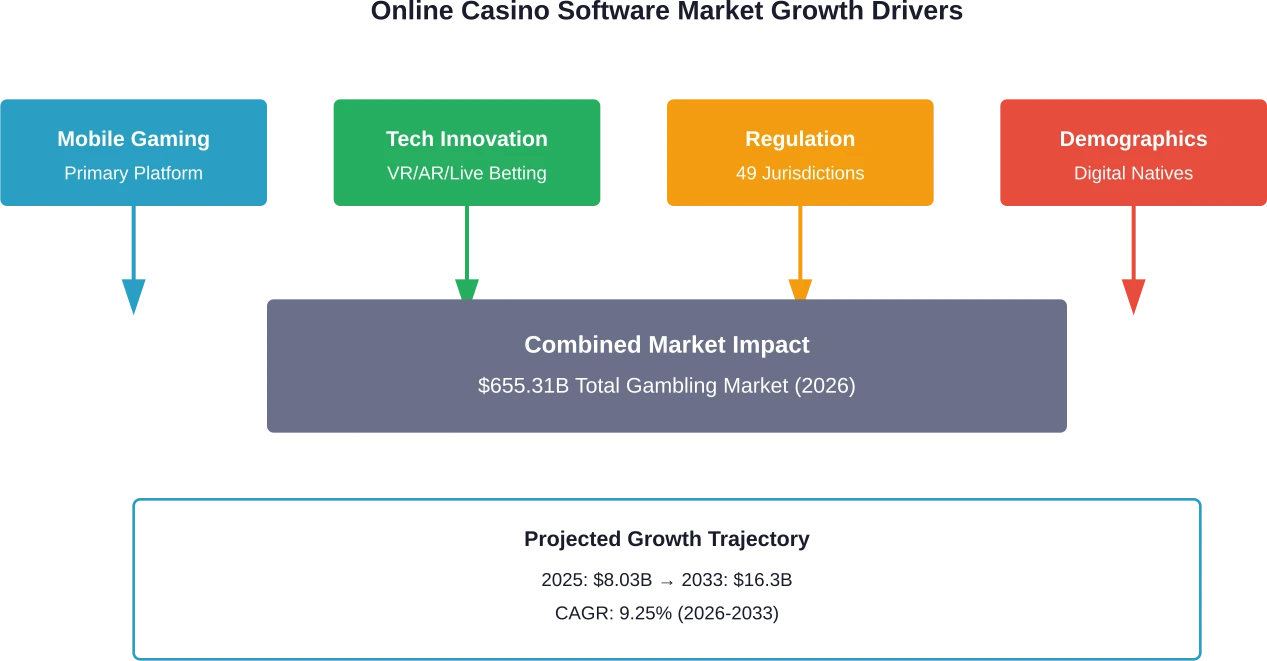
Key Market Drivers Fueling Growth
Several converging factors are propelling the online casino software market forward. Understanding these drivers helps explain not just the growth rate, but the direction the industry is heading.
Mobile Gaming Dominance
Mobile is no longer just a channel—it’s the primary platform for online gambling. Gaming apps rank among the most popular app categories in the United States, with earning potential that matches their popularity status.
Mobile represents one of the biggest segments of the video gaming market in the United States, ranking second only behind advertising. This mobile-first approach has fundamentally altered how casino software gets developed, tested, and deployed.
According to a March 2024 study cited by Statista, significant percentages of adult PC and console gamers in the United States regularly purchase digital in-game goods. While specific percentages require a subscription to access, the trend toward in-app purchases and virtual goods has clear implications for online casino monetization strategies.
Technological Innovation
Innovative offerings are attracting a burgeoning user base. Live betting, virtual reality experiences, and augmented reality features represent the cutting edge of what’s possible.
Technavio notes that the online gambling market is valued at over $50 billion, with these technological innovations playing a significant role in attracting new users. VR and AR aren’t just gimmicks—they’re creating genuinely differentiated experiences that justify premium pricing and increase player engagement.
But here’s the thing: not all technological advancement is flashy. Behind the scenes, improvements in random number generation (RNG) algorithms, real-time data processing, and cloud infrastructure matter just as much as VR headsets.
Regulatory Expansion
More jurisdictions are legalizing and regulating online gambling, creating new markets for software providers. Organizations like eCOGRA hold 49 jurisdictional approvals across 4 continents, providing testing and certification services across multiple global jurisdictions.
This regulatory maturation legitimizes the industry. When governments establish clear frameworks—complete with testing standards, licensing requirements, and consumer protection measures—institutional investors feel more comfortable, operators can plan long-term strategies, and consumers gain confidence in platform fairness.
Demographic Shifts
Younger demographics who grew up with smartphones and in-app purchases view online gambling differently than previous generations. The line between gaming and gambling continues to blur, with mechanics borrowed freely between traditional video games and casino software.
This demographic shift isn’t just about age—it’s about digital literacy, payment preferences, and entertainment expectations. Modern casino software needs to compete with every other app for attention, which drives constant innovation in user experience.
Market Segmentation Breakdown
The online casino and game software market isn’t monolithic. Different segments grow at different rates, serve different audiences, and face different competitive dynamics.
By Software Type
The market divides into several primary categories based on gambling type. Sports betting software handles wagers on athletic events, with sophisticated algorithms for odds calculation and real-time bet matching. Casino software powers traditional games like slots, blackjack, roulette, and baccarat adapted for digital platforms.
Poker platforms require unique social features and tournament management capabilities. Lottery and bingo software serves a distinct demographic with different regulatory requirements. Each category demands specialized development expertise and different compliance frameworks.
By Deployment Model
On-premise solutions give operators maximum control over their infrastructure but require significant upfront investment and ongoing maintenance. Cloud-based platforms offer flexibility, scalability, and lower initial costs—making them increasingly popular, especially among newer operators.
The cloud model has particular advantages for operators expanding into new jurisdictions, where spinning up region-specific instances becomes trivial compared to deploying physical infrastructure.
By Platform
Desktop platforms still matter for certain demographics and game types, particularly poker and complex strategy games where larger screens provide advantages. But mobile now dominates across most categories.
Tablet platforms occupy an interesting middle ground, popular for certain casino games that benefit from larger touch interfaces without requiring a full desktop setup. Multi-platform compatibility isn’t optional anymore—it’s table stakes.
By End User
Personal use represents the consumer-facing side—individual players accessing casino platforms for entertainment. Enterprise applications serve B2B needs, including white-label solutions for operators who want branded platforms without building from scratch.
The B2B software-as-a-service model has grown particularly quickly, allowing smaller operators to compete with established brands by leveraging sophisticated platforms they couldn’t afford to develop independently.
Regional Market Analysis
Geography matters tremendously in online gambling. Regulatory environments, cultural attitudes toward gambling, payment infrastructure, and internet penetration rates all vary significantly by region.
North America
The United States represents the single largest market opportunity. According to Statista Market Forecast, in global comparison, most revenue will be generated in the United States at US$216.85bn in 2026.
But the U.S. market remains fragmented due to state-by-state regulation. Operators must navigate different licensing requirements, tax structures, and compliance mandates in each jurisdiction where they operate. This complexity creates both challenges and opportunities for software providers who can streamline multi-state compliance.
Canada has taken a more unified approach in many provinces, with government-operated platforms competing alongside private operators in some jurisdictions.
Europe
Europe was an early adopter of online gambling regulation, with the United Kingdom leading the way through the UK Gambling Commission’s licensing framework. Countries including France, Germany, Italy, and Spain have each developed regulatory systems balancing consumer protection with market competition.
The European market is mature but still growing, with cross-border operators navigating a patchwork of national regulations. Some countries maintain state monopolies on certain gambling forms, while others have opened markets to competition.
Asia-Pacific
The Asia-Pacific region presents enormous growth potential but significant regulatory complexity. China maintains strict prohibitions on most gambling, though Macau operates as a special exception for land-based casinos.
Japan recently legalized certain forms of online gambling, creating a massive new market opportunity. India’s regulatory environment varies by state, with some allowing online gambling and others prohibiting it. South Korea permits limited gambling options, primarily through government-operated platforms.
According to Fortune Business Insights market segmentation, Asia-Pacific includes China, India, Japan, and South Korea, though regulatory restrictions limit immediate opportunities in some jurisdictions. Community discussions often highlight the vast untapped potential if regulatory environments evolve.
Rest of World
Latin America is experiencing rapid regulatory evolution, with countries like Brazil, Mexico, Argentina, and Colombia developing frameworks to license online gambling operators. This represents one of the fastest-growing regional markets.
Africa and the Middle East remain largely restricted, though some countries are exploring regulated frameworks. Australia has a well-established online gambling market, though recent regulatory changes have imposed stricter requirements on operators.
Region | Market Maturity | Regulatory Environment | Growth Outlook |
|---|---|---|---|
North America | Developing | State/Province Level | High (U.S. expansion) |
Europe | Mature | Country-Specific Licensing | Moderate (Stable) |
Asia-Pacific | Mixed | Highly Variable | Very High (Potential) |
Latin America | Emerging | Rapidly Evolving | Very High |
Middle East/Africa | Limited | Mostly Restricted | Low (Currently) |
Technology Trends Shaping the Market
The software powering online casinos has evolved dramatically from the early days of simple flash-based games. Modern platforms incorporate sophisticated technologies that would’ve seemed like science fiction a decade ago.
Live Dealer Technology
Live dealer games bridge the gap between online convenience and land-based casino atmosphere. High-definition video streams connect players with real dealers in real time, creating an experience that combines digital accessibility with human interaction.
The technology behind live dealer platforms is complex. Multiple camera angles, optical character recognition to track cards and wheels, chat functionality, and seamless integration with betting interfaces all need to work flawlessly with minimal latency.
eCOGRA provides specialized live dealer testing services to ensure these systems meet regulatory requirements across different jurisdictions. The stakes are high—technical glitches in live dealer games can trigger disputes, regulatory scrutiny, and player loss.
Virtual and Augmented Reality
VR casinos allow players to walk through virtual gaming floors, sit at tables, and interact with other players’ avatars. While still niche, VR gambling represents a growing segment, particularly among younger demographics comfortable with immersive technologies.
AR applications overlay digital elements onto physical environments. Imagine pointing a smartphone at a table and seeing betting odds, game statistics, or tutorial information displayed in real time. These capabilities are moving from experimental to practical implementation.
Artificial Intelligence and Machine Learning
AI powers multiple aspects of modern casino software. Player behavior analysis helps identify problem gambling patterns, triggering responsible gaming interventions. Personalization engines recommend games based on playing history and preferences. Fraud detection systems flag suspicious activity in real time.
Machine learning models continuously improve game balancing, optimize bonus offers for retention, and enhance customer support through chatbots that handle routine inquiries while routing complex issues to human agents.
Blockchain and Cryptocurrency
Blockchain technology offers provably fair gaming—players can verify that outcomes weren’t manipulated. Cryptocurrency payments provide faster transactions with lower fees compared to traditional banking, particularly for cross-border transfers.
However, cryptocurrency integration creates regulatory challenges. Many jurisdictions require operators to convert crypto deposits to fiat currency, track sources of funds, and implement anti-money laundering controls that can be complex with decentralized digital currencies.
Random Number Generation
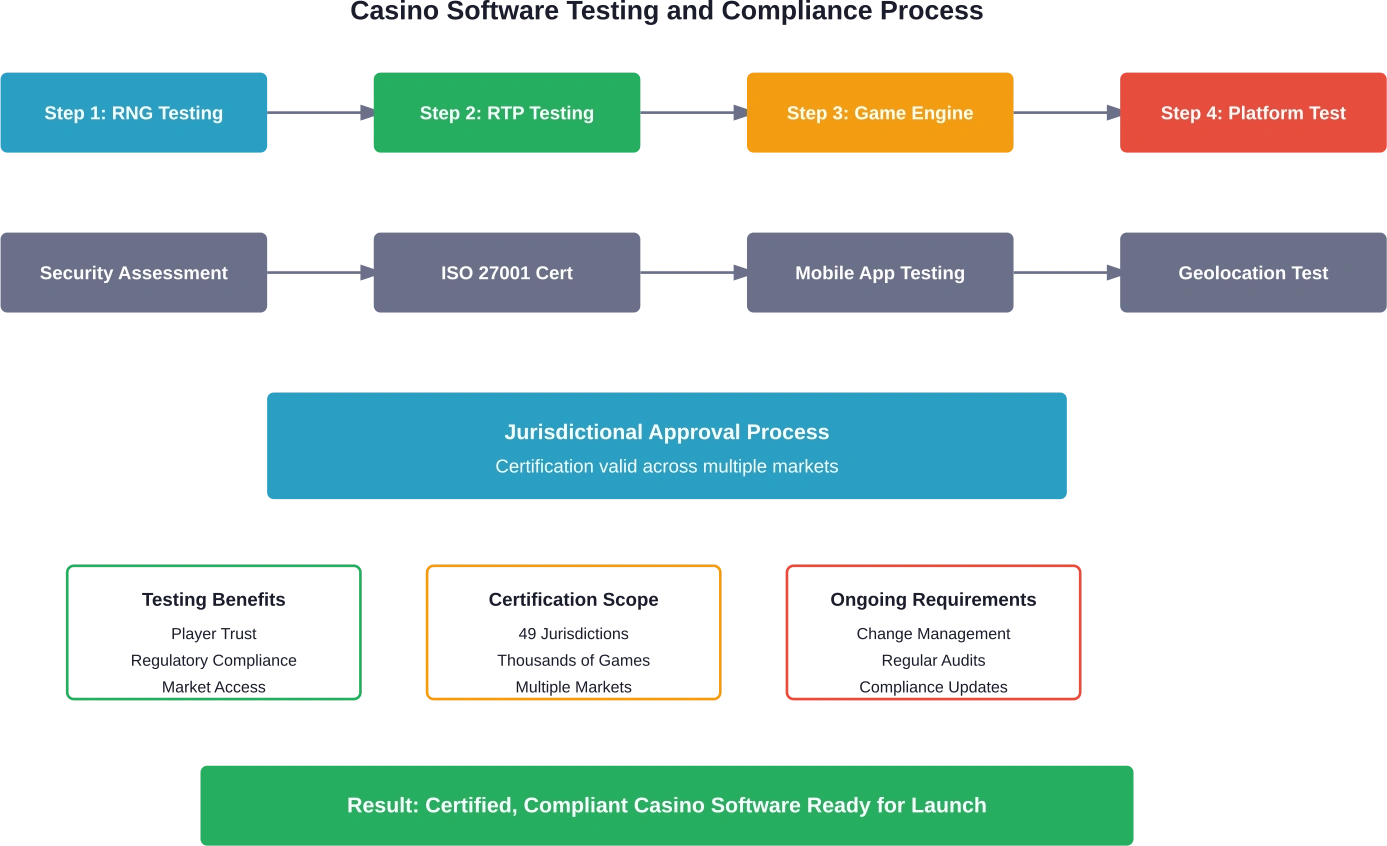
RNG testing remains fundamental to online casino software credibility. According to eCOGRA, Random Number Generator testing uses sophisticated algorithms to ensure game outcomes are completely random and fair, generating numbers without any predictable pattern.
eCOGRA’s RNG testing is a technical requirement for various international jurisdictions. The testing involves rigorous statistical analysis to verify randomness meets mathematical standards. This certification strives for random and unbiased game outcomes that build player trust.
Compliance and Testing Requirements
Software compliance isn’t optional in regulated markets—it’s the price of entry. The testing and certification process can be extensive, but it protects operators from regulatory penalties and players from unfair practices.
Game Engine Certification
eCOGRA provides game engine certification services that examine the core software powering casino games. This includes verifying that RNGs function properly, Return to Player (RTP) percentages match advertised rates, and games behave consistently across different devices and network conditions.
RTP testing uses large sample simulations to ensure the theoretical return to player is achievable in practice. A game might be mathematically designed to return 96%, but if software bugs or configuration errors alter that figure, players get cheated and operators face regulatory consequences.
Platform Certification
Beyond individual games, entire platforms require testing. This includes payment processing, account management, age verification, geolocation services to ensure players are in permitted jurisdictions, and data security protocols.
eCOGRA holds 49 jurisdictional approvals across 4 continents, having certified thousands of online gambling games. This extensive approval network allows software providers to achieve compliance across multiple markets through a single testing partner.
ISO 27001 Certification
ISO 27001 certification provides a robust framework for information security management. Online gambling regulators increasingly require or strongly prefer operators with ISO 27001 certification.
According to eCOGRA, security assessments and ISO 27001 certification help online gambling companies ensure high levels of information security. This is particularly critical as the industry experiences rapid growth and attracts more sophisticated cyber threats.
Benefits include cost savings through streamlined security practices, improved efficiency in meeting multiple regulatory requirements, and faster market entry when expanding to new jurisdictions that recognize the certification.
Mobile App Security Testing
Mobile apps face unique security challenges. eCOGRA recognizes the critical importance of meeting strict technical requirements set by gaming authorities in specific jurisdictions, particularly for mobile platforms.
Vulnerability scanning and penetration testing identify security weaknesses before bad actors can exploit them. Testing covers data encryption, secure storage of player credentials, protection against reverse engineering, and safeguards against tampering with game outcomes.
Competitive Landscape and Key Players
The online casino software market includes established gaming companies, specialized software developers, and technology firms expanding into gambling applications. Competition is fierce, with companies differentiating through technology capabilities, regulatory expertise, game libraries, and geographic coverage.
While specific company market shares fluctuate, the competitive landscape generally breaks down into several tiers. Top-tier providers offer comprehensive platforms with extensive game portfolios, multi-jurisdictional compliance, and white-label solutions for operators. These companies typically serve the largest casino brands and have the resources to invest heavily in emerging technologies.
Mid-tier providers often specialize in particular niches—maybe they excel at live dealer technology, focus on specific geographic markets, or offer particularly strong mobile experiences. These companies compete through specialization rather than trying to match the full breadth of tier-one platforms.
Smaller developers and startups bring innovation, particularly in areas like blockchain integration, VR experiences, or novel game mechanics. While they may lack the compliance infrastructure of established players, their agility allows them to experiment with approaches that larger companies find too risky.
Strategic Positioning
Successful software providers typically excel in at least one of these strategic dimensions: technological innovation that creates differentiated player experiences, regulatory expertise that simplifies multi-market operations, comprehensive game libraries that reduce operators’ need for multiple vendors, or favorable commercial terms that make their platforms accessible to smaller operators.
The most successful companies often combine several of these advantages. A platform with cutting-edge technology but poor regulatory support won’t succeed in heavily regulated markets. Conversely, a fully compliant but technologically stagnant platform will lose players to more engaging experiences.
Market Challenges and Restraining Factors
Despite strong growth projections, the online casino software market faces significant headwinds that could slow expansion or create obstacles for specific companies or market segments.
Regulatory Complexity
Navigating multiple jurisdictions with different requirements creates enormous compliance costs. A game certified in the UK may need additional testing for New Jersey, different modifications for Ontario, and might be prohibited entirely in some markets.
Regulatory changes can happen quickly, sometimes with minimal notice. When jurisdictions alter advertising rules, responsible gaming requirements, or technical standards, software providers must adapt rapidly or lose market access.
Problem Gambling Concerns
The same technologies that make online gambling convenient and engaging can enable problematic behavior. Regulators increasingly require operators to implement robust responsible gaming tools—deposit limits, self-exclusion options, reality checks, and behavioral analysis to identify at-risk players.
While these features protect consumers, they add development complexity and can reduce short-term revenue as compulsive gamblers get restricted. Software providers must balance commercial objectives with ethical obligations and regulatory mandates.
Payment Processing Challenges
Many banks and payment processors remain reluctant to serve gambling operators due to regulatory concerns, reputational risks, or internal policies. This creates friction in the player experience and increases transaction costs.
Chargebacks present particular challenges. Distinguishing between legitimate disputes and players trying to reverse losses after the fact requires sophisticated fraud detection. High chargeback rates can result in payment processors dropping operators entirely.
Cybersecurity Threats
Online casinos represent attractive targets for cybercriminals. Player accounts may contain funds, personal information includes payment details, and distributed denial-of-service attacks can extort operators who can’t afford platform downtime.
The arms race between security measures and attack techniques never ends. Software providers must continuously update defenses, implement multi-factor authentication, monitor for suspicious activity, and maintain incident response capabilities.
Market Saturation in Mature Regions
European markets that legalized online gambling early now face intense competition. Customer acquisition costs have risen as available players get divided among more operators. This squeezes margins and makes it harder for new entrants to gain traction.
In saturated markets, growth comes primarily from taking market share from competitors rather than expanding the overall player base. This shifts competitive dynamics from innovation toward marketing spend and promotional offers.
Emerging Opportunities and Future Outlook
The next five to ten years will see the online casino software market evolve in response to technological advances, regulatory changes, and shifting player preferences.
Latin American Expansion
Brazil’s population of over 200 million represents enormous untapped potential. As regulatory frameworks develop across Latin America, software providers with Spanish and Portuguese language capabilities, localized payment options, and regional compliance expertise will have first-mover advantages.
Convergence with Video Gaming
The lines between traditional video games and gambling continue to blur. Skill-based gambling games that incorporate video game mechanics appeal to younger demographics who view purely chance-based gambling as boring.
Conversely, video games increasingly incorporate gambling-like mechanics—loot boxes, gacha systems, and virtual currency. Regulatory scrutiny of these practices may eventually classify some video game features as gambling, expanding the potential market but also increasing compliance requirements.
Social and Casual Gaming Integration
Social casinos that offer gambling-style games without real-money wagering serve as both standalone businesses and marketing channels for real-money platforms. Players who enjoy free-to-play slots may eventually transition to paid gambling.
Regulatory arbitrage exists here—social casinos often face less stringent requirements than real-money gambling. But that gap is closing as regulators recognize the connection between social gambling and problem gambling behaviors.
Artificial Intelligence Advancements
AI will become more sophisticated at personalizing experiences, predicting player preferences, optimizing game parameters, and identifying problem gambling earlier. Machine learning models trained on vast player datasets can spot patterns invisible to human analysts.
Ethical considerations around AI in gambling will intensify. Using AI to maximize player spending crosses into manipulation if taken too far. Regulators will likely impose restrictions on how predictive models can be deployed.
5G and Edge Computing
Faster mobile networks enable richer experiences with less latency. Live dealer games become more responsive, VR casinos run smoothly on mobile devices, and real-time betting on sports events becomes more practical.
Edge computing brings processing closer to end users, reducing lag and enabling experiences that weren’t feasible when everything had to round-trip to centralized data centers.
Opportunity Area | Market Impact | Timeline | Key Requirements |
|---|---|---|---|
Latin American Markets | Billions in new revenue | 2026-2030 | Localization, compliance expertise |
VR/AR Gambling | Premium pricing segment | 2027-2033 | Hardware adoption, bandwidth |
Skill-Based Gaming | Younger demographic capture | 2026-2028 | Game design innovation |
AI Personalization | Improved retention rates | Ongoing | Data infrastructure, ethical frameworks |
Cryptocurrency Integration | Cross-border efficiency | 2026-2030 | Regulatory clarity, wallet integration |
Investment and M&A Activity
The online casino software market attracts significant investment from private equity firms, strategic acquirers, and public market investors. Strong growth projections and recurring revenue models make software providers attractive targets.
Consolidation continues as larger platforms acquire specialized providers to fill capability gaps. A company strong in slot games might acquire a live dealer specialist. A European-focused platform might buy a provider with strong North American regulatory credentials.
Technology giants occasionally enter the market through acquisition rather than building capabilities from scratch. The regulatory moat around gambling software makes acquiring proven, compliant platforms more efficient than developing them internally.
Valuations for online casino software companies typically command premiums compared to traditional software businesses, reflecting the barriers to entry and recurring revenue characteristics of the market.
Frequently Asked Questions
What growth rate is expected for online casino software?
Most market research firms project compound annual growth rates between 9% and 14% through 2030 and beyond, reflecting rapid industry expansion and digitization.
Which regions offer the strongest growth opportunities?
North America leads current market size, while Latin America and Asia-Pacific offer strong future growth potential. Europe remains stable but more mature.
What are the main types of online casino software?
Key categories include sports betting platforms, casino games, poker systems, lottery solutions, and bingo software, delivered via on-premise or cloud-based models.
How important is regulatory compliance for casino software?
Compliance is critical, requiring certification for fairness, security, and regulatory approval. Without it, operators cannot legally enter regulated markets.
What technologies are transforming online casino software?
Technologies such as AI, blockchain, live dealer systems, VR/AR, and mobile-first platforms are driving innovation and enhancing user experience.
Who are the major players in the online casino software market?
The market includes large gaming technology firms, niche developers, and startups, competing through innovation, compliance capabilities, and product offerings.
Conclusion
The online casino and game software market stands at an inflection point. With projections showing growth from $8.03 billion in 2025 to $16.3 billion by 2033, and the broader gambling market reaching $655.31 billion in 2026, the opportunity is undeniable.
But opportunity comes with complexity. Success requires navigating fragmented regulations across dozens of jurisdictions, implementing sophisticated compliance frameworks, continuously innovating against well-funded competitors, and balancing commercial objectives with responsible gaming obligations.
The winners in this market will be companies that combine technological excellence with regulatory expertise. Platforms that create engaging player experiences while maintaining rigorous fairness standards. Organizations that can scale across multiple markets while adapting to local requirements.
For operators evaluating software partners, the decision extends far beyond feature lists and pricing. Compliance credentials, track record across jurisdictions, financial stability for long-term support, and alignment on responsible gaming all matter tremendously.
The next decade will see continued convergence between gambling and gaming, mobile dominance becoming even more pronounced, artificial intelligence reshaping player experiences, and new markets opening as regulatory frameworks evolve. The companies that position themselves ahead of these trends—rather than merely reacting to them—will capture disproportionate value.
Whether you’re an operator choosing a platform, a developer building games, an investor evaluating opportunities, or a regulator crafting policy, understanding the forces shaping this market is essential. The online casino software industry isn’t just growing—it’s fundamentally transforming entertainment, technology, and gambling itself.
Related Articles

September 29, 2026Is the Casino Legal in Japan? The Real Answer...

September 29, 2026Is the Casino Legal in Gambia? What the Law...