 Nothing found for the request

Online Casino Market Size 2026: $78B Global Industry
Sologe April 21, 2026
Share:


Quick Summary
Quick Summary: The global online casino market size was estimated at USD 19.11 billion in 2024 and is projected to reach USD 38.00 billion by 2030, growing at a CAGR of 12.2% from 2025 to 2030. The broader online gambling market (including sports betting, poker, and bingo) reached $78.66 billion in 2024 and is forecast to hit $153.57 billion by 2030. Desktop platforms currently dominate revenue, while mobile usage continues accelerating rapidly across all regions.
The online casino and gambling industry has transformed from a niche digital experiment into a massive global market worth tens of billions annually. What started as basic digital card games and slot machines has evolved into sophisticated live dealer experiences, mobile-first platforms, and regulated markets across dozens of countries.
Understanding the market size matters—whether you’re an investor evaluating opportunities, a regulator tracking industry growth, or a business analyzing competitive landscapes. The numbers tell a story of rapid expansion, shifting consumer preferences, and technological disruption that’s reshaping traditional gambling.
This analysis breaks down the current market size, growth projections, regional dynamics, and key trends driving the online casino industry through 2030.
Current Online Casino Market Size: The 2024-2025 Landscape
According to Grand View Research, the online casino market specifically was estimated at USD 19.11 billion in 2024. That’s the pure casino segment—slots, table games, and live dealer experiences—separated from sports betting, poker, and other gambling verticals.
The broader online gambling market paints an even bigger picture. This comprehensive category includes casinos plus sports betting, poker, and bingo. Grand View Research valued this total market at USD 78.66 billion in 2024.
Here’s the thing though—these markets grew despite economic headwinds, regulatory challenges, and increased competition from other entertainment options. The resilience speaks to fundamental shifts in how people engage with gambling entertainment.
Market Segment | 2024 Market Size | 2030 Projection | CAGR 2025-2030 |
|---|---|---|---|
Online Casino Only | $19.11 billion | $38.00 billion | 12.2% |
Total Online Gambling | $78.66 billion | $153.57 billion | 11.9% |
Sports Betting Share | Over 50% | — | — |
Sports betting dominates the broader gambling market with over 50% revenue share in 2024. But casino games represent the fastest-growing pure-play digital gambling category, driven by innovation in game design and live dealer technology.
For context, Statista projects the total worldwide gambling market (including land-based venues) is projected to reach USD 655.31 billion in 2026, growing to USD 717.06 billion by 2030 at a more modest 2.28% CAGR. The online segment is clearly outpacing traditional brick-and-mortar growth by significant margins.
Market Breakdown by Platform Type
Desktop platforms held the largest revenue share across the online casino industry in 2024. This surprises some observers given mobile’s explosive user growth, but desktop players tend to have longer session times and higher average bets.
Mobile is rapidly closing the gap though. Smartphone and tablet access is driving new player acquisition, particularly in emerging markets where desktop penetration is lower but mobile ownership is nearly universal.
The desktop dominance in revenue doesn’t mean more users—it means higher-value users. Mobile brings volume; desktop brings value. Smart operators optimize for both.
Growth Projections Through 2030
The online casino market is projected to reach USD 38.00 billion by 2030, according to Grand View Research. That represents a compound annual growth rate of 12.2% from 2025 to 2030—substantially faster than most traditional entertainment sectors.
The total online gambling market (all verticals combined) is forecast to hit USD 153.57 billion by 2030 at an 11.9% CAGR. Some research firms project even higher numbers—Market Research Future estimates the online gambling market could reach USD 228.57 billion by 2035 at a 9.83% CAGR.
These aren’t just optimistic forecasts. They’re grounded in observable trends:
- Continued regulatory liberalization in key markets (Brazil, several U.S. states, parts of Asia-Pacific)
- Technological improvements making online experiences more immersive and trustworthy
- Demographic shifts as younger, digitally-native consumers reach gambling age
- Integration with cryptocurrency and blockchain for payments and provably fair gaming
- 5G network expansion enabling richer mobile experiences
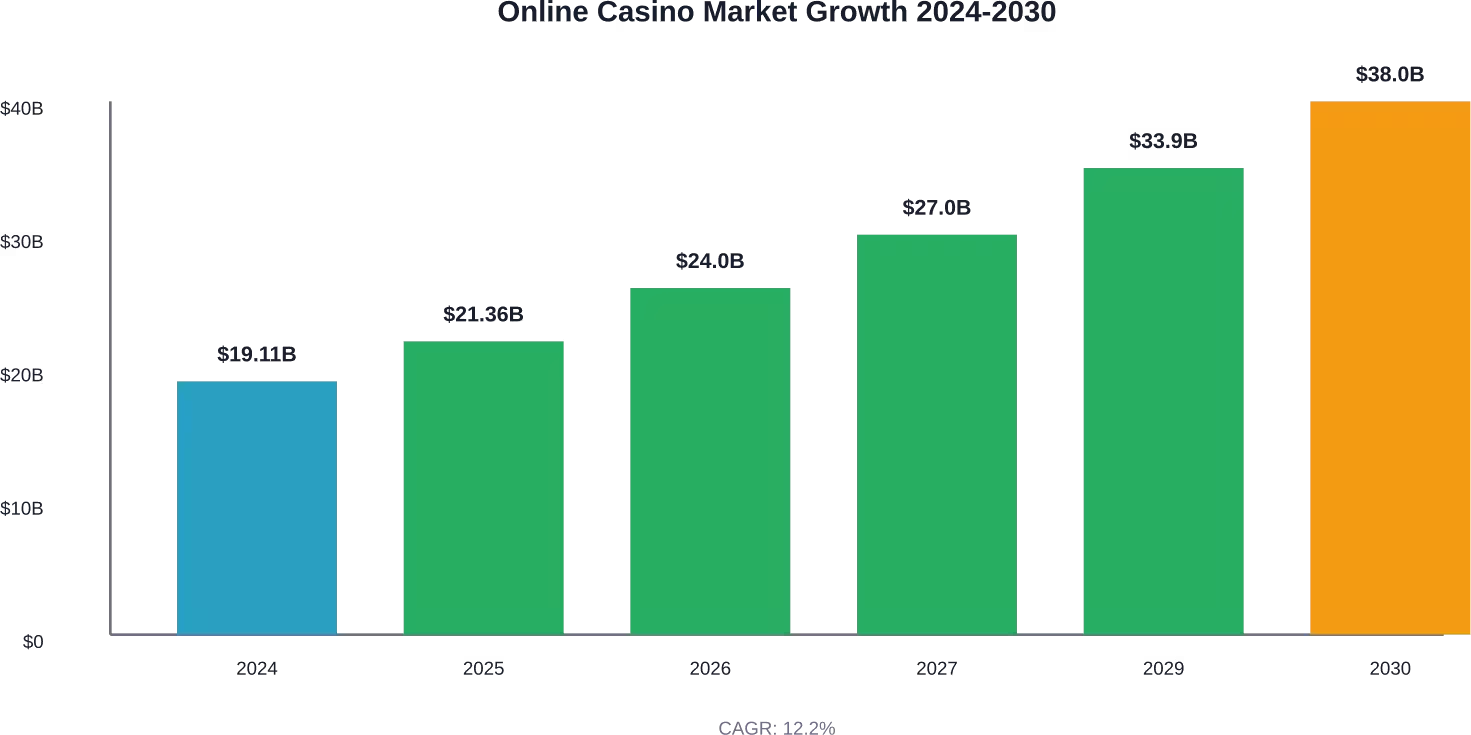
Now, this is where it gets interesting. Different segments within online casinos are growing at different rates. iSlots (interactive video slots with bonus features) are experiencing particularly strong growth as game developers push creative boundaries with licensed IP, progressive jackpots, and gamification mechanics.
Live dealer games represent another high-growth category. These stream real dealers from studios or actual casino floors, blending the convenience of online play with the authenticity of land-based experiences. The technology has matured significantly, with multiple camera angles, chat features, and near-zero latency on modern connections.
What’s Driving Double-Digit Growth?
Regulatory liberalization stands out as the primary catalyst. Countries and regions that historically banned or severely restricted online gambling are opening regulated markets. Brazil legalized sports betting and is moving toward casino licensing. Several U.S. states continue expanding beyond sports betting into full online casino offerings.
But wait. Regulation alone doesn’t create growth—it channels existing demand into legal, taxable frameworks. The underlying demand stems from:
- Convenience: Play from home, no travel to physical venues, available 24/7
- Game variety: Hundreds or thousands of titles versus the limited floor space of land-based casinos
- Lower barriers: Minimum bets often start at pennies online versus higher table minimums at physical casinos
- Bonuses and promotions: Online operators offer deposit matches and free spins that land-based venues can’t economically provide
- Privacy: Some players prefer the discretion of online play versus public casino visits
Technological improvements matter too. Payment processing has become faster and more diverse, with e-wallets, cryptocurrency, and instant bank transfers supplementing traditional credit cards. Game graphics rival console gaming quality. Mobile optimization has eliminated the clunky experiences that plagued early smartphone gambling.
Regional Market Dynamics
Europe held the largest online casino market share in 2024. This makes sense given the region’s mature regulatory frameworks, high internet penetration, and established gambling culture. The United Kingdom, Malta, and Gibraltar have become licensing hubs, with Malta’s Gaming Authority generating substantial regulatory revenue from gaming licenses and compliance activities.
According to the Brookings Institution, Tribal governments have collectively scaled a $44 billion gaming industry (comprising gaming revenues and related enterprises and amenities). Land-based tribal casinos face mounting pressure from the expansion of online sports betting and prediction markets, which are disrupting traditional revenue models.
Asia-Pacific represents the fastest-growing regional market. According to Growth Market Reports, the Asia Pacific market stands out as the fastest-growing segment, with a market size of USD 92.1 billion in 2024 and a projected CAGR of 8.5% through 2033. While regulatory environments vary widely—from liberal frameworks in the Philippines to strict prohibitions in mainland China—the region’s massive population and growing middle class drive substantial demand.
North American Market Expansion
The U.S. market deserves special attention given its size and rapid evolution. Following a key legal development, states gained authority to legalize sports wagering. Many have extended this to full online casino offerings.
As of September 2022, around 10% of American adults who wagered on live and online casino games did so at least once every week. The U.S. online gambling market size was estimated at USD 5.12 billion in 2023 and is projected to reach USD 9 billion by 2032 at a 17% CAGR, according to Custom Market Insights—substantially faster than the global average.
Atlantic City provides a useful microcosm. In November 2024, brick-and-mortar gaming still represented the largest share of total gaming revenue at nearly $224 million compared to $214 million from internet gaming and $66 million from sports wagering, according to Stockton University’s analysis. Internet gaming revenues exceeded $200 million monthly for the first time that month—a record high.
The trend line is clear: online is gaining ground rapidly, though land-based venues retain advantages in certain demographics and experience types (dining, entertainment, social atmosphere).
Market Segmentation: Game Types and Platforms
The online casino market segments into three primary game categories: iSlots (interactive slots), iTable games (digital versions of blackjack, roulette, baccarat, etc.), and iDealer (live dealer experiences).
Slots dominate revenue across most markets. They require no skill or decision-making, offer rapid play cycles, and feature progressive jackpots that create lottery-like excitement. Modern video slots incorporate licensed themes from movies, TV shows, and music artists, appealing to fans beyond traditional gambling demographics.
Table games attract more serious players who prefer strategy elements. Blackjack and poker variants reward skill development, while roulette and baccarat offer simpler mechanics with various betting systems. These games typically have higher average bets but lower volume than slots.
Live dealer games split the difference. They use streaming technology to show real dealers handling physical cards and wheels, with players making decisions through digital interfaces. The format addresses trust concerns some players have about random number generators, while maintaining online convenience.
Game Type | Revenue Share | Player Profile | Growth Rate |
|---|---|---|---|
iSlots | Highest | Casual players, wide demographic | Strong |
iTable Games | Medium | Strategic players, higher stakes | Moderate |
Live Dealer | Growing | Traditional casino fans, trust-focused | Very Strong |
Desktop vs. Mobile: Platform Battle
Desktop platforms accounted for the largest revenue share in 2024 despite mobile’s user growth advantage. This reflects behavioral patterns: desktop players tend to have longer sessions, place larger bets, and engage more with complex game features.
Mobile usage patterns differ. Sessions are shorter, often filling idle moments during commutes or breaks. Stakes tend to be lower, but frequency is higher. Mobile players also skew younger, representing future market growth as these cohorts age and increase spending power.
Smart operators don’t choose between platforms—they optimize for both. Progressive web apps and native mobile applications provide seamless experiences across devices, with account synchronization allowing players to switch between desktop and mobile within single sessions.
Tablet usage represents a middle ground, with session lengths and bet sizes falling between smartphones and desktop computers. Some operators report tablets showing the highest conversion rates from free play to real money wagering, possibly due to the comfortable viewing experience combined with the casual usage context.
Competitive Landscape and Key Players
The online casino market features a mix of large multinational operators and regional specialists. Consolidation has accelerated in recent years as larger companies acquire licenses, technology platforms, and customer bases through M&A activity.
Major publicly-traded operators often run multiple brands targeting different player segments. A single company might operate a premium brand focused on high-rollers, a mid-market brand emphasizing bonuses and promotions, and a casual brand targeting recreational players.
Software providers represent another critical competitive layer. These companies develop the actual casino games that operators license and integrate into their platforms. A few major software houses supply games to hundreds of different online casino sites, meaning players often encounter the same slots and table games across competing brands.
Payment processors, platform providers, and affiliate marketers round out the ecosystem. The industry has evolved into a complex value chain where most operators focus on customer acquisition and retention while outsourcing game development, payment infrastructure, and regulatory compliance technology.
Find the Right iGaming Partners Without Wasting Time

As the market grows, choosing the right partners becomes the part that slows everything down. Sologe helps operators and developers cut through that and focus only on companies that actually fit their setup. Instead of jumping between scattered sources, you get a clear view of platforms, game providers, payment solutions, and other services in one place, so decisions don’t drag on.
Compare and Connect With the Right Partners
Use Sologe to move from searching to real partnerships:
- Find verified iGaming companies already working in your segment
- Compare options quickly instead of reviewing vendors one by one
- Build a partner shortlist that fits your product and region
- Start conversations without long sourcing cycles
Contact Sologe to get matched with the right partners and move your setup in the right direction faster.
Regulatory Environment and Challenges
Regulation shapes market size more than any other single factor. Countries with clear licensing frameworks and reasonable tax rates attract legitimate operators and generate substantial government revenue. Malta’s Gaming Authority generated substantial regulatory revenue from gaming licenses and compliance activities.
Jurisdictions with prohibition or unclear legal status push gambling activity into unregulated markets. Players still gamble—they just do so with offshore operators who may not follow consumer protection standards, pay local taxes, or maintain fair gaming practices.
The trend globally is toward regulation rather than prohibition. Governments recognize that legalization allows them to collect tax revenue, enforce responsible gambling measures, prevent money laundering, and protect consumers from fraud—none of which is possible with underground markets.
That said, regulatory challenges remain significant:
- Advertising restrictions: Many jurisdictions limit how operators can market, particularly to prevent youth exposure
- Tax structures: Excessive taxation can make legal operators uncompetitive with unlicensed alternatives
- Responsible gambling requirements: Deposit limits, self-exclusion systems, and problem gambling interventions add compliance costs
- Cross-border complexity: Online businesses operate globally while regulations remain local, creating legal uncertainty
- Payment processing: Banks and payment networks sometimes restrict gambling transactions even in legal markets
The Malta Gaming Authority’s 2024 Annual Report noted that in 2024, it issued 35 warnings, 25 administrative penalties amounting to €306,250 and reached three regulatory settlements amounting to €61,522. The Commercial Communications Committee took seven decisions regarding possible breaches of the Gaming Commercial Communications Regulations. This illustrates the active enforcement approach in mature markets.
Technology Trends Shaping Market Growth
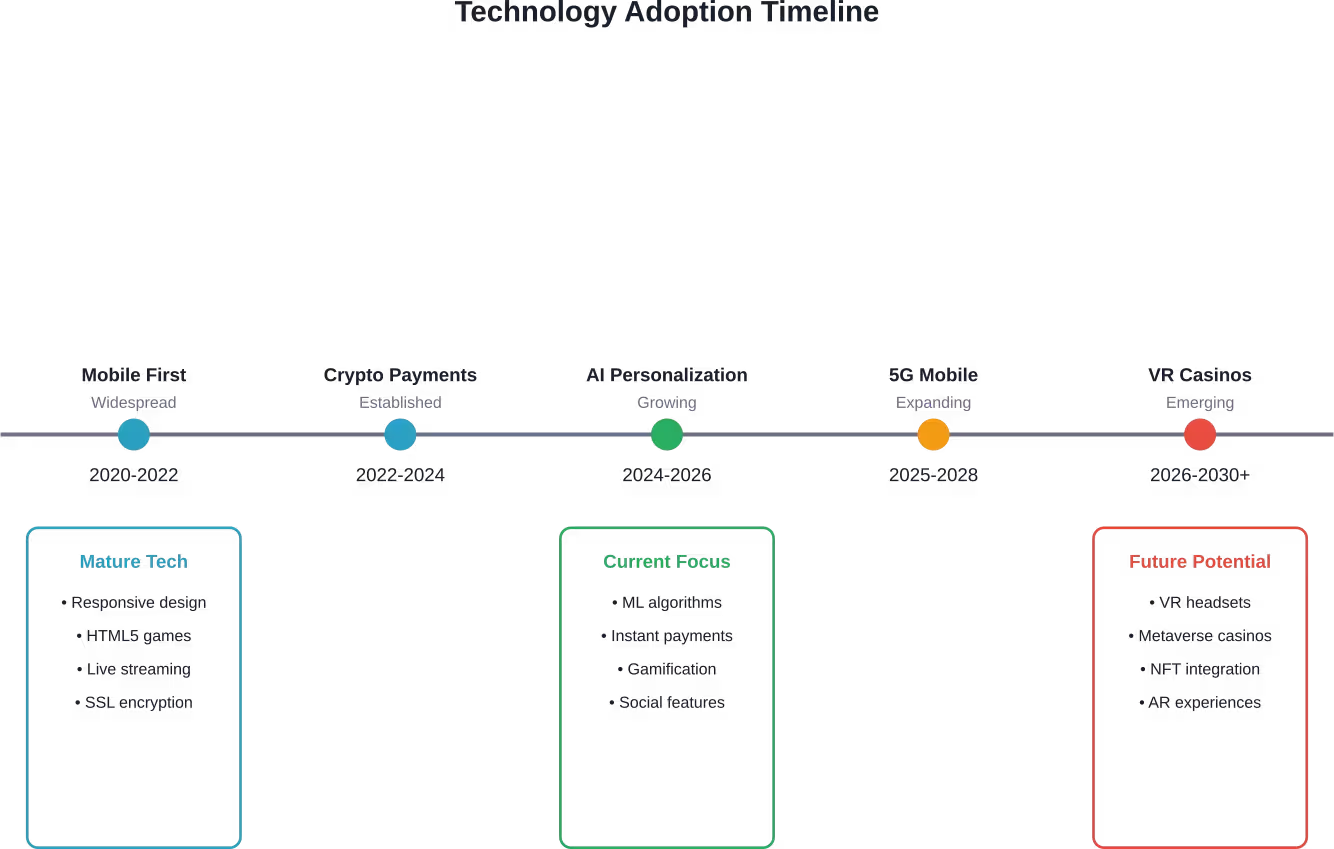
Technological innovation drives competitive differentiation and market expansion. Several trends stand out as particularly impactful:
- Cryptocurrency Integration: Bitcoin and other cryptocurrencies offer faster payments, lower fees, and enhanced privacy compared to traditional banking. Some operators now accept dozens of different cryptocurrencies, with dedicated crypto-only casinos emerging as a distinct subcategory.
- Blockchain for Provably Fair Gaming: Blockchain technology enables verifiable randomness, allowing players to cryptographically confirm that game outcomes weren’t manipulated. This addresses trust barriers that keep some potential players away from online gambling.
- Virtual Reality Casinos: VR technology creates immersive 3D casino environments where players can walk around virtual floors, interact with other players’ avatars, and experience spatial audio. Adoption remains niche due to VR headset requirements, but the technology demonstrates potential for future differentiation.
- Artificial Intelligence: AI powers personalized game recommendations, detects problem gambling patterns for early intervention, identifies fraud and money laundering, and optimizes bonus offers for individual players. The technology raises privacy concerns but delivers clear operational benefits.
- 5G Networks: Fifth-generation mobile networks enable richer graphics, smoother live streaming, and more complex multiplayer features on mobile devices. The technology narrows the quality gap between mobile and desktop experiences.
Comparison: Online vs. Land-Based Casino Markets
The global gaming market (which includes video games, mobile gaming, and other gaming segments) was estimated at USD 298.09 billion in 2024 and is projected to reach USD 505.17 billion by 2030 at an 8.7% CAGR, according to Grand View Research. The video game industry specifically generated nearly 522.5 billion U.S. dollars in 2025, per Statista.
These numbers dwarf the online casino market, but it’s important to separate video gaming (consoles, PC games, mobile games like Candy Crush) from gambling. They’re often lumped together in market research, creating confusion.
For pure gambling comparisons, Statista projects the total worldwide gambling market (online plus land-based) is projected to reach USD 655.31 billion in 2026. If online gambling represents USD 87.69 billion in 2025 (per Grand View Research), that implies land-based gambling still accounts for the majority of total global gambling revenue.
The gap is closing though. Land-based gambling is growing at 2.28% CAGR while online gambling expands at 11.9% CAGR. At these rates, online could represent 25-30% of total gambling revenue by 2030.
Factor | Online Casinos | Land-Based Casinos |
|---|---|---|
Revenue (2024) | ~$80B (gambling total) | ~$575B (estimated) |
Growth Rate | 11.9% CAGR | 2.28% CAGR |
Operating Costs | Lower (no physical property) | Higher (real estate, staff) |
Game Variety | Hundreds to thousands | Limited by floor space |
Social Experience | Limited (chat, multiplayer) | Strong (in-person interaction) |
Convenience | High (play anywhere) | Low (requires travel) |
Trust Perception | Improving but still a barrier | Established (see the game) |
Land-based venues aren’t going away. Las Vegas, Macau, Singapore, and other gaming destinations continue investing billions in new properties. But their growth strategies increasingly emphasize non-gaming revenue—restaurants, nightclubs, shows, conventions—recognizing that gambling alone faces structural challenges.
The future likely involves convergence rather than substitution. Many land-based operators now run online platforms, using physical properties for brand building while capturing digital revenue. Some offer hybrid experiences where players can use mobile apps while physically present in casinos.
Investment and M&A Activity
Financial markets show strong interest in online gambling operators, particularly those expanding in newly-regulated markets. Several major acquisitions in recent years have valued online casino businesses at substantial multiples of revenue.
Sports betting companies have been particularly acquisition-hungry, buying casino operators to cross-sell existing customers and offer integrated products. The logic is sound: player acquisition costs are high, so maximizing lifetime value through multiple product offerings improves unit economics.
Technology providers also attract investment. Companies that own popular slot titles or provide platform infrastructure can generate recurring revenue from hundreds of operators. This business-to-business model offers more predictable cash flows than consumer-facing brands dependent on marketing spend.
Private equity has entered the space aggressively, recognizing that online gambling combines high margins, recurring revenue, and regulatory barriers to entry—attractive characteristics for financial engineering. Some PE firms now own multiple gambling-related assets across the value chain.
Challenges and Risks Facing the Market
Despite strong growth projections, the online casino market faces legitimate headwinds that could slow expansion or create volatility:
- Regulatory Unpredictability: Governments can change policies suddenly. China’s crackdown on gaming sent shockwaves through markets. Individual U.S. states can reverse course on legalization. Operators must maintain flexibility for rapid regulatory changes.
- Problem Gambling Concerns: The convenience and 24/7 availability that make online casinos attractive also create addiction risks. Increased problem gambling could trigger stricter regulations, advertising bans, or deposit limits that constrain growth.
- Payment Processing Challenges: Banks and payment networks periodically restrict gambling transactions, even in legal markets. This creates customer friction and limits market accessibility.
- Economic Sensitivity: Gambling is discretionary entertainment spending. Economic recessions typically reduce gambling expenditure as consumers prioritize necessities. The market is not recession-proof.
- Competition from Other Entertainment: Online casinos compete for entertainment time and spending with streaming services, social media, video games, and countless other digital diversions. The attention economy is zero-sum.
- Technology Costs: Maintaining competitive platforms requires continuous investment in game development, security, payment systems, and customer service infrastructure. Smaller operators struggle to keep pace.
These risks explain why growth rates vary across forecasts. Conservative estimates assume some regulatory tightening and economic cycles. Bullish projections assume continued liberalization and technological adoption.
Frequently Asked Questions
How big is the online casino market in 2026?
The online casino market (excluding sports betting, poker, and bingo) reached approximately $19.11 billion in 2024 and is projected to grow to around $24 billion in 2026, based on a 12.2% CAGR. The total online gambling market, including all verticals, was valued at $78.66 billion in 2024 and is expected to exceed $95 billion in 2026.
What is the projected market size for online casinos in 2030?
Grand View Research projects the online casino market will reach $38.00 billion by 2030, growing at a 12.2% CAGR from 2025 to 2030. The broader online gambling market is forecast to hit $153.57 billion by 2030, with an 11.9% CAGR.
Which region has the largest online casino market?
Europe held the largest market share in 2024, driven by mature regulatory frameworks in countries like the UK, Malta, and Sweden. Asia-Pacific is the fastest-growing region, while North America is expanding rapidly as more U.S. states legalize online casinos.
Is online gambling growing faster than land-based casinos?
Yes. Online gambling is growing at approximately 11.9% CAGR, compared to about 2.28% CAGR for the overall gambling market dominated by land-based casinos. While land-based still accounts for around 85% of revenue, online is rapidly gaining share and could reach 25–30% by 2030.
What drives online casino market growth?
Growth is driven by regulatory expansion in key markets, advances in mobile and 5G technology, cryptocurrency adoption, increasing smartphone penetration, and shifting demographics. Lower operating costs compared to physical casinos also allow more competitive offerings.
Do online casinos generate more revenue from desktop or mobile?
Desktop platforms generated the largest share of revenue in 2024, as players tend to spend more time and place higher bets. However, mobile usage is growing faster, especially in regions with high smartphone adoption. Most platforms now support seamless cross-device experiences.
How much revenue does the U.S. online casino market generate?
The U.S. online gambling market was valued at $5.12 billion in 2023 and is projected to reach $9 billion by 2032, growing at a 17% CAGR. This reflects only states where online casinos are legal, meaning significant growth potential remains as more states regulate the market.
The Bottom Line on Online Casino Market Size
The online casino market has evolved from a fringe activity into a multi-billion dollar global industry experiencing double-digit growth. Current market size stands at approximately $19 billion for pure casino offerings and nearly $80 billion for total online gambling when including sports betting and other verticals.
Growth projections through 2030 show continued strong expansion, with the casino segment potentially doubling to $38 billion and total online gambling approaching $154 billion. These forecasts assume continued regulatory liberalization, technological advancement, and shifting consumer preferences toward digital entertainment.
Regional dynamics vary substantially. Europe leads in current market size with mature frameworks. Asia-Pacific shows the fastest growth despite fragmented regulations. North America is expanding rapidly as U.S. states legalize, though it still lags global leaders.
The competitive landscape features consolidation among operators, continued M&A activity, and substantial investment in technology infrastructure. Mobile platforms are gaining share rapidly, though desktop still dominates revenue. Live dealer games and cryptocurrency integration represent high-growth subcategories.
Risks remain. Regulatory unpredictability, problem gambling concerns, economic sensitivity, and intense competition for attention all pose challenges. But the fundamental trend toward digital gambling consumption appears firmly established.
For investors, operators, regulators, and researchers tracking the industry, understanding market size provides essential context for strategic decisions. The numbers indicate an industry in sustained expansion, with the potential to capture significantly larger shares of global entertainment spending over the next decade.
Looking to dive deeper into online casino market dynamics? Track regulatory developments in your region, monitor technological innovations like VR and blockchain integration, and watch how major operators adapt to mobile-first consumer behavior. The market is moving fast—staying informed requires continuous attention to evolving data and trends.
Related Articles

September 29, 2026Is the Casino Legal in Japan? The Real Answer...

September 29, 2026Is the Casino Legal in Gambia? What the Law...