 Nothing found for the request

Online Casino Market 2026: Size, Growth & Trends
Sologe March 30, 2026
Share:


Global Market Size and Growth Trajectory
The online casino market has maintained impressive momentum despite economic headwinds and regulatory challenges in various jurisdictions. The sector’s resilience stems from fundamental shifts in consumer behavior and technological accessibility.
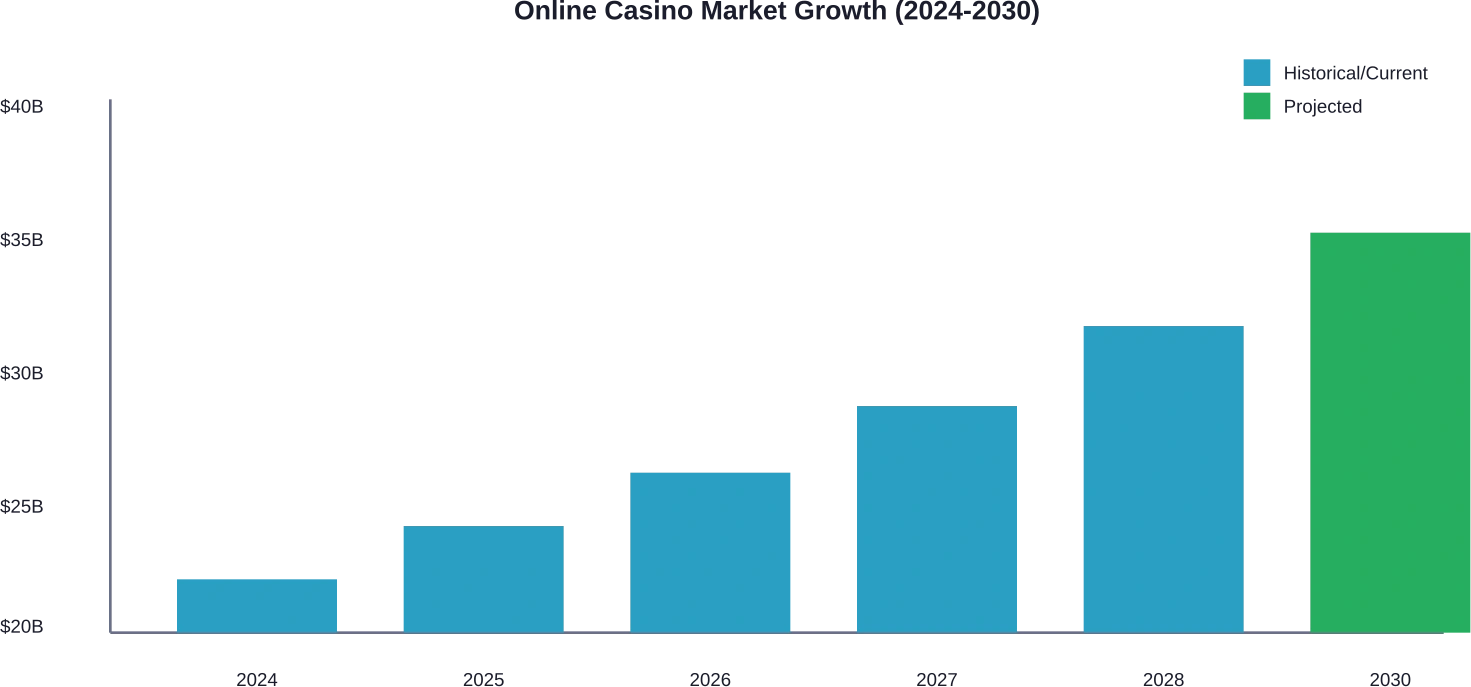
Market valuation in 2025 stands at approximately $21.36 billion, showing consistent year-over-year growth from the 2024 baseline of $19.11 billion. This upward trajectory reflects not just more players entering the market, but also increased average spend per user and expanded gaming options.
Here’s the thing though—these figures represent just online casinos. The broader gambling market tells an even bigger story.
Revenue in the overall gambling market (including lotteries, sports betting, and land-based casinos) is projected to reach $655.31 billion in 2026, with an expected annual growth rate of 2.28% through 2030. Within this massive ecosystem, online casinos represent one of the fastest-growing segments.
Regional Performance Breakdown
Europe held the largest market share in 2024, and it’s not particularly close. The region benefits from mature regulatory frameworks, high internet penetration, and widespread acceptance of online gambling as legitimate entertainment.
Several European countries have established well-defined licensing systems that provide both consumer protection and tax revenue for governments. The UK, Malta, Gibraltar, and several Nordic countries have become hubs for online casino operators.
North America is experiencing rapid expansion following regulatory liberalization. The U.S. online gambling market specifically was estimated at $12.68 billion in 2024 and is expected to grow at a 9.8% CAGR through 2030, reaching $22.19 billion. Real-world data from companies operating in the region confirms this trajectory—Rush Street Interactive announced record quarterly revenue of $324.9 million in Q4 2025, up 28% year-over-year, with full year 2025 revenue exceeding guidance at $1,134 million, up 23% year-over-year.
Asia-Pacific represents the fastest-growing market, driven by increasing smartphone adoption and improving internet infrastructure. However, regulatory environments vary dramatically across the region, creating both opportunities and challenges for operators.
Region | 2024 Market Position | Key Growth Drivers | Regulatory Environment |
|---|---|---|---|
Europe | Largest market share | Mature infrastructure, established licensing | Well-regulated, country-specific frameworks |
North America | Rapid expansion phase | State-level legalization, sports betting integration | Evolving, state-by-state in the U.S. |
Asia-Pacific | Fastest growth rate | Mobile adoption, rising disposable income | Highly variable, restrictive in many markets |
Latin America | Emerging opportunity | Regulatory modernization, mobile penetration | Progressive reforms in select countries |
Device Preferences and Gaming Platforms
One of the most interesting dynamics in the online casino market involves the ongoing device shift—or lack thereof.
Desktop held the largest revenue share across the online casino industry in 2024. This might seem counterintuitive in an increasingly mobile-first world, but there’s solid reasoning behind it.
Desktop gaming offers advantages for certain player segments: larger screens for detailed slot animations, easier navigation for table games requiring multiple betting options, and more comfortable extended play sessions. High-value players particularly favor desktop experiences for their stability and enhanced visibility.
That said, mobile is the growth engine.
Mobile casino gaming has seen explosive adoption driven by smartphone ubiquity and improved mobile internet speeds. The convenience factor can’t be overstated—players can engage during commutes, lunch breaks, or while waiting in line.
According to a JAMA study examining sports betting (a closely related market), total sports wagers increased from $4.9 billion during 2017 to $121.1 billion during 2023, with 94 percent of wagers during 2023 being placed online. A February study in JAMA Internal Medicine also noted that internet searches for gambling-addiction help have risen 23 percent nationally from the 2018 court ruling through June 2024. While this statistic specifically addresses sports betting, community discussions suggest similar patterns in casino gaming.
Cross-Platform Considerations
Modern operators don’t force an either-or choice. Successful platforms deliver seamless cross-device experiences, allowing players to start a session on mobile and continue on desktop without friction.
Progressive web apps (PWAs) have emerged as a middle ground, offering app-like experiences without requiring downloads from restrictive app stores. This matters particularly in jurisdictions where Apple and Google impose limitations on real-money gambling apps.
Game Type Segmentation and Player Preferences
The online casino market breaks down into several distinct game categories, each with its own revenue profile and player demographics.
iSlots (Online Slot Machines)
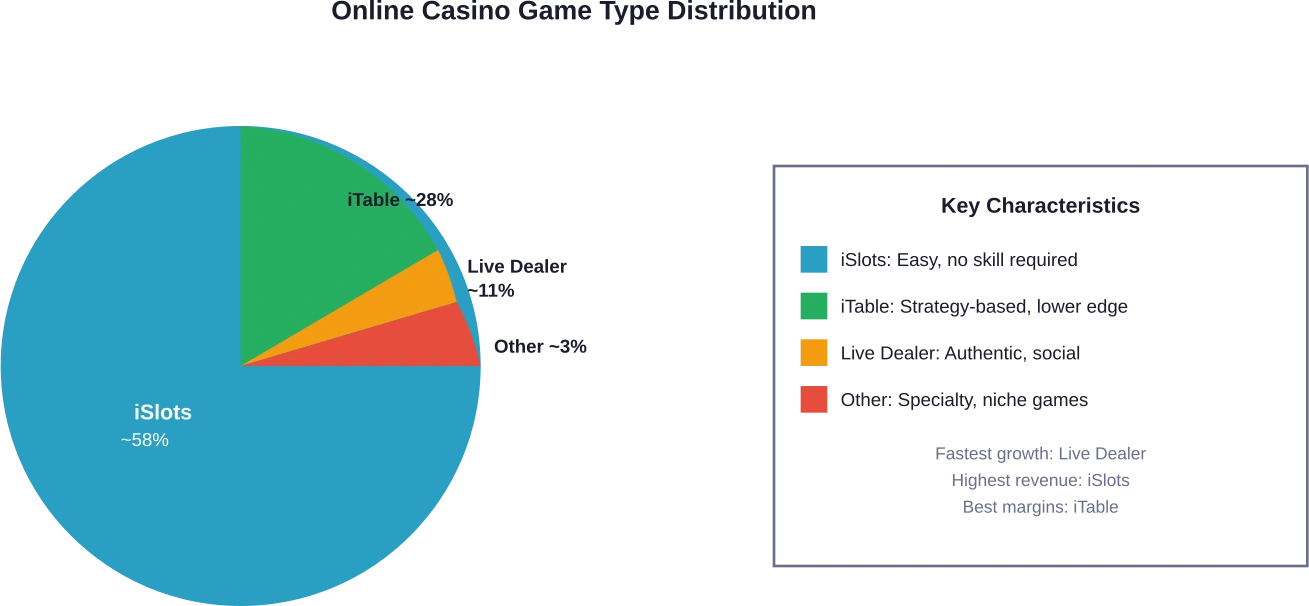
Slots dominate online casino revenue. These digital versions of slot machines range from simple three-reel classics to elaborate video slots with complex bonus rounds, progressive jackpots, and branded intellectual property.
The appeal is straightforward: easy to understand, require no skill or strategy, and offer the potential for significant payouts from small stakes. Slots also provide operators with flexible content libraries—leading platforms offer hundreds or thousands of titles from multiple software providers.
iTable Games
Digital versions of traditional table games (blackjack, roulette, baccarat, craps) attract players seeking more strategic gameplay. These games typically feature lower house edges than slots and appeal to players who prefer skill-based gambling.
Random number generator (RNG) table games allow for rapid play with low minimum bets. They lack the social element of physical casinos but compensate with convenience and accessibility.
Live Dealer Games
Live dealer games transform the online casino experience by streaming real human dealers operating physical gaming equipment in real-time. Players place bets through digital interfaces while watching actual cards being dealt or roulette wheels spinning.
This category has seen tremendous growth as it bridges the gap between online convenience and land-based authenticity. Many players who were skeptical of RNG fairness have embraced live dealer alternatives.
As the line between gaming and gambling blurs, social features are becoming essential for differentiating offerings in a highly competitive market. Live dealer games inherently provide more social interaction through chat features and the presence of human dealers.
Competitive Landscape and Key Players
The online casino market features a mix of established gaming conglomerates, specialized digital operators, and emerging regional players. Market concentration varies by geography due to licensing restrictions and local competition.
Real talk: market share data for private operators is notoriously difficult to verify. Many leading platforms operate under holding companies with diversified gaming portfolios, making pure online casino revenue hard to isolate.
Rush Street Interactive represents one transparent example, as a publicly traded company required to disclose financial results to the SEC. Their Q4 2025 performance—$324.9 million in quarterly revenue with a 28% year-over-year increase—demonstrates the growth potential for well-positioned operators. Their record quarterly adjusted EBITDA of $44.1 million in Q4 2025 (up 44% year-over-year) and full year net income of $74.0 million shows that online casino operators can achieve profitability at scale.
Competitive Differentiation Strategies
With similar game libraries available through third-party software providers, operators compete on several dimensions beyond game selection:
- Welcome bonuses and promotions: Aggressive customer acquisition spending remains standard, though increasingly scrutinized by regulators
- Payment options: Speed of withdrawals and diverse deposit methods create competitive advantages
- User experience: Interface design, site performance, and mobile optimization influence retention
- Customer support: Availability and quality of support differentiate premium operators
- Exclusive content: Some operators invest in proprietary games unavailable elsewhere
- VIP programs: High-value player retention through tiered rewards and dedicated account management
Brand reputation matters enormously in an industry where players deposit real money and trust operators to pay out winnings. Established brands with land-based casino heritage often leverage their reputations for credibility in digital markets.
Regulatory Environment and Compliance Challenges
Perhaps no factor influences the online casino market more profoundly than regulation. The patchwork of global gambling laws creates a complex operating environment where success requires navigating contradictory requirements across jurisdictions.
United States Market Dynamics
The U.S. represents both the biggest opportunity and the most fragmented regulatory landscape. Following the 2018 Supreme Court decision overturning the federal sports betting ban, states have gained authority to legalize various forms of online gambling.
According to research published by Harvard in January 2026, states have passed legislation legalizing sports betting in some form, with total sports wagers increasing from $4.9 billion during 2017 to $121.1 billion during 2023, with 94 percent of wagers during 2023 being placed online. A February study in JAMA Internal Medicine also noted that internet searches for gambling-addiction help have risen 23 percent nationally from the 2018 court ruling through June 2024. While sports betting has expanded more rapidly than online casino gambling, several states now permit both.
The state-by-state approach means operators must obtain separate licenses, comply with distinct technical standards, and navigate varying tax structures for each market they enter. This creates significant barriers to entry but also protects licensed operators from competition.
Nevada, as the traditional gambling capital, maintains its own regulatory framework through the Nevada Gaming Control Board. Monthly revenue reports track performance across the state’s nonrestricted gaming operations, providing transparency into market trends.
Tribal Gaming Considerations
The boom in online sports betting and prediction markets is disrupting Tribal government gaming, according to analysis from the Brookings Institution published in January 2026. Tribal governments have collectively scaled a $44 billion gaming industry (comprising gaming revenues and related enterprises and amenities), which has become central to the economic well-being of Tribes and Native peoples.
Any gaming on Indian lands that is not authorized by a Tribal-state compact violates federal and state criminal laws. The rise of online gambling accessible anywhere via smartphones creates competitive pressure on physical Tribal casino properties, presenting both economic and sovereignty challenges.
Social Concerns and Responsible Gaming
Public sentiment toward gambling legalization has shifted. According to a Pew Research Center poll cited by Harvard researchers, 43 percent of U.S. adults now say the fact that sports betting is now legal in much of the country is a bad thing for society—up from 34 percent in 2022.
Gambling addiction concerns have intensified as online access removes traditional friction from wagering. The Harvard research notes that it typically takes between five and seven years before countries see the full social impact of gambling liberalization.
Operators face increasing pressure to implement responsible gaming features: deposit limits, self-exclusion tools, time-based restrictions, and reality checks. Regulatory frameworks increasingly mandate these protections, and failure to demonstrate responsible gaming commitments can jeopardize licensing.
Technology Trends Shaping Market Evolution
Technological innovation drives competitive differentiation and creates new player experiences in the online casino market.
Payment Innovation and Cryptocurrency
Traditional payment processing has long been a pain point for online casinos due to banking restrictions on gambling transactions in certain jurisdictions. Credit card processors often decline gambling-related charges, and traditional banking transfers can be slow.
Cryptocurrency adoption has provided alternative payment rails, offering faster transactions and enhanced privacy. Bitcoin, Ethereum, and stablecoin options appear on many platforms, particularly those serving international markets.
However, regulatory acceptance of cryptocurrency gambling remains inconsistent. Some jurisdictions explicitly prohibit it, while others have embraced it as a technological evolution.
Artificial Intelligence and Personalization
AI applications in online casinos extend across multiple functions:
- Game recommendations: Machine learning algorithms analyze playing patterns to suggest games matching player preferences
- Bonus optimization: Dynamic promotional offers tailored to individual player value and engagement patterns
- Fraud detection: Anomaly detection systems identify suspicious betting patterns or account behavior
- Problem gambling identification: Behavioral analysis flags potentially harmful playing patterns for intervention
- Customer service automation: Chatbots handle routine inquiries, escalating complex issues to human agents
Virtual Reality and Immersive Experiences
VR casino applications have been “the next big thing” for several years without achieving mainstream adoption. The technology exists, and VR casino platforms offer impressive immersive environments.
But wait. Widespread adoption faces practical barriers: VR headset penetration remains relatively low, extended VR sessions can cause discomfort, and the added immersion doesn’t necessarily improve the core gambling experience enough to justify the friction.
That said, technological improvements and falling hardware costs could change this calculus. Some operators maintain VR offerings as premium options for players seeking novel experiences.
Market Challenges and Growth Obstacles
Despite impressive growth projections, the online casino market faces headwinds that could impact the trajectory.
Regulatory Uncertainty
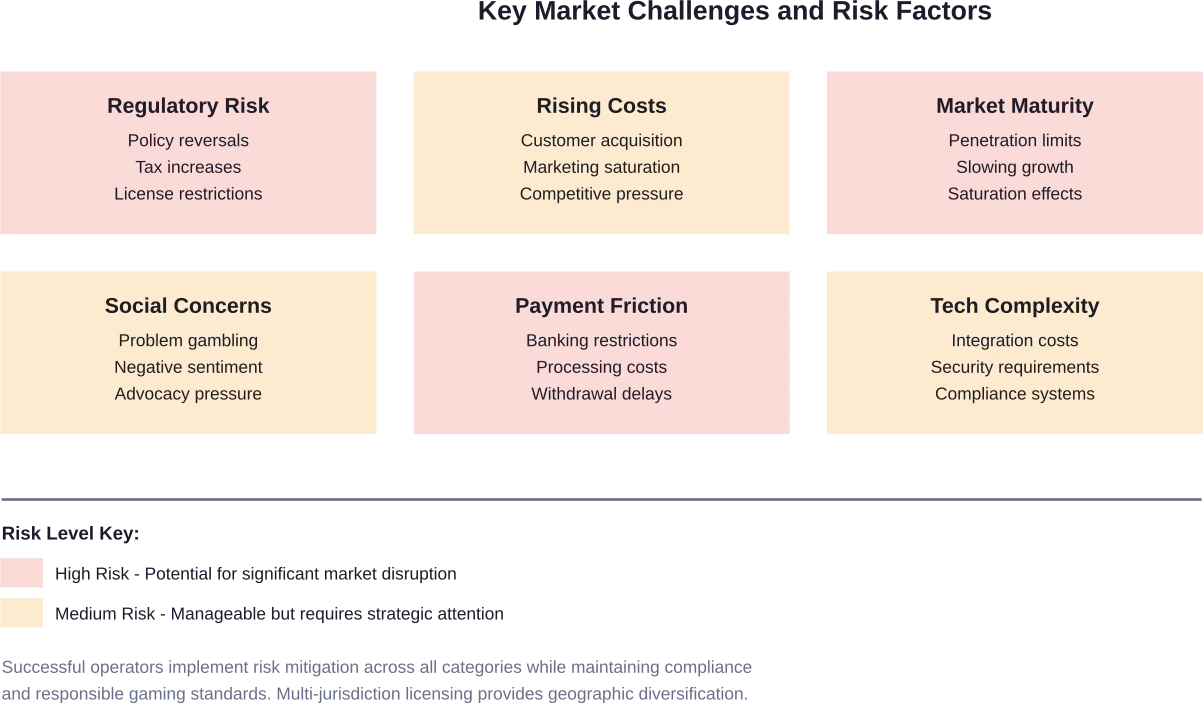
Jurisdictions can reverse liberalization policies. When governments face budget pressures, gambling regulation changes can introduce new taxes or restrictions that impact profitability. Operators must build business models resilient to regulatory flux.
Marketing and Customer Acquisition Costs
As markets mature, customer acquisition becomes increasingly expensive. The most accessible players have already been converted, requiring more sophisticated (and costly) marketing to reach remaining potential customers.
New market entrants face particularly steep acquisition costs as they compete against established brands. This creates consolidation pressure, favoring larger operators with deeper pockets.
Saturation in Mature Markets
Early-stage markets offer explosive growth as legalization unlocks pent-up demand. But mature markets inevitably slow as they reach natural penetration limits.
European markets demonstrate this pattern—established jurisdictions show single-digit growth while emerging markets post double-digit expansion. Operators must continuously enter new geographies to maintain growth rates.
Social Acceptance and Reputational Risk
The gambling industry operates under persistent scrutiny regarding its social impact. Negative publicity around problem gambling, predatory marketing, or regulatory violations can trigger political responses that reshape market conditions.
Brand partnerships between gambling operators and sports leagues or teams face backlash from advocacy groups concerned about normalizing gambling for young audiences.
Convergence with Sports Betting
The sports betting segment accounted for a significant market share of over 24% in the broader U.S. online gambling market in 2024. Many jurisdictions that legalized sports betting have subsequently added online casino offerings, and vice versa.
This convergence creates integrated platforms where players can bet on sports and play casino games within the same account ecosystem. Cross-selling between products improves customer lifetime value and provides more entertainment options.
Sports betting also serves as a customer acquisition channel for casino products. Players who start with sports wagering often explore casino options, particularly during sports off-seasons or when seeking different entertainment.
The integration isn’t without complications though. Sports betting attracts different player demographics and psychology compared to casino gambling. Marketing messages and product features that resonate with sports bettors may not translate to casino players.
Future Outlook and Emerging Opportunities
Looking ahead through the rest of 2026 and toward 2030, several trends will likely shape market evolution.
Continued North American Growth
Additional U.S. states will likely legalize online casino gambling as they observe tax revenues generated by early adopters. California, Texas, and Florida represent massive untapped markets that could add billions in addressable market size if they legalize.
Canadian provinces are also exploring expanded online gambling options, potentially opening significant new market opportunities.
Latin American Market Development
Several Latin American countries have implemented or are considering regulatory frameworks for online gambling. Brazil, Argentina, Mexico, and Colombia present substantial opportunities given their populations and growing middle classes.
Regulatory clarity in these markets would attract international operators and legitimize currently grey-market activity.
Mobile-First Innovation
As mobile devices become even more powerful and 5G networks expand, mobile casino experiences will continue improving. Games designed specifically for mobile interaction rather than desktop ports will become standard.
Portrait-mode gaming optimized for one-handed smartphone use represents one design evolution already gaining traction.
Esports Integration
The boundary between competitive gaming and gambling continues blurring. Esports betting has grown substantially, and some platforms experiment with skill-based gaming elements that incorporate gambling mechanics.
Younger demographics raised on video games represent future casino customers, and products that blend gaming engagement with gambling elements could capture this audience.
Investment and M&A Activity
The online casino market attracts significant investment capital given its growth profile. Both strategic acquisitions by established gaming companies and private equity investment drive consolidation.
Larger operators acquire smaller competitors to gain market share, obtain valuable licenses, or access proprietary technology. Software providers that develop popular game titles become acquisition targets for operators seeking differentiated content.
SPAC mergers brought several online gambling companies public in recent years, though market conditions have cooled somewhat from the peak enthusiasm. Public market valuations now more closely reflect realistic profitability timelines rather than pure growth stories.
Get the Right Partners in Place Before You Scale

The online casino market keeps expanding, but growth alone does not translate into results. What usually makes the difference is how well the business is set up behind the scenes – from platform choices to service providers and operational support. Sologe is built around that part of the process, giving casino operators and developers a place to connect with companies across the industry and move forward with a clearer structure.
Instead of spending time sourcing vendors one by one, teams use Sologe to explore and compare options in one place – whether they are preparing a launch or improving an existing setup. It helps reduce friction when building or scaling in a fast-moving market.
If you want to turn market trends into something actionable on the product and operations side, contact Sologe and start a direct conversation.
Frequently Asked Questions
How big is the online casino market?
The online casino market was valued at $19.11 billion in 2024 and is projected to reach $38.00 billion by 2030, representing a compound annual growth rate of 12.2% from 2025 to 2030. Some analysts forecast even higher growth, with estimates reaching $56.8 billion by 2033 at a 12.5% CAGR. Europe currently holds the largest market share, while Asia-Pacific shows the fastest growth rate.
Which region has the largest online casino market?
Europe held the largest revenue share in the online casino market in 2024. The region benefits from mature regulatory frameworks, widespread internet penetration, and established consumer acceptance of online gambling. Countries like the UK, Malta, and several Nordic nations have well-developed licensing systems that support a robust online casino industry. North America is experiencing rapid expansion but still trails Europe in total market size.
Is mobile or desktop more popular for online casinos?
Desktop held the largest revenue share across the online casino industry in 2024, despite the broader trend toward mobile-first digital experiences. Desktop offers advantages for certain player segments including larger screens for detailed graphics, easier navigation for complex table games, and more comfortable extended play sessions. However, mobile is the fastest-growing segment, driven by smartphone ubiquity and improved mobile internet speeds. Most successful operators now provide seamless cross-platform experiences.
What game types generate the most revenue for online casinos?
Online slots (iSlots) dominate revenue generation in the online casino market, accounting for the majority of total gaming revenue. These digital slot machines appeal to players because they require no skill or strategy and offer potential for significant payouts from small stakes. Table games (iTable) represent the second-largest category, attracting players who prefer strategic gameplay. Live dealer games show the fastest growth rate as they bridge the gap between online convenience and land-based authenticity.
How is regulation affecting the online casino market?
Regulation fundamentally shapes the online casino market, creating both opportunities and constraints. In the United States, the state-by-state legalization approach following the 2018 Supreme Court sports betting decision has opened new markets but created a fragmented regulatory landscape. Operators must obtain separate licenses and comply with distinct requirements in each jurisdiction. Internationally, regulatory environments vary dramatically, with Europe having generally mature frameworks while many Asian markets maintain restrictive policies. Social concerns around problem gambling are driving increased regulatory scrutiny and responsible gaming requirements.
What is driving growth in the online casino market?
Several factors drive online casino market growth: regulatory liberalization in new jurisdictions, particularly North American states; increasing smartphone penetration enabling mobile gaming; improved internet infrastructure supporting live dealer experiences; convergence with legalized sports betting creating integrated platforms; and technological innovations like cryptocurrency payments and AI-driven personalization. Demographic shifts as younger digital-native consumers reach gambling age also contribute to long-term growth potential.
What challenges does the online casino industry face?
The industry faces multiple headwinds including regulatory uncertainty, rising customer acquisition costs in maturing markets, market saturation in established jurisdictions limiting growth potential, social concerns about problem gambling affecting public sentiment, payment processing friction due to banking restrictions, and technological complexity requiring significant compliance and security investments. Additionally, negative publicity around gambling addiction and predatory marketing practices creates reputational risks that can trigger political responses.
Conclusion: A Market at an Inflection Point
The online casino market stands at a fascinating crossroads. Explosive growth continues as new markets legalize and mobile technology improves accessibility. Revenue projections show the market potentially doubling by 2030.
But that growth isn’t guaranteed or uniform. Regulatory shifts, social concerns, and market maturity in established regions create uncertainty. Companies like Rush Street Interactive demonstrate that profitability is achievable—their Q4 2025 results with $44.1 million in quarterly adjusted EBITDA and $74.0 million full year net income prove the business model works at scale.
For operators, success requires navigating complex regulatory environments, investing heavily in customer acquisition while maintaining unit economics, implementing robust responsible gaming measures, and continuously innovating to differentiate in an increasingly crowded market.
For investors, the sector offers compelling growth characteristics balanced against regulatory risk and social acceptance concerns. Companies with strong compliance frameworks, diversified geographic exposure, and demonstrated paths to profitability present the most attractive profiles.
For policymakers, the challenge involves balancing economic benefits (tax revenue, job creation) against social costs (problem gambling, predatory practices). The coming years will reveal whether jurisdictions can effectively regulate online casinos to maximize benefits while minimizing harms.
The online casino industry has transformed from a technological novelty into a mainstream entertainment sector generating tens of billions in annual revenue. Whether it can sustain 12%+ annual growth while addressing legitimate social concerns will define the market through 2030 and beyond.
One thing is certain: the evolution is far from over. New technologies, regulatory developments, and changing consumer preferences will continue reshaping this dynamic market for years to come.
Related Articles

September 29, 2026Is the Casino Legal in Japan? The Real Answer...

September 29, 2026Is the Casino Legal in Gambia? What the Law...