 Nothing found for the request
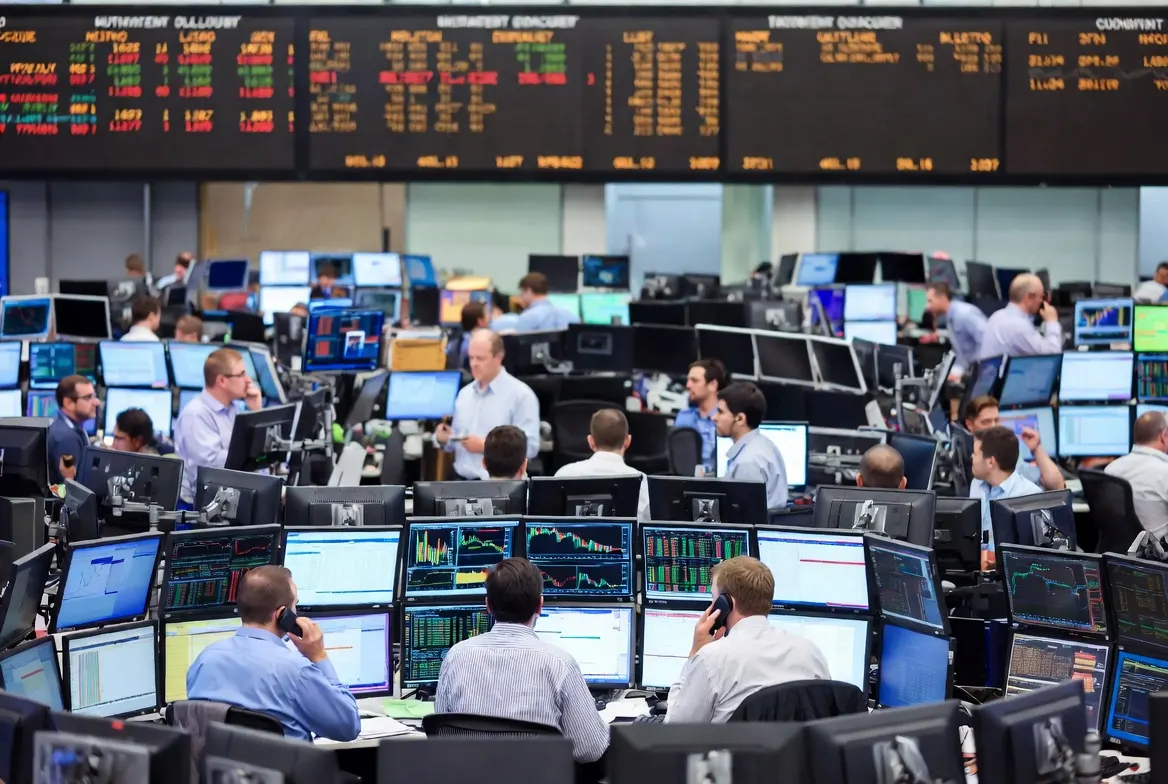
Stock Market Casino: Where Investing Meets Gambling in 2026
Sologe March 27, 2026
Share:


The House Edge: Casinos vs. Stock Markets
Casinos operate on a simple principle: the house always wins. Every game features a built-in mathematical advantage called the house edge.
Take roulette. On a simple red or black bet, you’d think you have a 50/50 chance. But those green 0 and 00 slots? They tilt the odds in the casino’s favor on every single spin. Over time, this edge guarantees the casino profits while players lose.
The stock market doesn’t work this way.
There’s no entity extracting a mathematical edge from every transaction. Companies create real value through products, services, and innovation. When you own stock, you own a piece of that value creation. Dividends flow to shareholders. Stock prices generally rise over decades as the economy grows.
According to Federal Reserve research on market volatility, global volatility was near 20 percent at the end of 2015 and had almost halved by mid-2017. These movements reflect economic fundamentals rather than a rigged house edge.
Where the Comparison Breaks Down
But wait. This doesn’t mean the stock market can’t function like a casino for certain participants.
The critical difference? How you play the game.
Buy and hold investors who purchase diversified portfolios benefit from long-term economic growth. Casino gamblers who pull slot machine levers face guaranteed mathematical losses over time. These aren’t comparable activities.
Day traders making dozens of transactions weekly? Now we’re entering different territory.
The Gamblification of Trading Platforms
Something shifted in recent years. Trading platforms transformed investing into something that looks, feels, and functions suspiciously like gambling.
Research from Columbia University examining “gamblification” in financial markets identified how platforms like Robinhood and Webull integrate gambling elements from video games. These include instant rewards, immersive visuals, and constant engagement triggers.
The result? Investing morphs into a high-stakes game.
Community discussions highlight how modern trading apps use confetti animations when you make a trade. Push notifications encourage more frequent trading. The interface resembles mobile games designed to maximize engagement rather than returns.
The Psychology of Speculative Trading
According to research from the University of Colorado, retail investors increasingly explore higher-risk speculative markets. The online trading platform market was valued at nearly $9.6 billion in 2023 and is expected to grow 7.3% annually through 2030.
This growth isn’t driven by more people adopting sensible buy-and-hold strategies. It’s fueled by speculation, frequent trading, and dopamine-seeking behavior.
Research in the Journal of Behavioral Addictions examined associations between stock market trading frequency and problem gambling, analyzing investor portfolios with relative portfolio turnover averaging 0.9765.
Frequent trading reduces returns. Transaction costs accumulate. Tax inefficiency destroys wealth. Yet the behavior persists, driven by the same psychological mechanisms that keep gamblers at slot machines.
Make Your Casino Business Easier to Find

The casino gaming market includes a wide mix of operators, suppliers, and service providers, which makes discovery harder through general channels alone. Sologe is built to solve that. It works as an iGaming marketplace where buyers search for products, services, and partners, while vendors use the platform to present their offering and connect with relevant companies.
Want Better Visibility Among Gaming Buyers?
Use Sologe to:
- present your company inside a marketplace built for gaming businesses
- reach buyers already searching for suppliers and partners
- stay visible beyond exhibitions and short-term campaigns
👉 Get in touch with Sologe to discuss becoming a vendor on the platform.
When Stock Trading Becomes Gambling
So when exactly does investing cross the line into gambling territory?
Pattern Day Trading Rules
FINRA maintains specific rules governing day trading. Current pattern day trading rules require a $25,000 minimum account balance for traders who execute four or more day trades within five business days.
These regulations exist because day trading resembles gambling more than investing. Without adequate capital buffers, retail traders face devastating losses.
The rules are evolving. Regulatory discussions contemplate eliminating the pattern day trader designation and the $25,000 minimum equity requirement in favor of intraday risk-based margin standards without any fixed equity threshold.
The GameStop Phenomenon
Remember early 2021? GameStop stock skyrocketed from under $20 per share to nearly $500 in just two weeks of trading. Reddit communities coordinated mass buying of a bankrupt company’s shares.
This wasn’t investing in any traditional sense. Participants ignored fundamental analysis, cash flows, and business viability. They bought shares hoping to drive prices higher through volume alone.
Sound familiar? It’s the same impulse that drives lottery ticket purchases.
Cornell Law School analysis described this as “modern gambling”—stock trading transformed into speculation divorced from underlying business value.
Market Volatility and Risk Perception
Markets move. Sometimes violently.
Federal Reserve analysis of global risk transmission shows that risk-off episodes feature sharp increases in credit spreads, high equity market volatility, and significant price swings. During the 2007-2009 financial crisis, volatility peaked at approximately 80 percent—higher than typical stress test scenarios which average around 67 percent in the Federal Reserve’s stress test analysis.
Does this make markets casino-like? Not necessarily.
Volatility reflects uncertainty about economic conditions, corporate earnings, and policy decisions. This uncertainty differs fundamentally from the predetermined mathematical edge in casino games.
The Role of Speculation
Research from UCLA Anderson suggests that markets actually need speculators. A working paper categorizes market participants into three types: rational investors, irrational speculators, and gamblers who seek entertainment value.
Gamblers counteract impulses from other market personality types. Research found that a certain significant increase in the Catholic-to-Protestant ratio corresponds to about a 4.27% increase in median stock turnover and reduces ‘relative beta’ (a measure of price distortion) by about 3.9%.
In other words, the gambling element in markets might serve a function—providing liquidity and counterbalancing other behavioral biases.
Regulatory Oversight: A Critical Difference
Here’s something casinos and stock markets definitely don’t share: regulatory frameworks.
The SEC’s regulations on selective disclosure and insider trading (Regulation FD) require companies to disclose material nonpublic information to all investors simultaneously. When non-intentional disclosures occur, companies must make public disclosure promptly.
These rules create transparency that doesn’t exist in casinos. Companies face legal obligations to shareholders. Financial statements undergo audits. Fraud carries criminal penalties.
Casinos operate under gaming regulations focused on mechanical fairness and player protection, but they openly advertise their mathematical edge. Nobody regulates casinos to ensure you win.
Casino Stocks: Investing in the House
Wait—can’t you just invest in actual casino stocks?
Absolutely. And this reveals another key difference between markets and casinos.
When you invest in casino operator stocks like MGM, Las Vegas Sands, or Wynn Resorts, you’re buying ownership in companies with real estate assets, hospitality operations, and entertainment venues. These businesses generate cash flows, pay dividends, and can be analyzed using traditional valuation methods.
You’re not gambling on red or black. You’re investing in the house.
Casino stocks trade on major exchanges alongside technology, healthcare, and consumer goods companies. They face the same disclosure requirements and analyst scrutiny. Volatility in casino stocks reflects industry fundamentals, tourism trends, regulatory changes, and macroeconomic conditions.
Aspect | Casino Gambling | Stock Market Investing |
|---|---|---|
Wealth Creation | Zero-sum game with house edge | Positive-sum from economic growth |
Time Horizon | Minutes to hours | Years to decades (for investors) |
Skill Component | Minimal (except poker, some games) | Significant for analysis and strategy |
Regulation | Gaming commissions ensure fair play | SEC ensures disclosure and prevents fraud |
Expected Returns | Negative (house edge) | Historically positive (~10% annually) |
Tax Treatment | Gambling winnings fully taxed | Favorable capital gains rates |
The Problem With Frequent Trading
Here’s the uncomfortable truth: most active traders underperform simple index funds.
Transaction costs accumulate with every trade. Bid-ask spreads extract value. Tax inefficiency from short-term capital gains destroys returns. Behavioral biases lead to buying high and selling low.
Research examining stock market trading frequency found that personal investors decrease their returns through frequent trading. The behavioral finance literature primarily attributes this to overconfidence and low financial literacy.
But there’s more. The Journal of Behavioral Addictions study revealed that frequent traders share psychological characteristics with problem gamblers. The activity itself becomes rewarding independent of outcomes.
Practical Implications for Investors
So what’s the takeaway? How should this knowledge affect your approach to markets?
Know Which Game You’re Playing
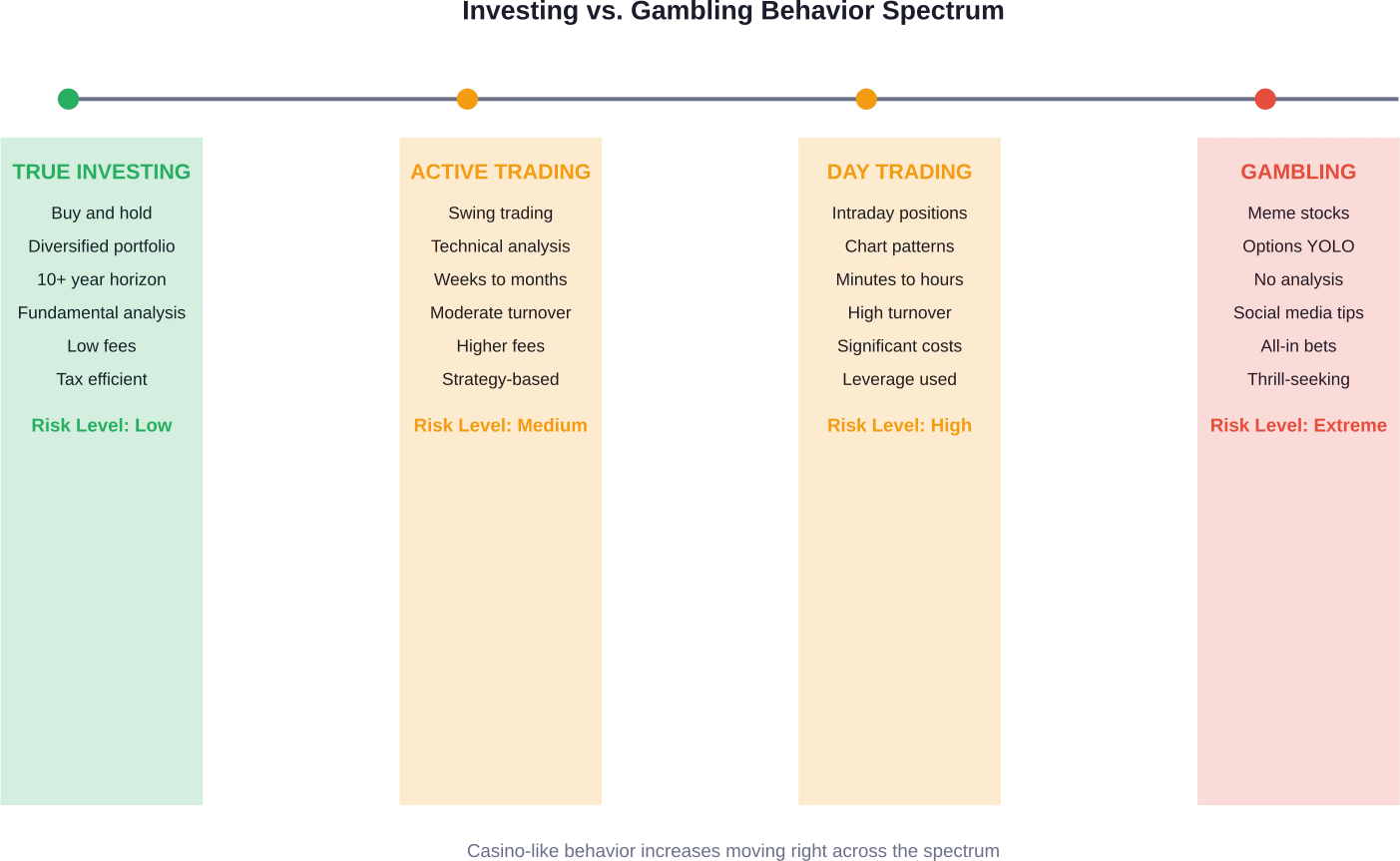
Long-term wealth building through diversified portfolios represents true investing. This approach harnesses economic growth, compound returns, and the wealth creation of thousands of companies.
Frequent trading, speculation on unprofitable meme stocks, and options gambling represent casino-like behavior. These activities might generate occasional wins, but they destroy wealth over time.
The difference isn’t the market itself—it’s your behavior within it.
Platform Design Matters
Choose platforms and interfaces that support your goals. If confetti animations and push notifications encourage overtrading, disable them. Consider traditional brokerages with less gamified interfaces.
Purdue University research on gambling-like behavior in markets emphasizes that dangerous trading doesn’t always come from obvious sources. Platform design subtly shapes behavior.
Risk-Based Thinking
Commentary on FINRA’s day trading rules proposes that risk-based portfolio margin frameworks might better address trading risks than arbitrary pattern day trading restrictions. This represents a shift toward recognizing that risk management—not prohibition—should guide trading activity.
Apply this principle personally. Understand your risk tolerance. Size positions appropriately. Never trade with money you can’t afford to lose completely.
Frequently Asked Questions
Is day trading the same as gambling?
Day trading shares psychological and behavioral characteristics with gambling, including frequent transactions, short time horizons, and entertainment value. However, unlike casino games with built-in house edges, day traders can theoretically profit through skill and analysis. In practice, most day traders underperform buy-and-hold investors after accounting for costs and taxes. The activity becomes gambling when it’s driven by thrill-seeking rather than disciplined strategy.
What’s the main difference between stock markets and casinos?
Casinos operate with a mathematical house edge that guarantees operator profits and player losses over time. Stock markets create wealth through economic growth, innovation, and value creation by thousands of companies. Markets have no systematic house edge—they’re positive-sum games where patient investors generally profit over decades. The critical difference depends on participant behavior: long-term investors experience completely different outcomes than frequent speculators.
Can you invest in casino stocks?
Yes, major casino operators trade on stock exchanges like any other company. Investing in casino stocks means owning businesses with real estate, hospitality operations, and entertainment venues. These investments should be analyzed using traditional valuation methods including cash flow, debt levels, and industry trends. Casino stocks face the same disclosure requirements as all public companies and represent ownership stakes rather than gambling bets.
Why do trading platforms use game-like features?
Research on gamblification shows that platforms integrate gaming elements to increase user engagement and trading frequency. Features like instant rewards, confetti animations, and push notifications trigger dopamine responses similar to video games and slot machines. Higher engagement typically translates to more trades and increased revenue for platforms. This design priority doesn’t necessarily align with investor outcomes, as frequent trading generally reduces returns.
What are pattern day trading rules?
FINRA requires traders who execute four or more day trades within five business days to maintain at least $25,000 in their accounts. These rules exist because day trading involves significant risks that can devastate undercapitalized accounts. Regulatory discussions contemplate evolving these rules toward risk-based portfolio margin requirements rather than strict pattern day trading restrictions, recognizing that sophisticated risk management might better protect traders than arbitrary thresholds.
Do frequent traders actually lose money?
Research consistently shows that frequent trading reduces investment returns. Studies examining portfolio turnover found that investors who essentially turn over their entire portfolio annually decrease their returns compared to buy-and-hold strategies. Transaction costs, bid-ask spreads, tax inefficiency on short-term gains, and behavioral biases all contribute to underperformance. While some professional traders succeed, retail investors engaging in frequent trading typically would have earned better returns holding index funds.
When does investing become speculation or gambling?
Investing transforms into speculation when decisions ignore fundamental business value and focus purely on price momentum or social media hype. It becomes gambling when the activity provides entertainment value independent of financial outcomes, when position sizing risks catastrophic losses, or when behavior resembles compulsion rather than rational decision-making. The GameStop phenomenon exemplified this shift—participants bought a failing company’s shares hoping to drive prices higher through volume alone, completely divorced from business fundamentals.
Final Thoughts: Choose Your Game Wisely
The stock market isn’t inherently a casino. But it can become one depending on how you participate.
Long-term investors who buy diversified portfolios and hold them through market cycles build substantial wealth. They harness the economic growth engine that casinos can never replicate.
Frequent traders, day traders, and speculators chasing meme stocks transform markets into casino-like environments where they’re far more likely to lose than win.
The choice is yours. The market doesn’t care which game you play—but your financial future certainly does.
Real talk: if opening your trading app gives you the same rush as spinning a roulette wheel, you’re probably not investing anymore. Recognize the difference. Your retirement account will thank you.
Related Articles

September 29, 2026Is the Casino Legal in Japan? The Real Answer...

September 29, 2026Is the Casino Legal in Gambia? What the Law...