 Nothing found for the request
Is Sports Betting Legal in Brazil? The Full 2026 Answer
Sologe September 30, 2026
Share:


Quick Summary
Sports betting in Brazil was first authorized under Federal Law 13,756/2018 and regulated by Law 14,790/2023. The licensed market launched on January 1, 2025 under the Secretariat of Prizes and Betting (SPA). That regime ended on September 25, 2026, when Provisional Measure 1,394 prohibited fixed-odds betting nationwide. Land-based casinos remain banned.
Ask a Brazilian sports fan whether betting on the Brasileirão or the Seleção is legal, and the answer used to depend on who you asked. For a stretch it did not. From January 2025 the market ran under federal licenses. As of late September 2026, the picture is clear again: that licensed market has been shut down by Provisional Measure 1,394.
Brazil spent decades treating gambling as mostly illegal, then quietly tolerating offshore sportsbooks that Brazilians used anyway. A regulated SPA market then existed, with a dedicated regulator, licensing fees in the tens of millions of reais, and tax rules for operators and players. That opening lasted less than two years. This guide breaks down how Brazil got here, what the 2025 regime looked like, and what the September 2026 ban changed.
The Short Answer: No. Fixed-Odds Sports Betting Is No Longer Legal
Fixed-odds sports betting in Brazil is no longer legal at the federal level. It was permitted through SPA-licensed operators from January 1, 2025 until MP 1,394 banned the activity on September 25, 2026. That ban covers bets on real sporting events and on virtual / online games.
Horse-race betting has long been a separate exception to Brazil’s gambling ban. It is regulated mainly under Law 7,291/1984 and may be offered by authorized non-profit racetrack entities, not as a Caixa sportsbook product. State-run lotteries also remain a distinct legal category. What changed in 2025 was the licensing of football, basketball, tennis, esports, and online casino-style games on betting platforms. What changed in September 2026 was the ban on that entire fixed-odds category.
Until September 25, 2026, legality hinged on an SPA license. After MP 1,394, even previously authorized operators may not offer new fixed-odds bets. Unlicensed offshore sites were already outside the legal market. After the ban, new fixed-odds bets offered to people in Brazil are prohibited whether or not the operator once held an authorization.
How Brazil Got Here: A Quick Timeline
Brazil’s relationship with gambling has swung between total prohibition and selective tolerance for close to a century. Understanding that swing helps explain why the current framework looks the way it does.
- 1946: A federal decree bans most forms of gambling, including bookmaking, across the country.
- 1967: Horse race betting is carved out as an exception, placed under the state-owned bank Caixa Econômica Federal.
- December 2018: President Michel Temer sanctions Law 13,756/2018, legalizing fixed-odds sports betting in principle, but without a working regulatory structure yet in place.
- 2018–2023: A long gap follows. Betting is technically legal, but no licenses exist, so most operators serving Brazilians run from abroad, largely unregulated.
- December 2023: President Lula signs Law 14,790/2023, finally building the licensing regime, tax structure, and enforcement powers the market needed.
- 2024: The Secretariat of Prizes and Betting (SPA) issues technical ordinances covering security, responsible gambling, and advertising standards.
- January 1, 2025: The regulated market officially launches. Licensed operators go live; unlicensed ones face blocking measures.
- September 25, 2026: Provisional Measure 1,394 prohibits the operation, offering, intermediation, and advertising of fixed-odds betting nationwide. Existing SPA authorizations enter a wind-down and are set to expire.
What Law 14,790/2023 Actually Changed
Law 13,756 opened the door in 2018, but it was Law 14,790/2023 that built the actual house. This is the legislation that gave Brazil a working regulatory body, a licensing process, and rules operators must follow to keep that license.
Key provisions include:
- Creation of the Secretariat of Prizes and Betting (SPA), housed inside the Ministry of Finance, as the sole federal regulator.
- A federal authorization fee that can run up to R$30 million, covering up to three commercial brands for a period of up to five years.
- A requirement that foreign operators establish a legal headquarters inside Brazil to receive authorization.
- A gross gaming revenue (GGR) tax applied to operators, commonly cited at around 12%, alongside separate taxation on player winnings.
- Advertising restrictions, including limits on how betting ads can target minors and requirements for responsible-gambling messaging.
It’s a heavier compliance load than many operators expected, and that’s by design. Brazil’s regulators clearly wanted a market with real oversight rather than a repeat of the loosely policed years between 2018 and 2023.
What’s Legal, What’s Still Off-Limits
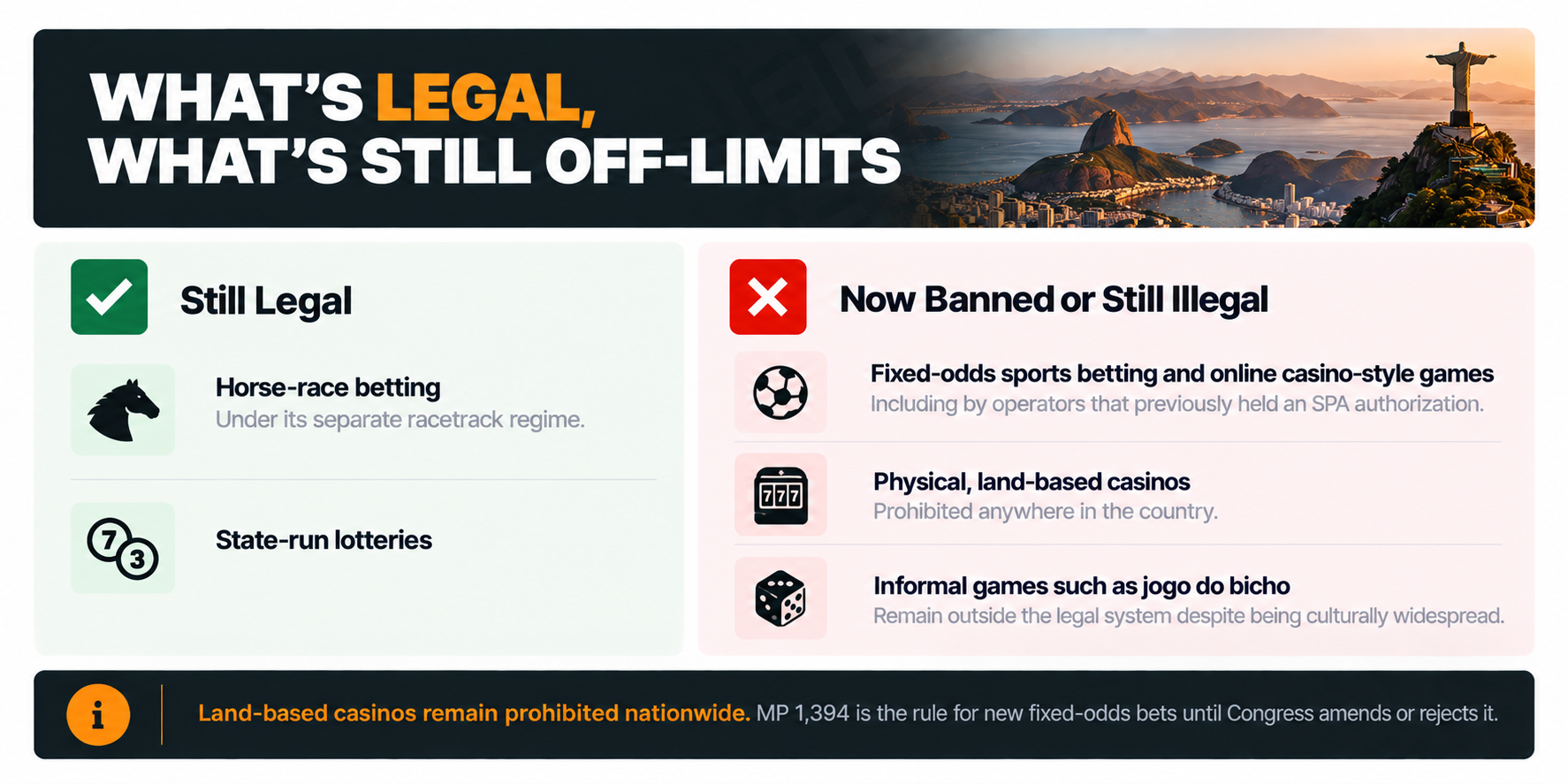
Land-based casinos remain prohibited nationwide. That restriction predates the sports-betting reforms and was not repealed by them. Slot machines and physical casino floors were never part of the SPA framework.
Here’s roughly how things break down after September 25, 2026:
Still Legal
- Horse-race betting under its separate racetrack regime
- State-run lotteries
Now Banned or Still Illegal
- Fixed-odds sports betting and online casino-style games, including by operators that previously held an SPA authorization
- Physical, land-based casinos anywhere in the country
- Informal games such as jogo do bicho, which remain outside the legal system despite being culturally widespread
Congress can still amend or reject a provisional measure. Until that happens, MP 1,394 is the rule for new fixed-odds bets.

Get Your Sports Betting Product Seen with Sologe
AtSologe, we bring sportsbook and iGaming vendors into a marketplace where buyers can browse betting platforms, payment products, software, services, and other industry solutions. We help your business become easier to find when potential partners are already comparing providers.
Want to Reach More Relevant Buyers?
With Sologe, you can:
- add your company and products to an iGaming-focused marketplace
- organize your offer under the right category
- make your solutions easier to find during vendor research
- give interested buyers a clear way to learn more about your business
👉Contact us to get your offer listed on Sologe.
Taxes: Operators and Players Both Pay
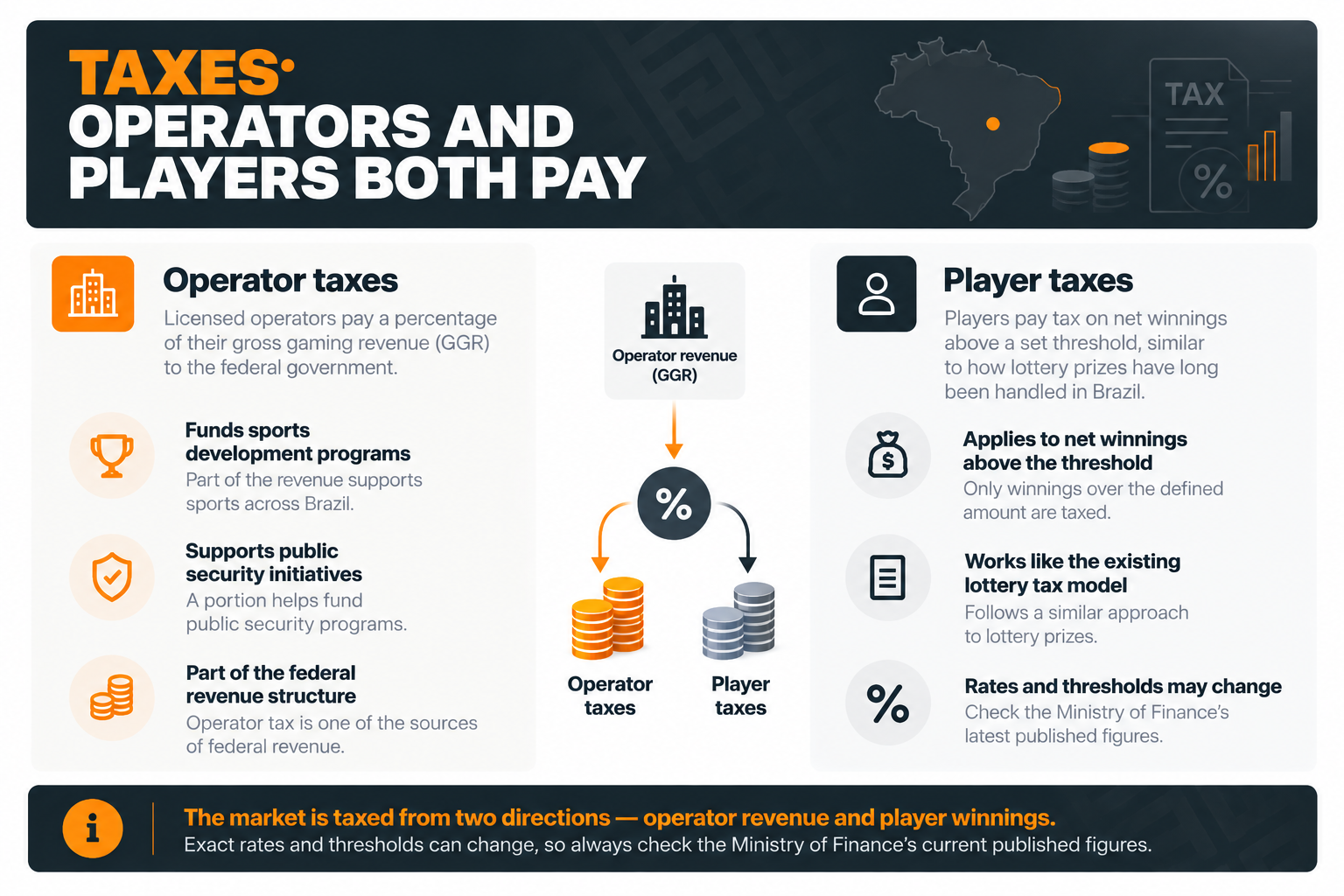
Brazil’s framework taxes the market from two directions. Operators owe a percentage of gross gaming revenue to the federal government, funding everything from sports development programs to public security initiatives, according to how the revenue-sharing rules were structured. Players, meanwhile, are taxed on net winnings above a set threshold, similar to how lottery prizes have long been handled in Brazil.
Exact percentages and thresholds have shifted slightly as ordinances were finalized, so anyone placing large bets should check the Ministry of Finance’s current published rates rather than relying on figures from the 2018-2023 gray-market period, which no longer apply.
Why This Matters for Bettors and Businesses
While the SPA regime lasted, licensed operators had to offer self-exclusion tools, honor audited payouts, and follow advertising limits. Complaints had a formal path through the SPA. Those consumer rules still matter for balances left in accounts during the wind-down.
For businesses, Brazil was briefly one of the largest newly regulated betting markets in Latin America. The R$30 million authorization fee favored well-capitalized brands. MP 1,394 ended that opening and left paid licenses in a wind-down without a simple return to the pre-2025 status quo.
FAQ: Sports Betting in Brazil
Is online sports betting legal in Brazil right now?
No. Online fixed-odds sports betting was legal through SPA-licensed operators from January 1, 2025 until Provisional Measure 1,394 banned it on September 25, 2026.
What law legalized sports betting in Brazil?
Federal Law 13,756/2018, signed by President Michel Temer, first authorized fixed-odds betting. Law 14,790/2023, signed by President Lula, built the licensing framework that made the market operational in 2025.
Are foreign betting sites legal in Brazil?
No. Foreign sites were legal only with an SPA license and a Brazilian headquarters. After MP 1,394, new fixed-odds offers to people in Brazil are prohibited even for former licensees.
Are casinos legal in Brazil?
Land-based casinos remain illegal nationwide. Online casino-style games on licensed betting platforms were part of the 2025 SPA framework. MP 1,394 banned that category as well.
Do Brazilian bettors have to pay tax on winnings?
Yes. Net winnings above a set threshold were – and for past prizes still may be – subject to IRPF, similar to lottery rules. Check Receita Federal guidance for the rate and threshold that apply to money already earned.
Who regulates sports betting in Brazil?
The Secretariat of Prizes and Betting (SPA), part of the Ministry of Finance, licensed and supervised the 2025-2026 market and still handles supervision of the wind-down.
What happened to sites that operated before regulation?
Many pre-2025 offshore operators applied for federal licenses. Those that did not were treated as unlicensed and faced blocking. After September 2026, the ban covers the previously licensed fixed-odds category too.
The Bottom Line
Sports betting in Brazil is no longer a licensed gray-market story. From January 1, 2025 it ran as a federally taxed SPA regime. On September 25, 2026, Provisional Measure 1,394 banned fixed-odds betting nationwide and put existing authorizations on a wind-down. For anyone who still has a balance, follow official SPA and Receita guidance on withdrawals and tax on net winnings.
Related Articles

September 30, 2026Is Sports Betting Legal in Iran? The Real...
September 30, 2026Is Sports Betting Legal in Ukraine? The Full...