 Nothing found for the request
Is Sports Betting Legal in Tunisia? The 2026 Rules Explained
Sologe September 30, 2026
Share:


Quick Summary
Sports betting is legal in Tunisia only through Promosport, the state-owned operator that holds an exclusive monopoly under a framework dating back to 1974. Every other sportsbook, whether it’s an offshore online bookmaker or an unlicensed local operation, sits outside the law, and a bill moving through parliament in 2026 would make using those sites a criminal offense rather than just a gray-market activity.
Search “sports betting Tunisia” and you’ll get a jumble of answers. Some sites say it’s legal. Others call it illegal. The truth sits in between, and it’s tied up in decades-old decrees, a state monopoly that most Tunisians have never heard called by its real name, and a 2026 legislative push that’s about to change the stakes for anyone using an offshore betting app.
Here’s the short version: yes, sports betting is legal in Tunisia, but only one operator is allowed to run it. Everything else — the international bookmakers Tunisian bettors actually use in large numbers — operates in a legal void that lawmakers are now trying to close, hard.
The Short Answer: Promosport Holds the Monopoly
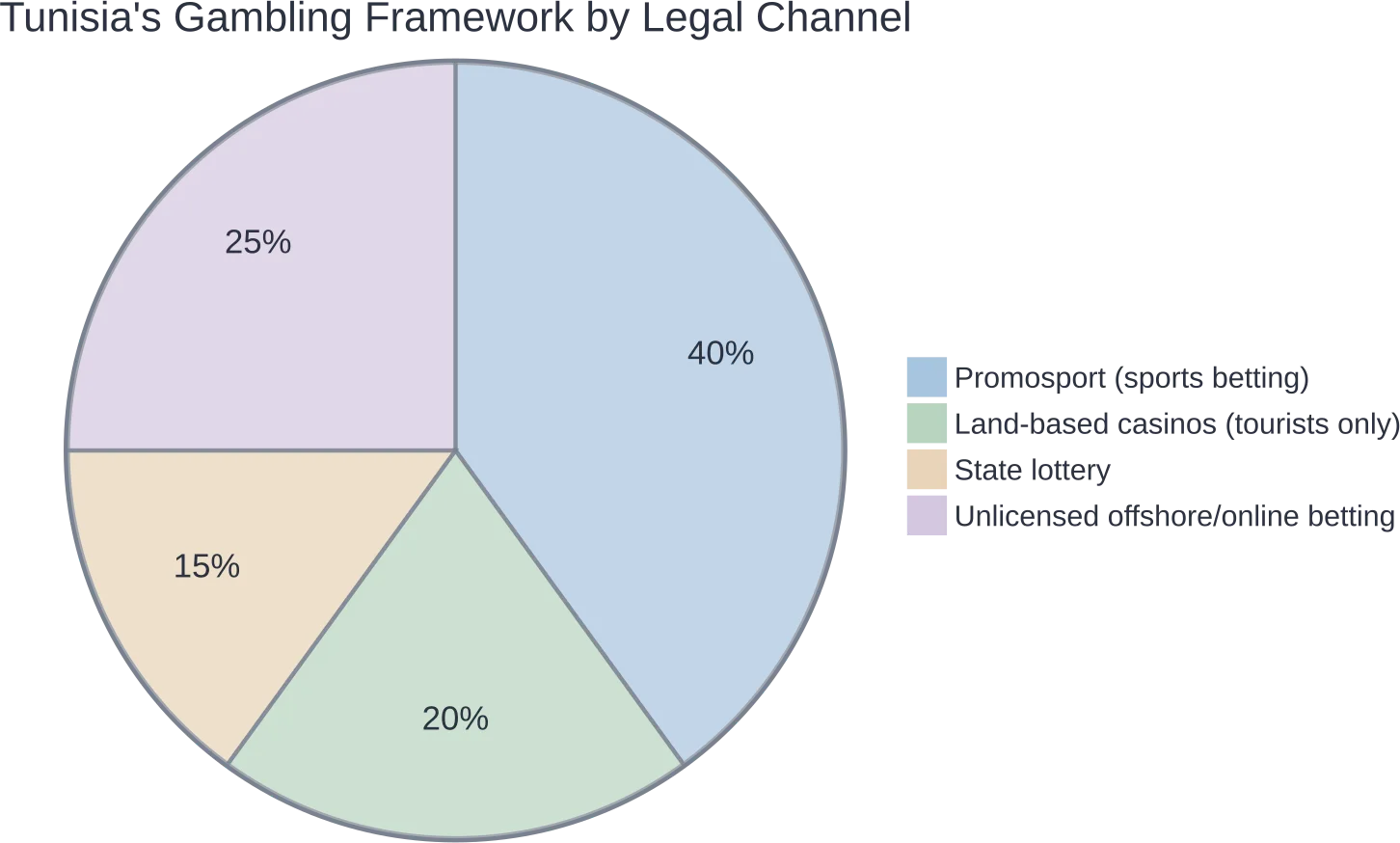
Tunisia’s gambling framework traces back to two decree-laws from October 1974: Decree-Law 74-20, covering betting, games of chance and lotteries, and Decree-Law 74-21, covering casinos. Neither was written with the internet in mind, obviously, but they’re still the backbone of what’s legal today.
Sports betting specifically got carved out in 1984, when Law 84-63 created Promosport, a public company placed under the Ministry of Youth and Sports. Promosport is the only entity legally allowed to offer sports wagering to Tunisian residents. No private operator, domestic or foreign, has ever been granted a license to compete with it.
That’s the legal reality in one sentence: sports betting is legal in Tunisia, but exclusively through Promosport’s own network and, more recently, its own online platform.
What Promosport Actually Is
Promosport isn’t a brand most outsiders recognize, and that’s kind of the point — it was never built to compete internationally. It runs retail betting shops across Tunisia, takes wagers on football and other sports, and channels a share of revenue back to state sports funding. Faced with growing competition from offshore online books, Promosport eventually launched its own online betting site rather than staying paper-only.
That move matters. It signals the state recognizes demand has shifted online, even while the surrounding legal framework hasn’t caught up in any comprehensive way. Promosport’s online arm remains the only legally licensed digital sports betting product in the country.
Land-Based Casinos: A Different Set of Rules
Casinos are legal in Tunisia too, but with a catch that trips up a lot of people: they’re reserved for foreign tourists. Tunisian nationals are barred from entering, a restriction that’s been in place since the 1970s framework and reaffirmed through subsequent regulation. Casino games require prior authorization from a joint order of the Ministers of the Interior and National Economy, and there’s no meaningful pathway for a resident to gamble legally in one.
So the pattern across Tunisian gambling law is consistent: the state permits certain forms of gambling, but locks down who can participate and through which channel. Sports betting for residents flows only through Promosport. Casino gambling flows only to non-residents.
Activity | Legal status in Tunisia | Who can participate |
|---|---|---|
Sports betting (Promosport) | Legal, state monopoly | Tunisian residents and visitors |
Land-based casinos | Legal, restricted venues | Foreign tourists only |
Offshore online sportsbooks | Unregulated, no license issued | Technically anyone, but unlawful to operate/advertise |
Online casino/poker sites | Illegal, no licensing route exists | No one, legally |
National lottery | Legal, state-run | Tunisian residents |
Why So Many Tunisians Still Bet Offshore
Despite the monopoly, international betting sites see substantial traffic from Tunisia. That’s not really surprising — Promosport’s product historically lagged behind global bookmakers on odds, market variety, live betting features, and payment convenience. Offshore operators offer a slicker experience, and until recently, enforcement against them was minimal.
That’s the “passive prohibition” phase several analysts have described: the activity was technically unauthorized, but there was little active policing of individual bettors or blocking of the sites they used. Regulators focused more on Promosport’s own commercial position than on chasing offshore traffic.
That passive stance is exactly what’s now being dismantled.

Put Your Sports Betting Offer in Front of More Buyers with Sologe
At Sologe, we give sportsbook and iGaming vendors a focused marketplace for betting platforms, payment solutions, gaming software, services, and related products. We help make your offer easier to discover for buyers already looking for suppliers in the industry.
Want More People to Find What You Provide?
With Sologe, you can:
- add your product or service to an iGaming-focused marketplace
- place your offer in the category that fits it best
- make your company easier to discover during supplier research
- give potential partners a simple way to explore your solutions
👉 Get in touch with us to add your offer to Sologe.
The 2026 Legislative Overhaul
In early 2026, a bill was submitted to Tunisia’s Assembly of the Representatives of the People aimed squarely at unlicensed online gambling, sports betting included. Rather than creating a licensing pathway for private operators — the route several other markets have taken — the draft leans toward suppression.
Key elements reported around the bill include:
- Criminalizing the organization, promotion, and use of unauthorized gambling platforms, with online betting and apps singled out specifically.
- Prison terms reportedly ranging from one to five years for offenses tied to unlicensed gambling operations.
- Fines that, according to reporting on the draft, could run up into the hundreds of thousands of Tunisian dinars for organizers and promoters.
- New legal obligations on internet service providers and electronic payment companies to block access to gambling platforms and restrict related financial transactions.
As of late 2026, the measure was still moving through the legislative process rather than sitting on the books as finalized law — so the exact penalties, thresholds, and effective date could still shift before final adoption. Anyone weighing the legal risk of using an offshore site should check current status through official Tunisian government or parliamentary sources rather than relying on any single article, including this one.
What Changes If the Bill Passes
If enacted largely as drafted, the shift is significant. Right now, a Tunisian bettor using an offshore sportsbook faces mostly indirect risk — payment friction, occasional account restrictions, no consumer protection if a site refuses to pay out. Under the proposed law, the framework moves toward direct criminalization, with ISPs required to block gambling domains and payment processors required to cut off related transactions.
That’s a meaningful jump from “unregulated” to “actively enforced.” Whether Tunisia has the technical capacity to block every mirror domain and VPN workaround is another question entirely — plenty of countries with similar blocking laws still see steady offshore traffic. But the legal exposure for individual users and, more so, for anyone promoting or organizing access to these platforms, would rise sharply.
Why Tunisia Hasn’t Simply Licensed Private Operators
Some regional neighbors and other African markets have gone the licensing route — bring offshore operators into a regulated, taxed system rather than trying to ban them outright. Tunisia’s draft law takes the opposite path, leaning on suppression instead of regulation. Critics, including some industry commentators, have argued this misses an opportunity: a licensed and taxed market could generate government revenue and better protect consumers, rather than pushing activity further underground.
Whether that argument gains traction remains to be seen. For now, protecting Promosport’s monopoly position appears to be a bigger policy priority than opening the market to competition.
Practical Guidance for Anyone Asking This Question
For residents wanting to bet on sports within a clearly legal framework, Promosport — including its online platform under Ministry of Youth and Sports supervision — is the only option with unambiguous legal standing. Everything else falls outside the law as it stands, and that gray zone is shrinking fast.
A few practical points worth keeping in mind:
- There is no licensing regime that authorizes private online sportsbooks to serve Tunisian customers, so no offshore site can claim to be “legal” in Tunisia no matter what its own marketing says.
- Land-based casino gambling is off the table for Tunisian nationals regardless of citizenship of the operator running the venue.
- Payment and connectivity restrictions tied to the 2026 bill could affect access to offshore betting sites even before any criminal enforcement kicks in.
- Anyone running a gambling-adjacent business — affiliate marketing, payment processing, or platform hosting — faces materially higher legal exposure than an individual casual bettor, based on how the draft law is currently framed.
FAQ: Sports Betting Legality in Tunisia
Is online sports betting legal in Tunisia?
Only through Promosport’s own licensed online platform. Offshore online sportsbooks are not licensed to operate in Tunisia and fall into an unregulated, increasingly criminalized category.
What is Promosport?
Promosport is the state-owned company created under a 1984 law that holds an exclusive monopoly over sports betting in Tunisia, operating under supervision from the Ministry of Youth and Sports.
Can Tunisians legally use foreign betting sites like Bet365 or 1xBet?
There’s no licensing arrangement that makes any foreign sportsbook legal for Tunisian residents. Usage has historically been tolerated in practice, but the 2026 legislative push aims to criminalize both the use and promotion of such platforms.
Are land-based casinos open to Tunisian citizens?
No. Casinos operating under Tunisia’s 1974 framework are restricted to foreign tourists; Tunisian nationals are not permitted entry.
What penalties does the 2026 gambling bill propose?
Reports on the draft describe prison terms in the range of one to five years and substantial fines for those organizing or promoting unlicensed gambling platforms, along with new obligations for ISPs and payment processors to block related access and transactions. The bill had not been finalized as of late 2026, so figures could still change.
Is the Tunisian national lottery legal?
Yes, the state-run lottery operates under its own legal authorization and is treated separately from sports betting and casino gambling.
Will Tunisia ever license private betting operators?
Nothing in the current legislative direction suggests that. The 2026 draft leans toward tighter enforcement of the existing monopoly rather than opening the market, though policy positions can shift as the bill moves through parliament.
The Bottom Line
Sports betting is legal in Tunisia — just not the way most bettors experience it in practice. Promosport holds the only lawful claim to the market, a position rooted in decades-old decrees and reinforced by a 2026 bill aimed at shutting down the offshore competition that’s quietly dominated actual betting activity for years. Anyone weighing the risk of using an unlicensed platform should treat the current legislative session as a moving target and check official parliamentary or government sources before assuming yesterday’s tolerance still applies tomorrow.
Related Articles
September 30, 2026Is Sports Betting Legal in Brazil? The Full...

September 30, 2026Is Sports Betting Legal in Iran? The Real...