 Nothing found for the request
Is Sports Betting Legal in Iran? The Real Answer for 2026
Sologe September 30, 2026
Share:


Quick Summary
No, sports betting is not legal in Iran. All forms of gambling, including sports betting, remain criminal offenses under Articles 705–711 of Iran’s Islamic Penal Code; after the 2023 amendment, an ordinary bettor faces confiscation of proceeds and a fine. Despite the ban, millions of Iranians access offshore betting sites through VPNs, and authorities have proposed even harsher penalties, including a controversial death-penalty bill for large-scale online gambling operations.
Ask most Iranians whether they can legally place a bet on a football match, and the answer comes fast: no. But ask whether people actually do it anyway, and the answer gets a lot more interesting.
Sports betting sits in a strange legal gray zone in Iran — banned outright on paper, yet thriving underground and online. This guide breaks down exactly what Iranian law says, what penalties look like in practice, why enforcement keeps failing, and what actually happens to people caught betting on sports inside the country.
The Short Answer: Sports Betting Is Illegal in Iran
Iran treats sports betting the same way it treats every other form of gambling: as a criminal act. There’s no licensing body, no regulated bookmaker, no legal path to place a wager on a football match, a cricket score, or anything else. This has been the case since the 1979 Islamic Revolution, when gambling was reclassified from a social vice into a religious and criminal offense under Sharia-influenced law.
Unlike countries that regulate betting through licensed operators and tax revenue, Iran’s legal framework leaves zero room for a state-sanctioned sportsbook. A limited statutory exception now exists: a note to the amended Article 705 excludes from those offences a loser’s obligation to pay a winner in horse racing, shooting and fencing contests held in physical space.
The Legal Basis: Articles 705 to 711 of the Islamic Penal Code
The core of Iran’s anti-gambling law lives in a specific chapter of the Islamic Penal Code, sometimes translated as the section on “Advocating the use of alcoholic beverages, gambling and debauchery.” Article 705 is the headline provision, and it’s the one prosecutors reach for most often when sports betting cases come to court.
- Article 705 covers anyone who establishes or runs a physical venue or any virtual space used for gambling, betting or lottery. The base penalty is grade-6 ta’zir imprisonment (six months to two years); if the offender also made money from that activity, the sentence rises to grade-5 imprisonment plus confiscation and a fine of two to five times the proceeds.
- Article 706 applies when the same conduct is a profession or is carried out as the leader of an organized group, or when the sums involved pass a statutory threshold. Those cases carry a substantially heavier prison term than ordinary participation or running a site..
- Articles 708-711 pick up the surrounding conduct: producing, selling or holding gambling tools (including digital ones), working for or assisting an operator, and related facilitation. Advertising and profiting from the activity can fall under these provisions as well as the operator articles, including when the platform is online.
Here’s where it gets legally messy though. Some Iranian legal scholars argue sports betting doesn’t perfectly fit the traditional definition of “gambling” (games of pure chance) under Article 705, since sports outcomes involve skill and prediction rather than randomness alone. Courts have generally sidestepped that debate by prosecuting bettors anyway — sometimes under Article 705, sometimes under separate fraud and “illegal property acquisition” statutes when large sums or organized networks are involved.
What Happens If You’re Caught? Penalties Explained
Under the amended Article 705 (February 2023), the standard penalty for placing a bet is confiscation of proceeds plus a grade-6 fine or a fine of one to three times those proceeds, whichever is greater. That’s for a basic gambling or betting offense. Organizers, operators, and anyone running a betting platform or physical gambling den face steeper consequences, including longer prison terms and business or asset seizure.
Then there’s the online dimension. In 2023, lawmakers amended the legal framework specifically to bring online betting under the same criminal umbrella as physical gambling, closing what had been a loophole exploited by offshore platforms. More recently, a bill drafted within Iran’s judiciary and legal commission proposed the death penalty for individuals running large-scale online gambling operations — a sign of just how seriously the state now views the issue, even though that proposal hadn’t become settled law as of 2026. Anyone researching this topic should check current Iranian legislative sources directly, since penalty structures here have shifted more than once in just a few years.
Violation | Legal Basis | Typical penalty |
Placing a bet (individual) | Article 705 (as amended 2023) | Confiscation of proceeds and a grade-6 fine, or a fine of one to three times the proceeds, whichever is greater |
Establishing or running a venue or online platform | Article 706 | Grade-6 imprisonment (6 months–2 years); if profit was made, grade-5 imprisonment plus confiscation and a 2–5× fine |
Professional operation or leading an organized group | Article 707 | Longer ta’zir imprisonment (commonly treated as a higher grade than 706) |
Tools, assistance, advertising or other facilitation | Articles 708–711 | Fines, imprisonment and confiscation, depending on the specific article |
Large-scale online network | Articles 706–707, and in some cases separate “corruption on earth” / economic-crime charges | Lengthy imprisonment; capital punishment is not the default under 705–711 but has been invoked in some large operator cases under other statutes |
Why Online Betting Keeps Growing Anyway
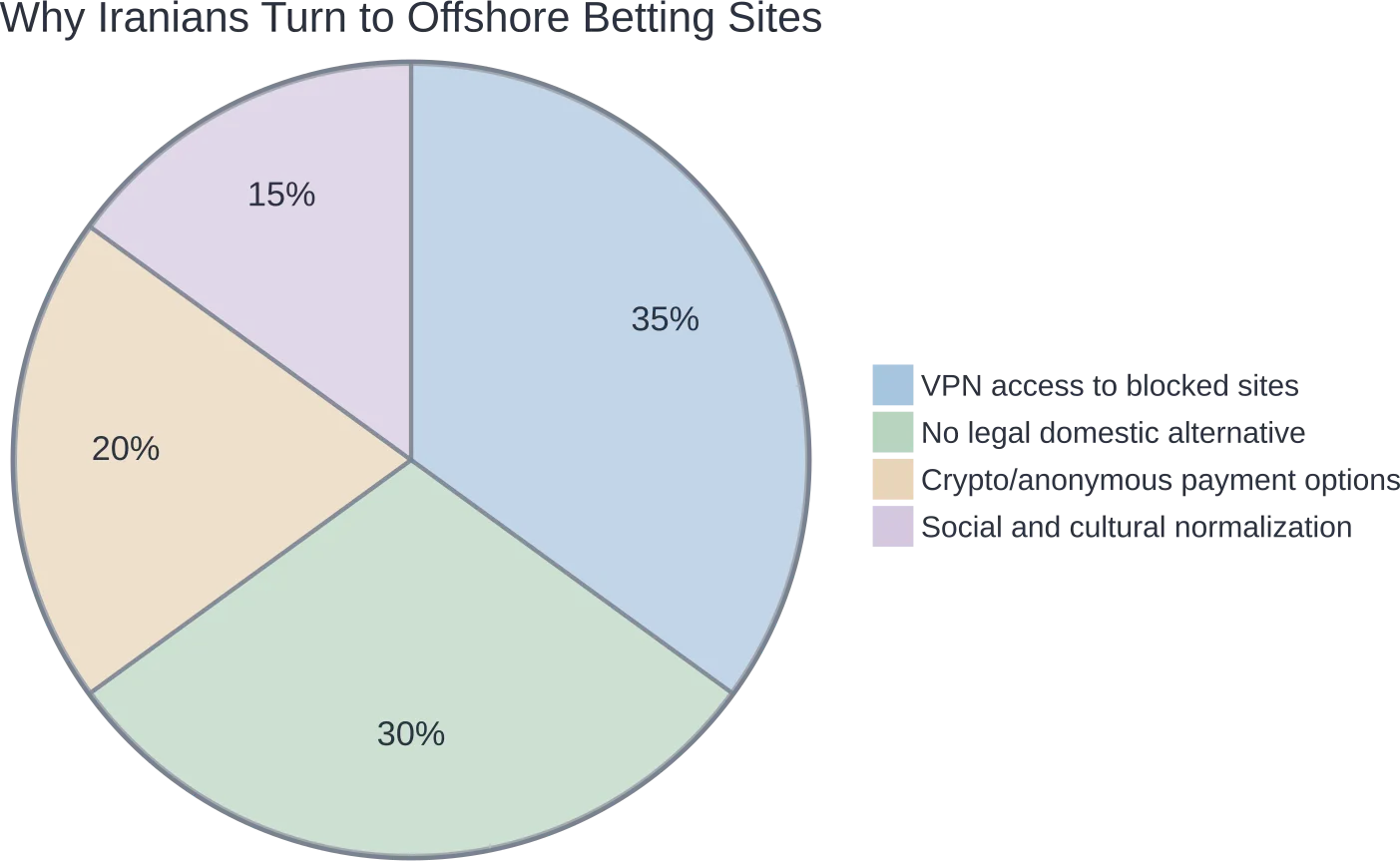
So if the law is this strict, why do reports keep surfacing about massive Iranian gambling networks getting busted? Simple: enforcement is hard, demand is real, and technology makes borders porous.
Millions of Iranians use VPNs daily just to access ordinary blocked websites, and that same infrastructure makes it trivially easy to reach offshore sportsbooks and casino platforms. Payment gets routed through crypto, informal money transfer networks, or intermediaries — methods that dodge Iran’s banking restrictions and international sanctions at the same time. Some of these networks have grown so large that investigators have linked them to billions of dollars in transactions and sanctions evasion, not just recreational betting.
Authorities periodically dismantle these operations, arrest network managers, and publicize the busts as warnings. But the underlying economics — high demand, easy VPN access, and profitable operators based outside Iran’s jurisdiction — mean new platforms tend to fill the gap almost as fast as old ones get shut down.

Showcase Your Sports Betting Solutions with Sologe
At Sologe, we provide a dedicated place for iGaming vendors to present sportsbook platforms, payment solutions, software, services, and other industry products. We help buyers already researching the market find and review relevant offers more easily.
Want Your Offer to Be Easier to Discover?
With Sologe, you can:
- add your products or services to an industry-specific marketplace
- select the most relevant category for your offer
- make it easier for buyers to understand what your company does
- give potential partners a direct path to explore your business
👉 Get in touch with us to list your offer on Sologe.
Football, Cricket, and the “Skill Sports” Gray Area
Iran officially draws a line between gambling and what it calls skill-based sporting competitions — shooting, swimming, and horseback riding are sometimes cited in legal commentary as activities the state tolerates or even encourages when framed as competitive sport rather than wagering. That framing, though, has nothing to do with betting on football scores, and it shouldn’t be confused with a legal loophole for sports betting generally.
Football remains the most heavily bet-on sport among Iranians who do gamble, largely because of the Iranian Premier League’s popularity and international leagues like the English Premier League and Champions League broadcast widely across the country. Offshore operators know this audience exists and market accordingly, often through Persian-language sites and Telegram channels that operate just outside easy detection.
How Iran Compares to Its Neighbors
Iran isn’t alone in banning gambling outright — several countries in the region take a similarly hardline stance, though enforcement intensity and penalty severity vary quite a bit.
Country | Sports Betting Status | Notes
|
|---|---|---|
Iran | Fully illegal | Criminal penalties under Articles 705-711; online betting explicitly covered since 2023 |
Saudi Arabia | Fully illegal | Religious and legal prohibition similar to Iran |
United Arab Emirates | Illegal, with narrow exceptions | Some regulated fantasy/skill contests exist; traditional betting banned |
Turkey | Legal, state-monopolized | Betting runs through licensed state operator (İddaa); private/offshore betting illegal |
That contrast matters. Turkey shows a regional government can regulate and tax sports betting without collapsing under religious objections, by keeping it state-controlled. Iran, so far, has chosen prohibition instead of regulation — a decision rooted more in ideology than in a lack of technical capacity to run a licensed system.
Is There Any Path to Legal Sports Betting in Iran?
Realistically, not in the near term. Iran’s current political and religious leadership treats gambling as a moral and legal red line, not a regulatory question. Recent legislative moves have trended toward harsher punishment, not liberalization — the 2023 amendment extending penalties to online betting and the proposed death-penalty bill both point the same direction.
Any change would likely require a broader shift in how the state balances religious law against economic pressure — something that hasn’t shown serious momentum as of 2026. For now, anyone in Iran considering sports betting should treat it as a genuine legal risk, not a minor technicality.
FAQ: Sports Betting in Iran
Is online sports betting legal in Iran?
No. Online betting was explicitly brought under Iran’s gambling laws through a 2023 amendment, meaning it carries the same criminal exposure as in-person gambling under Article 705.
What is the punishment for sports betting in Iran?
A basic gambling or betting offense under the amended Article 705 typically carries confiscation of proceeds and a monetary fine (grade 6, or one to three times the proceeds).
Do Iranians actually bet on sports despite the ban?
Yes. Reports and periodic law-enforcement crackdowns indicate a substantial underground and offshore betting market, accessed largely through VPNs and cryptocurrency payments to platforms based outside Iran.
Can foreigners legally bet on sports while visiting Iran?
No. Iran’s gambling laws apply regardless of nationality. Foreign visitors caught betting or gambling face the same criminal exposure as Iranian citizens.
Why hasn’t Iran legalized and regulated sports betting like some other countries?
Gambling is treated as a serious moral and religious violation under Iran’s interpretation of Islamic law, not just a matter of economic policy. That framing has kept regulation off the table even as neighboring approaches, like Turkey’s state-run betting monopoly, show a licensed model is technically possible.
What should someone do if they’re unsure about current Iranian gambling law?
Laws and enforcement priorities in Iran have shifted more than once in recent years. Anyone needing precise, current legal guidance should consult Iran’s official Islamic Penal Code text or a qualified legal professional rather than relying on general online guides.
The Bottom Line
Sports betting is illegal in Iran, full stop. The legal framework is clear, the penalties are codified, and recent legislative trends show the government tightening restrictions rather than loosening them. Yet enforcement struggles against a tide of VPN access, offshore operators, and genuine public demand — a gap that’s unlikely to close anytime soon.
For readers researching betting laws across different countries, it’s worth digging into how neighboring markets like Turkey or the UAE handle the same question — the contrast says a lot about how religious law, economics, and technology collide differently depending on where you look. Always verify penalty details and legislative status against official Iranian government sources before drawing conclusions, since this is an area of law that keeps moving.
Related Articles

September 30, 2026Is Sports Betting Legal in Brazil? The Full...

September 30, 2026Is Sports Betting Legal in Ukraine? The Full...