 Nothing found for the request

What Is a Wager in Gambling? Definition & Examples 2026
Sologe April 28, 2026
Share:


Quick Summary
Quick Summary: A wager is the amount of money risked on a specific outcome in betting or gambling. If the prediction is correct, the bettor wins based on the odds; if wrong, the wagered amount is lost. Wagers apply to sports betting, casino games, and online gambling, with varying requirements for bonuses and promotions.
Gambling has changed drastically from the days of placing bets at Las Vegas casinos or finding a neighborhood bookmaker taking wagers on weekend games. Within the next few years, nearly all Americans will have access to legalized sports betting—with tens of millions of people placing bets on everything from their favorite college team to specific player performances.
But what exactly is a wager?
The term gets thrown around constantly in betting circles, yet many newcomers—and even some experienced bettors—aren’t entirely clear on what it means or how it works across different gambling contexts. This guide breaks down everything about wagers: what they are, how they function in sports betting versus casinos, and what those confusing “wagering requirements” actually mean for your bonuses.
What Is a Wager in Betting?
A wager is the amount of money risked on a specific outcome. That’s it.
If the prediction is correct, the bettor wins according to the odds at the time of the wager. If wrong, the amount wagered is lost. Simple mechanics.
Whether betting on a sports game, spinning a slot machine, or playing blackjack, the wager represents the financial commitment to that particular event or game. The term applies universally across gambling formats, though the mechanics and calculations can vary significantly.
Here’s the thing though—while “wager” and “bet” are often used interchangeably, there are subtle distinctions worth understanding.
Wager vs Bet vs Stake
These three terms appear constantly in gambling contexts, and they’re closely related:
- Wager: The money risked on a prediction or outcome
- Bet: The act of placing that wager (though also used to describe the wager itself)
- Stake: The exact dollar amount committed to a single wager
In practice, most bettors use these terms interchangeably without issue. A $100 stake on the Lakers to win is the same as a $100 wager or a $100 bet. The process works the same regardless of terminology: real money gets risked on a sports result or gambling outcome.
According to research from the University of South Carolina, sports gambling has expanded to the point where specific bettor profiles have emerged. “All-Ins”—the most engaged sports bettors—watch an average of 22.38 hours of sports per week and tend to be extroverts who are competitive, impulsive and good with numbers.
List Your Product in an iGaming Marketplace

Sologe gives vendors a place to publish gaming products and services in one structured platform. You can list offers across categories like software, platforms, equipment, traffic, and payment solutions.
Want to Add Your Offer?
List with Sologe to:
- publish your product in a focused marketplace
- choose the right category for your listing
- reach users browsing gaming products
👉 Get in touch with Sologe to list your product
How Wagers Work in Sports Betting
Sports wagering involves selecting an event (such as an NBA game or soccer match), determining the bet type, and committing money to that prediction. The sportsbook sets odds that determine potential returns.
Let’s break down the most common wager types:
Wager Type | What It Means | Example |
|---|---|---|
Moneyline | Pick the winner straight up | Lakers to win at +150 |
Point Spread | Bet on margin of victory | Warriors -5.5 points |
Over/Under | Bet on total points scored | Over 215.5 total points |
Futures | Bet on future outcomes | Chiefs to win Super Bowl |
Prop Bets | Bet on specific events within games | Player to score first touchdown |
Understanding Odds and Payouts
Odds determine how much a wager can return. In American sportsbooks, odds are shown in American format with positive (+) or negative (-) numbers:
- +500 odds: Win $500 from a $100 wager
- -240 odds: Need to wager $240 to win $100
A wager can be small or large. Whether staking $1 or $500, the process works identically: money gets risked on a sports result, and the odds determine the potential return.
Real Sports Betting Examples
NBA Wager Example:
A bettor places a $50 wager on the Lakers to beat the Warriors with a moneyline of +120. If the Lakers win, the return is $110 total ($50 stake plus $60 profit). If the Lakers lose, the entire $50 is lost.
NFL Wager Example:
A $100 wager on the Chiefs -7.5 against the Broncos means the Chiefs must win by 8 or more points. If they win by exactly 7, the wager loses even though the Chiefs won the game.
Soccer Wager Example:
Betting $75 on Over 2.5 goals in a Premier League match means the total combined goals must be 3 or more. A 2-1 result (3 total goals) wins the wager; a 1-1 result (2 total goals) loses it.
Now, this is where it gets interesting.
How Wagers Work in Casino Games
Casino wagering operates differently than sports betting. Instead of predicting outcomes against other bettors or teams, casino wagers are placed against the house on games with predetermined odds and mathematical edges.
Each casino game handles wagers uniquely:
- Slot Machines: Wagers are placed per spin, with bet sizes ranging from pennies to hundreds of dollars. Return-to-player (RTP) percentages determine long-term expected returns, typically 92-97% for online slots.
- Blackjack: Each hand requires a wager within table minimum and maximum limits. Skilled players using basic strategy can reduce the house edge to around 0.5%.
- Roulette: Wagers can be placed on individual numbers, groups of numbers, colors, or odd/even outcomes. Different bet types offer different odds and payouts.
- Poker: In casino poker variants like Caribbean Stud or Three Card Poker, players wager against the house rather than other players. Tournament poker involves buy-in wagers with prize pool distributions.
The crucial difference? Sports betting odds fluctuate based on real-world factors and betting volume. Casino game odds remain fixed based on mathematical probabilities.
What Are Wagering Requirements?
Here’s where things get confusing for many bettors.
Wagering requirements (also called playthrough requirements) are conditions attached to casino bonuses and some sportsbook promotions. They specify how many times a bonus amount must be wagered before it can be withdrawn as cash.
According to research published in the journal Addiction, wagering inducements—which include these bonus structures—may represent a risk factor for developing or exacerbating gambling problems. The study, which analyzed gambling tracking data longitudinally, found that these inducements significantly impact the gambling behaviors of online gamblers under naturalistic conditions.
How Casino Wagering Requirements Are Calculated
The calculation is straightforward:
(Bonus Amount) × (Wagering Requirement) = Total Bet Needed |
- Example: Deposit $50, receive a $50 match bonus with 30x wagering requirements.
- Calculation: $50 (bonus) × 30 = $1,500 total bets required before withdrawal
That doesn’t mean risking $1,500. It means the total amount wagered across all bets must reach $1,500. Win or lose, each bet counts toward the requirement.
Bonus Amount | Wagering Requirement | Total Bets Needed |
|---|---|---|
$25 | 20x | $500 |
$50 | 30x | $1,500 |
$100 | 40x | $4,000 |
$200 | 35x | $7,000 |
Some casinos apply wagering requirements to both the deposit and bonus amount, significantly increasing the total. Others apply it only to the bonus itself.
Sportsbook Wagering Requirements
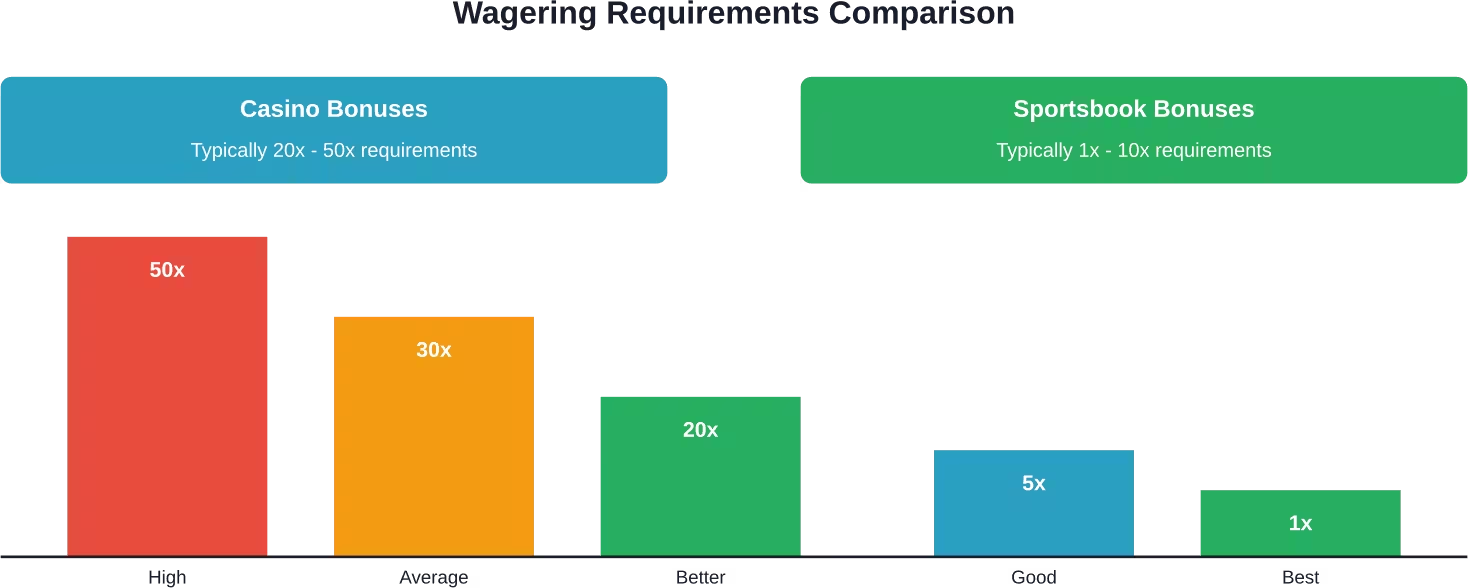
Sports betting bonuses typically have lower wagering requirements than casino bonuses, often ranging from 1x to 10x. But they come with additional restrictions:
- Minimum odds requirements: Bets must be placed at -200 odds or longer
- Bet type restrictions: Some promotions exclude parlays or certain bet types
- Time limits: Requirements must be met within 7-30 days typically
- Sport restrictions: Some bonuses only count bets on specific sports
A $100 free bet with 1x rollover at -200 minimum odds means placing at least $100 in qualifying bets before any winnings can be withdrawn.
No Wagering Requirement Bonuses
Some operators offer bonuses with zero wagering requirements. These “cashable no deposit bonuses” or “wager-free bonuses” let players withdraw winnings immediately without any playthrough obligations.
Sound too good to be true? There’s usually a catch:
- Smaller bonus amounts ($10-$25 typically)
- Maximum withdrawal caps ($50-$100)
- Restricted game selection
- Limited availability or exclusive to VIP players
Still, for bettors who understand the restrictions, these represent genuine value without the complexity of traditional wagering requirements.
Common Mistakes Bettors Make With Wagers
Even experienced gamblers fall into predictable traps when it comes to wagering. Here are the most common errors:
Ignoring Wagering Requirement Terms
Many bettors accept bonuses without reading the full terms. They discover too late that certain games don’t count toward requirements, or that the playthrough must be completed within an unrealistic timeframe.
Real talk: if a casino bonus seems extremely generous, the wagering requirements are probably strict. Read the terms completely before accepting any bonus.
Chasing Losses With Increased Wagers
Research on sports wagering in the context of addictive disorders shows that gambling disorder and problem gambling are long-recognized public health concerns. Excessive, compulsive, or addictive gambling behaviors have been classified as a distinct psychiatric illness by the American Psychiatric Association.
Increasing wager sizes to recover losses accelerates the problem rather than solving it. Responsible gambling means setting predetermined limits and sticking to them regardless of outcomes.
Misunderstanding Odds and Value
Not all wagers at the same amount carry equal value. A $100 wager at -110 odds on a 50/50 proposition offers better value than a $100 wager at -300 odds on a heavily favored outcome, even though both risk the same amount.
Understanding implied probability and comparing it to actual probability determines whether a wager offers positive expected value.
Betting Without Bankroll Management
Professional and serious recreational bettors use systematic bankroll management, typically risking 1-5% of their total bankroll on any single wager. Casual bettors often wager inconsistent amounts based on emotion rather than strategy.
A consistent approach protects against variance and allows for long-term assessment of betting performance.
Understanding Wager Types Across Different Sports
Different sports offer unique wagering opportunities based on their structure and scoring systems.
Basketball Wagering
NBA and college basketball wagers commonly focus on point spreads due to high-scoring games. The spread typically ranges from 1.5 to 15.5 points. Over/under totals are popular because basketball scores are predictable within ranges. Live in-game wagering thrives in basketball due to constant scoring and momentum shifts.
Football Wagering
NFL wagering revolves around spreads (usually 1.5 to 14.5 points) and totals. Key numbers like 3 and 7 (common victory margins) create value opportunities. Prop bets on player performances, team statistics, and game events have exploded in popularity. Teaser bets allowing point spread adjustments across multiple games are football-specific wagering options.
Soccer Wagering
Soccer wagers typically use three-way moneylines (home win, draw, away win) since ties are common. Asian handicaps provide alternative spread betting without the draw option. Over/under goals totals (often 2.5) are standard. Correct score wagers and half-time/full-time results offer higher odds for more specific predictions.
Baseball Wagering
MLB wagers focus heavily on moneylines rather than spreads due to lower scoring. Run lines (typically 1.5) function similarly to spreads but with adjusted odds. Total runs over/under varies by matchup and pitching. First five innings betting isolates starting pitcher performance from bullpen variance.
Responsible Wagering Practices
The expansion of legal sports betting and online gambling access brings important considerations about responsible wagering behavior.
Medical research published in journals including Addiction and through the National Institutes of Health has documented that wagering inducements—promotional offers, bonuses, and loyalty programs—can impact gambling behaviors significantly. Studies show these inducements may represent risk factors for developing or exacerbating gambling problems.
Responsible wagering practices include:
- Set loss limits before wagering: Determine maximum acceptable losses per session, day, week, or month
- Never chase losses: Increasing wager sizes after losses is a warning sign of problematic behavior
- Use time limits: Set specific time allocations for gambling activities
- Avoid wagering under influence: Alcohol and substances impair judgment and increase impulsive decisions
- Keep gambling separate from other activities: Don’t wager to cope with stress, boredom, or emotional problems
- Monitor behavior patterns: Track frequency, duration, and amounts to identify concerning trends
Most regulated sportsbooks and online casinos offer self-exclusion programs, deposit limits, and reality checks. These tools exist for a reason—use them proactively rather than reactively.
The Legal Landscape of Wagering
The legal status of wagering varies dramatically by jurisdiction and continues evolving rapidly.
As noted by researchers at the University of South Carolina studying sports gambling growth, within the next few years nearly all Americans will have access to legalized sports betting. Recent legal cases, technological advances, and sports league administrative decisions have provided unprecedented access to various forms of sports wagering across the United States.
This creates a complex regulatory environment where:
- Some states allow full sports and casino wagering online
- Others permit only retail sportsbooks at physical locations
- Some prohibit sports betting entirely while allowing casino gambling
- Federal laws like the Wire Act and UIGEA add additional complexity
Before placing any wagers, bettors should verify the legal status in their specific jurisdiction and only use licensed, regulated operators.
Frequently Asked Questions
What’s the difference between a wager and a bet?
The terms are functionally interchangeable in modern gambling contexts. “Wager” typically refers to the amount of money risked, while “bet” can describe both the money risked and the act of placing it. In practice, saying “I placed a $50 wager” and “I made a $50 bet” mean the same thing.
How do wagering requirements work for casino bonuses?
Wagering requirements specify how many times a bonus must be bet before winnings can be withdrawn. A $50 bonus with 30x wagering requirements means placing $1,500 in total bets (not risking $1,500—each bet counts toward the total regardless of outcome). Different games contribute different percentages toward meeting requirements.
Can I withdraw bonus money immediately?
Generally no, unless the bonus specifically states “no wagering requirements” or “wager-free.” Standard bonuses require completing playthrough requirements before withdrawal. Attempting to withdraw before meeting requirements typically forfeits the bonus and any winnings derived from it.
Are sports betting wagering requirements different from casino requirements?
Yes. Sportsbook bonuses typically have much lower wagering requirements (1x to 10x) but include additional restrictions like minimum odds requirements, eligible bet types, and sport limitations. Casino bonuses have higher multipliers (20x to 50x) but fewer restrictions on how bets are placed.
What happens if I don’t meet wagering requirements in time?
Most bonuses have expiration periods, typically 7 to 30 days. If wagering requirements aren’t completed within that timeframe, the bonus and any winnings from it are forfeited. Only the original deposited funds (if applicable) remain in the account.
Is there a minimum wager amount for sports betting?
Minimum wager amounts vary by sportsbook, typically ranging from $0.10 to $5 per bet. Some prop bets or exotic wagers may have higher minimums. Maximum wagers vary significantly based on bet type, sport, and the bettor’s account history with the sportsbook.
Conclusion
Understanding what a wager is—and how wagering works across different gambling contexts—is fundamental for anyone participating in sports betting or casino gaming. A wager is simply the amount of money risked on a specific outcome, but the implications extend far beyond that simple definition.
From the mechanics of sports betting wagers on moneylines, spreads, and totals, to the complex calculations involved in casino wagering requirements, the concept touches every aspect of gambling activity. The expansion of legal sports betting means millions more people have access to wagering opportunities than ever before, making informed understanding more important than it’s ever been.
The key takeaways? Read bonus terms completely before accepting them. Understand that wagering requirements can significantly impact the actual value of promotional offers. Use responsible gambling practices including bankroll management, loss limits, and self-awareness about behavior patterns. And remember that research from medical and academic institutions consistently shows that wagering inducements and promotional structures can influence gambling behaviors in ways that may increase risk for problem gambling.
Whether placing a $5 wager on a favorite team or navigating complex casino bonus structures, informed decision-making separates recreational gambling from problematic behavior. Check jurisdiction’s legal status, only use licensed operators, and approach wagering as entertainment with predetermined limits rather than as income generation.
Ready to place a first wager or better understand the bonuses available? Start by reviewing the terms and conditions at a chosen sportsbook or casino, set clear personal limits, and remember that successful wagering is built on knowledge, discipline, and responsible practices.
Related Articles

September 30, 2026Is Sports Betting Legal in Brazil? The Full...

September 30, 2026Is Sports Betting Legal in Iran? The Real...