 Nothing found for the request

How Much Do Betting Companies Make in Kenya? 2026 Data
Sologe June 8, 2026
Share:


Quick Summary
Quick Summary: Kenya’s betting industry generates billions of shillings annually, with firms collectively earning around Sh88.5 billion in wagers by mid-2023. The government collects 5% tax on withdrawals plus licensing fees, while operators retain the majority of stakes after payouts. Market growth continues despite regulatory challenges, driven by mobile penetration and youth participation.
Kenya’s betting market has exploded over the past decade. Walk through any major town, and the glow of betting shop screens competes with traditional storefronts. But here’s the question everyone asks: exactly how much money are these companies raking in?
The numbers tell a staggering story. Kenyans staked Sh88.5 billion through online bets in the full year to June 2023, according to competitor sources. This figure is referenced in SERP materials as relating to online betting activity., a figure that rivals activity on the Nairobi Securities Exchange.
But stakes aren’t the same as profits. Understanding what betting firms actually earn requires peeling back layers of payouts, taxes, and operational costs.
The Betting Market Size in Kenya
Kenya’s gambling sector has become one of East Africa’s most active. The shift from brick-and-mortar shops to mobile platforms accelerated growth dramatically.
Sports betting dominates the landscape. According to global industry forecasts, sports betting dominates the global online gambling market, accounting for over 50% of online gambling revenue in 2024. Kenya follows this pattern, with football betting leading the charge.
The country’s young population and smartphone penetration created perfect conditions. According to academic research cited in source materials, certain prevalence rates for gambling frequency and disorder have been identified among Kenyan populations, with particularly high rates among university students., highlighting the market’s intensity.
What Betting Companies Actually Earn
Here’s where things get interesting. That Sh88.5 billion in stakes isn’t pure profit. Not even close.
Betting firms operate on a margin model. When Kenyans place bets, the majority of that money gets paid back to winners. Industry-standard payout rates typically range from 85% to 95% of total stakes, depending on the operator and bet type.
So if a company collects Sh100 in bets, it might pay out Sh88 to winners. The remaining Sh12 represents gross gaming revenue, the real earnings figure before operating costs.
Based on typical payout rates of 85-95% observed in the betting industry, Kenya’s betting firms would generate gross revenue representing 5-15% of total stakes, though specific aggregated figures are not independently verified. The variance depends on each operator’s payout structure and bet mix.
Breaking Down Individual Operator Earnings
Monthly earnings vary dramatically between operators. Market leaders process significantly higher volumes than smaller players.
Large firms handling billions in monthly stakes can generate tens of millions in monthly gross revenue. Mid-tier operators might see single-digit millions. Smaller shops operate on much tighter margins.
Operational costs eat into those figures substantially. Marketing campaigns, technology infrastructure, payment processing fees, licensing, and staff salaries all chip away at the bottom line.
Review Revenue-Side iGaming Vendors With Sologe

Understanding how much betting companies make in Kenya also means looking at the tools and partners that support revenue, transactions, traffic, and operations. Sologe brings together iGaming vendors and business buyers in one marketplace. Instead of focusing on players, it helps companies discover suppliers across the commercial side of the industry, including platform technology, sportsbook software, payment services, traffic tools, affiliate systems, analytics, and operational support.
Sologe helps companies connect revenue research with real vendor categories:
- review providers that support payments, traffic, and platform operations
- find analytics and business tools used by iGaming companies
- compare affiliate, marketing, and user acquisition service providers
- discover software vendors serving sportsbook and gaming businesses
- create visibility for your company among industry buyers
Contact Sologe to find iGaming vendors, compare supplier options, or place your company in front of business buyers.
Taxation and Government Revenue
The Kenya Revenue Authority enforces strict tax obligations on betting operators. According to KRA guidelines, betting companies must withhold withdrawals at a rate of 5% as provided by tax regulations.
This creates two revenue streams for the government. First, the 5% withholding tax on all withdrawals paid to gamblers. Second, corporate taxes and licensing fees paid by the betting firms themselves.
Tax Type | Rate | Applied To |
|---|---|---|
Withholding Tax on Withdrawals | 5% | All player withdrawals before payout |
Corporate Income Tax | 30% | Company net profits |
Excise Duty | Variable | Gross gaming revenue |
Annual Licensing Fee | Fixed | Per operator license |
A bookmaker, defined as a person in the business of receiving or negotiating bets on their own account or on behalf of others, must register with KRA and comply with all tax obligations. Failure to remit taxes results in penalties and potential license revocation.
Player Betting Patterns and Spending
Understanding how much companies make requires looking at how Kenyans bet. Research from academic studies reveals telling patterns.
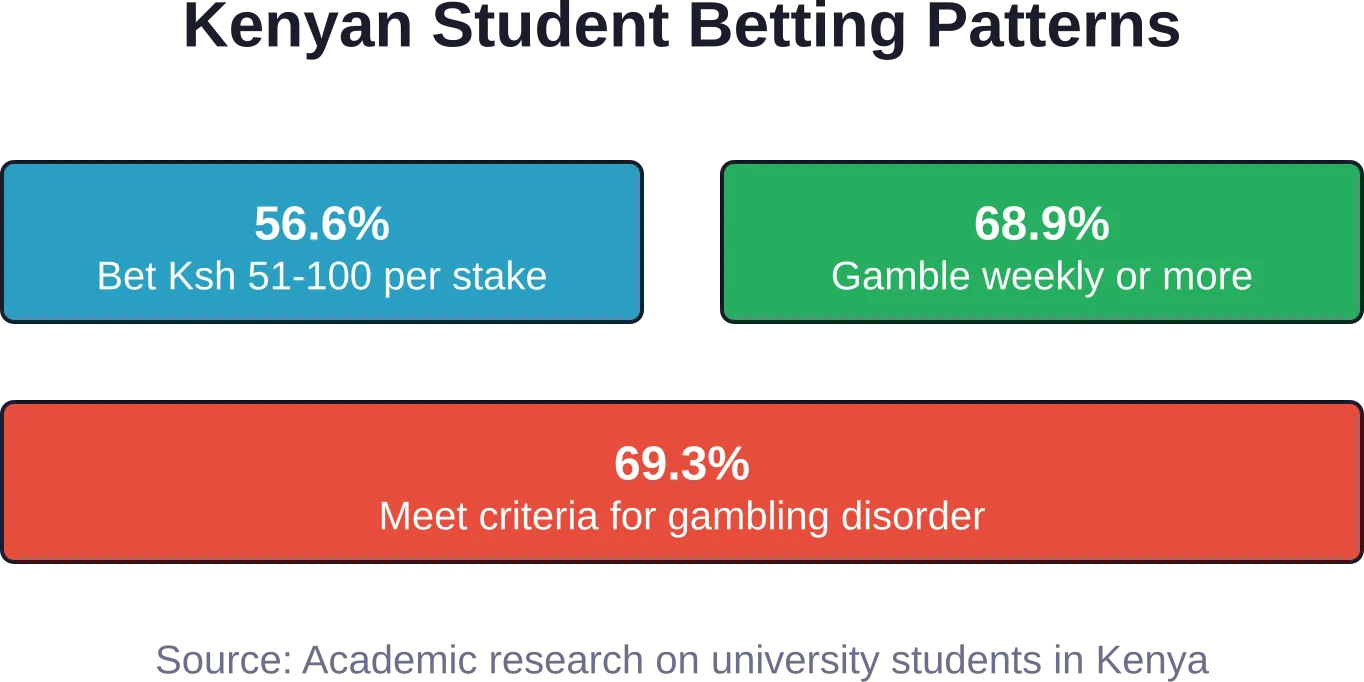
According to academic research on betting patterns, specific stake size distributions have been documented among university student populations. These small-stake, high-frequency bets drive volume for operators.
The frequency matters more than individual stake size. With 68.9% of participants gambling more than once a week, the cumulative volume adds up fast. Multiply modest daily bets across millions of active users, and the market scale becomes clear.
Market Growth and Global Context
Kenya’s gambling boom mirrors global trends. The online gambling market worldwide was valued at USD 78.66 billion in 2024, projected to reach USD 153.57 billion by 2030, growing at a CAGR of 11.9% from 2025 to 2030.
Sports betting dominates globally, accounting for over 50% of online gambling revenue in 2024. Mobile devices increasingly drive access, though desktop usage still maintains significant share in certain markets.
Africa’s gambling industry continues expanding rapidly, driven by digital adoption and young demographics. Kenya sits at the forefront of this growth, alongside Nigeria and South Africa.
Real talk: the regulatory environment remains critical. Kenya has tightened oversight in recent years, balancing revenue generation against social concerns about gambling addiction.
The Business Model Behind the Billions
So how do betting companies turn those stakes into sustainable profits? The model relies on mathematical advantage.
Bookmakers set odds that embed a margin. If true probability suggests a 50% chance for each outcome, the bookmaker might offer odds that imply 52% and 53% probabilities respectively. That extra percentage represents the house edge, guaranteeing profit across enough bets.
Volume amplifies this edge. With thousands of bets daily across multiple events, short-term variance evens out. The mathematical advantage ensures profitability over time, assuming proper risk management.
Operational efficiency determines net margins. Firms that minimize costs while maximizing bet volume generate the highest returns. Marketing spend remains substantial, as customer acquisition and retention drive the business.
Frequently Asked Questions
How much profit do betting companies make in Kenya?
Betting firms generate gross revenue of approximately 5-15% of total stakes after paying winners, translating to billions of shillings annually across the industry. Net profit margins after operational costs and taxes vary depending on scale and efficiency.
Do betting companies pay taxes in Kenya?
Yes. Betting companies must withhold 5% tax on all withdrawals paid to gamblers, plus pay corporate income tax at 30% on net profits, excise duties on gross gaming revenue, and annual licensing fees to regulatory authorities.
How much do Kenyans spend on betting annually?
Kenyans staked over Sh88.5 billion through online bets in the year ending June 2023. The market continues growing, with estimates suggesting spending exceeds Sh200 billion when including all betting channels and forms of gambling.
What is the biggest betting company in Kenya?
Market leaders process the highest transaction volumes and command the largest market shares, though specific rankings fluctuate. Major operators handle billions in monthly stakes and maintain extensive marketing presence across the country.
Are betting winnings taxed in Kenya?
The Kenya Revenue Authority requires betting firms to withhold 5% tax from all withdrawals before payout. Winners receive 95% of their gross withdrawals, with the 5% remitted directly to KRA by the betting company.
What percentage of stakes do betting companies keep?
Betting operators typically return 85-95% of stakes to winners as payouts, retaining 5-15% as gross gaming revenue. The exact percentage varies by operator, bet type, and competition level in different market segments.
The Future of Betting Revenue in Kenya
Where does the industry go from here? Growth appears likely despite regulatory headwinds.
Mobile money integration continues driving accessibility. M-Pesa and similar platforms eliminated payment friction, enabling instant deposits and withdrawals. This convenience fuels participation across demographic groups.
But wait. Social costs are mounting. The prevalence of gambling disorder among students, with 69.3% meeting diagnostic criteria, signals serious public health concerns. Regulatory pressure will likely intensify as awareness grows.
Taxation policy remains fluid. Governments worldwide are reassessing gambling taxes as revenue needs increase. Kenya may adjust rates or introduce new levy structures, directly impacting operator profitability.
Market consolidation seems probable. Smaller operators struggle with compliance costs and marketing expenses. Larger firms with economies of scale will likely absorb market share, concentrating revenue among fewer players.
Technology evolution presents opportunities and challenges. Live betting, esports wagering, and virtual sports expand product offerings. Each innovation requires investment but opens new revenue streams.
The global online gambling market’s projected growth to USD 153.57 billion by 2030 suggests Kenya’s sector will continue expanding, barring dramatic regulatory intervention. The country’s young, mobile-savvy population provides a ready customer base.
Still, sustainability questions persist. Can the market grow indefinitely? Or will saturation, regulation, and social backlash eventually cap expansion? The next few years will reveal which trajectory Kenya’s betting industry follows.
Betting companies in Kenya generate substantial revenue, measured in billions of shillings annually. The exact figures depend on market conditions, regulatory environment, and operational efficiency. What’s certain: the industry has grown from niche activity to major economic force, with all the complexity that entails.
Understanding these earnings requires looking beyond headline stake figures to the margins, taxes, and business models that determine actual profitability. As the market matures, transparency around these numbers will become increasingly important for policy decisions and public discourse.
Related Articles

September 30, 2026Is Sports Betting Legal in Brazil? The Full...

September 30, 2026Is Sports Betting Legal in Iran? The Real...