 Nothing found for the request
Licensed Betting Sites in Kenya: 2026 Complete Guide
Sologe June 8, 2026
Share:


Quick Summary
Quick Summary: Licensed betting sites in Kenya operate under the authority of the Betting Control and Licensing Board (BCLB), established in 1966. As of 2026, the regulatory framework requires operators to maintain valid licenses, comply with taxation rules (5% excise tax on stake and 5% withholding tax on withdrawals), and adhere to strict compliance standards. Only BCLB-licensed bookmakers can legally offer sports betting and gaming services to Kenyan residents.
Sports betting has exploded in Kenya over the past decade, transforming from a niche activity into a mainstream entertainment option for millions. But here’s the thing—not every betting site operating in the country is actually legal.
The difference between licensed and unlicensed operators isn’t just paperwork. Licensed betting sites in Kenya offer consumer protections, guaranteed payouts, and regulatory oversight that unlicensed platforms simply can’t match.
This guide breaks down everything about licensed betting sites in Kenya: who regulates them, how to identify legitimate operators, what taxes apply, and which bookmakers hold valid licenses in 2026.
Understanding Kenya's Betting Regulatory Framework
Kenya’s gambling industry operates under a structured legal framework that dates back decades. The Betting Control and Licensing Board (BCLB) serves as the primary regulatory authority, established through an Act of Parliament (Chapter 131 Laws of Kenya) in 1966.
The BCLB governs the authorization of lotteries, prize competitions, and all betting activities across Kenya. Located at ACK Garden Annex, 1St Ngong Ave in Nairobi, this government body ensures operators meet strict standards before they can legally accept bets from Kenyan residents.
The Role of the Betting Control and Licensing Board
Real talk: the BCLB doesn’t just hand out licenses like candy. The board evaluates applications based on financial stability, operational capability, consumer protection measures, and compliance infrastructure.
According to Wikipedia, the BCLB governs the authorization of lotteries and prize competitions as well as eradication of illegal gambling activities in Kenya. The board conducts regular audits, investigates complaints, and has the authority to suspend or revoke licenses when operators fail to meet regulatory standards.
The legal foundation rests on the Betting, Lotteries and Gaming Act (Chapter 131 of the Laws of Kenya), established in 1966. These legal precedents shape how the BCLB enforces regulations and resolves disputes between operators, consumers, and the government.
Recent Regulatory Changes and Market Evolution
Kenya’s betting market experienced significant regulatory shifts between 2024 and 2025. Research from Altenar highlights how taxation became a key lever for market control, with authorities using tax policy to shape operator behavior and generate government revenue.
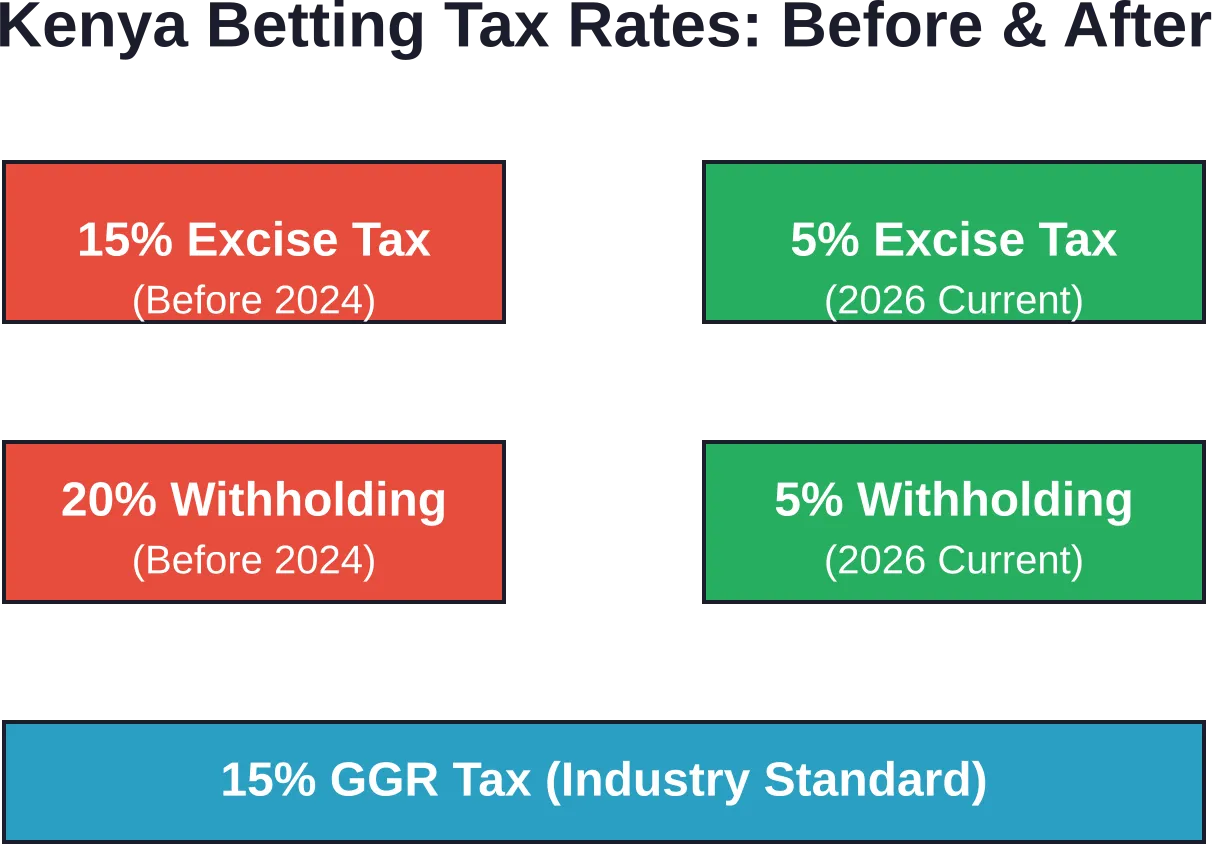
The most notable change? Tax rates dropped substantially. The Finance Act 2025 introduced a structural shift to a wallet-flow taxation model, setting a 5% excise duty on deposits and a 5% tax rate on every withdrawal made on a betting wallet, replacing the previous 15% excise duty on stakes and 20% withholding tax on net winnings. These reductions made Kenya’s betting market considerably more attractive for both operators and bettors.
But taxation isn’t the only moving piece. The Finance Act 2025 introduced provisions for taxing deposits and withdrawals in certain circumstances, while maintaining a 15% tax on Gross Gaming Revenue (GGR) as an industry benchmark, according to Altenar’s regulatory analysis.
How to Identify Licensed Betting Sites in Kenya
So how do bettors separate legitimate operators from unlicensed platforms? The answer lies in verification.
Every licensed betting site in Kenya must display its BCLB license number prominently on its website—typically in the footer or on a dedicated “About Us” or “License” page. This isn’t optional; it’s a regulatory requirement.
Verification Steps for Bettors
Look, verifying a betting site’s license takes less than two minutes. Here’s how:
- Check the website footer for a BCLB license number
- Visit the official BCLB website (bclb.go.ke) to verify active licenses
- Look for physical address details and contact information in Kenya
- Verify the operator appears on reputable betting site directories that list licensed bookmakers
- Check whether the site uses Kenyan payment methods like M-Pesa, which licensed operators typically support
According to data from top100bookmakers.com, Kenya generates approximately 3,221,000 total visits to online bookmakers. That’s a massive market, which unfortunately attracts both legitimate operators and unlicensed platforms trying to capitalize on demand.
Red Flags That Indicate Unlicensed Operations
Some warning signs scream “unlicensed operator.” Missing or vague license information tops the list. If a betting site doesn’t clearly display a BCLB license number, that’s your first red flag.
Other concerning indicators include:
- No physical address or contact details in Kenya
- Payment processing through obscure or international-only methods
- Promotional materials that seem too good to be true
- Poor website quality with grammatical errors and broken links
- Absence from reputable betting site directories and review platforms
The government has taken direct action against unlicensed operators. Reports indicate authorities have listed and suspended websites of illicit betting companies operating without proper authorization.
Top Licensed Betting Sites Operating in Kenya (2026)
The Kenyan market hosts dozens of licensed bookmakers, but not all deliver the same quality of service. Data from multiple sources reveals which operators dominate the market and why bettors prefer them.
Bookmaker | Welcome Bonus | Sports Offered | Key Feature |
|---|---|---|---|
22Bet Kenya | KSh 19,000 | 45+ sports | Extensive market coverage |
Betwinner Kenya | Competitive offer | 45+ sports | High odds across markets |
Megapari | 130% up to 31,400 KES | 40+ sports | Generous bonus structure |
BetAndYou | 100% up to 13,000 KES | 35+ sports | User-friendly interface |
1xBet | 200% up to 20,000 KES | 40+ sports | Live streaming options |
According to data from top competitor sources, the BCLB licenses major operators including 10Bet Kenya, 22Bet Kenya, Bangbet Kenya, Bet254 Kenya, BETAFRIQ Kenya, BetBureau Kenya, and Betika Kenya, among others.
What Makes These Operators Stand Out
Licensed betting sites in Kenya compete on several dimensions: bonus offers, sports coverage, odds competitiveness, payment options, and mobile app quality.
22Bet Kenya offers coverage across 45+ sports according to multiple source listings. That’s exceptional breadth, covering everything from football and basketball to niche sports like table tennis and esports.
Betwinner Kenya also offers extensive sports coverage, positioning itself as another comprehensive option for Kenyan bettors who want variety beyond mainstream football betting.
But here’s where it gets interesting: bonus structures vary wildly. Megapari’s 130% bonus up to 31,400 KES represents one of the more generous offers in the market. Meanwhile, operators like BetAndYou focus on simpler 100% match bonuses with lower maximums.
Mobile Betting and Payment Integration
Mobile betting dominates Kenya’s market. Most licensed operators offer dedicated Android and iOS apps, though the quality varies significantly.
Payment integration matters enormously in the Kenyan context. M-Pesa integration isn’t optional—it’s essential. Licensed betting sites that don’t support M-Pesa deposits and withdrawals struggle to compete, since mobile money dominates financial transactions across Kenya.
Other payment methods commonly supported by licensed operators include Airtel Money, bank transfers, and card payments. But M-Pesa remains the primary method for the vast majority of Kenyan bettors.
Licensing Requirements and Compliance Standards
What does it actually take to secure a betting license in Kenya? The process involves substantial financial investment, operational infrastructure, and ongoing compliance obligations.
According to Altenar’s regulatory analysis, Kenya introduced tougher licensing rules. Industry sources reference $750k security fees for certain licensing categories as authorities seek to ensure only serious, well-capitalized operators enter the market.
Financial and Operational Requirements
The BCLB evaluates applicants across multiple dimensions. Financial stability tops the list—operators must demonstrate sufficient capital reserves to cover potential liabilities and ensure they can pay out winnings even during periods of high bettor success.
Operational infrastructure requirements include:
- Secure betting platforms with proven technology
- Customer service capabilities, including Kenyan-based support
- Responsible gambling measures and self-exclusion tools
- Anti-money laundering (AML) protocols
- Age verification systems to prevent underage gambling
- Data protection and privacy compliance
The BCLB doesn’t issue licenses and forget about operators. Regular audits ensure ongoing compliance. Operators must submit financial reports, undergo system security assessments, and demonstrate continued adherence to responsible gambling standards.
Taxation and Revenue Requirements
Licensed operators in Kenya face a multi-layered taxation structure. The 5% excise duty applies to deposits made into the betting wallet, while the 5% tax gets deducted from all withdrawals from the wallet, regardless of whether individual bets were successful.
Additionally, the 15% tax on Gross Gaming Revenue represents the operator’s own tax burden—separate from the taxes paid by bettors. This three-tier taxation approach generates substantial government revenue while remaining competitive compared to some neighboring markets.
The Finance Act 2025 introduced provisions for taxing deposits and withdrawals in certain circumstances, though implementation details continue to evolve. Operators must maintain robust accounting systems to accurately calculate and remit these various tax obligations.
Compare Licensed Market Vendors With Sologe

Licensed betting sites in Kenya are only the visible part of the wider business ecosystem. Sologe helps iGaming companies look at the suppliers behind regulated operators. The marketplace includes business-side categories such as gaming software, sportsbook platforms, payment solutions, analytics tools, traffic services, affiliate systems, licensing-related providers, and operational support.
With Sologe, businesses can:
- explore vendor categories around licensed betting operations
- find platform, payment, and analytics providers
- review companies before making contact
- understand what supplier types usually support operators
- present their own services to iGaming companies
👉Contact Sologe to explore vendors around licensed iGaming markets or add your company to the marketplace.
Consumer Protection and Responsible Gambling
Here’s why licensing matters beyond just legality: consumer protection. Licensed betting sites in Kenya operate under regulatory oversight that protects bettors in ways unlicensed platforms simply can’t match.
Dispute Resolution Mechanisms
When disputes arise between bettors and licensed operators, the BCLB provides a formal resolution mechanism. Bettors can file complaints with the board, which investigates and can compel operators to take corrective action.
Court cases documented at new.kenyalaw.org demonstrate this oversight in action. Cases like “Republic v Betting Control and Licensing Board & another” and “Pevans East Africa Limited v Betting Control & Licensing Board & 2 others” show how disputes escalate through Kenya’s legal system when necessary.
Unlicensed operators offer no such recourse. Bettors who experience problems with unlicensed sites have limited options for recovery, since these platforms operate outside Kenya’s legal framework.
Responsible Gambling Tools
Licensed operators must implement responsible gambling measures. These typically include:
- Deposit limits that bettors can set themselves
- Self-exclusion options for problem gamblers
- Time-out features that temporarily suspend accounts
- Reality checks that alert bettors about time spent gambling
- Links to problem gambling support resources
The BCLB mandates these protections as licensing conditions. Operators that fail to maintain adequate responsible gambling measures risk license suspension or revocation.
Sports Coverage and Betting Markets
Football dominates Kenya’s betting market, but licensed operators offer far more variety. Understanding the breadth of sports coverage helps bettors choose platforms that match their interests.
Most Popular Sports for Betting in Kenya
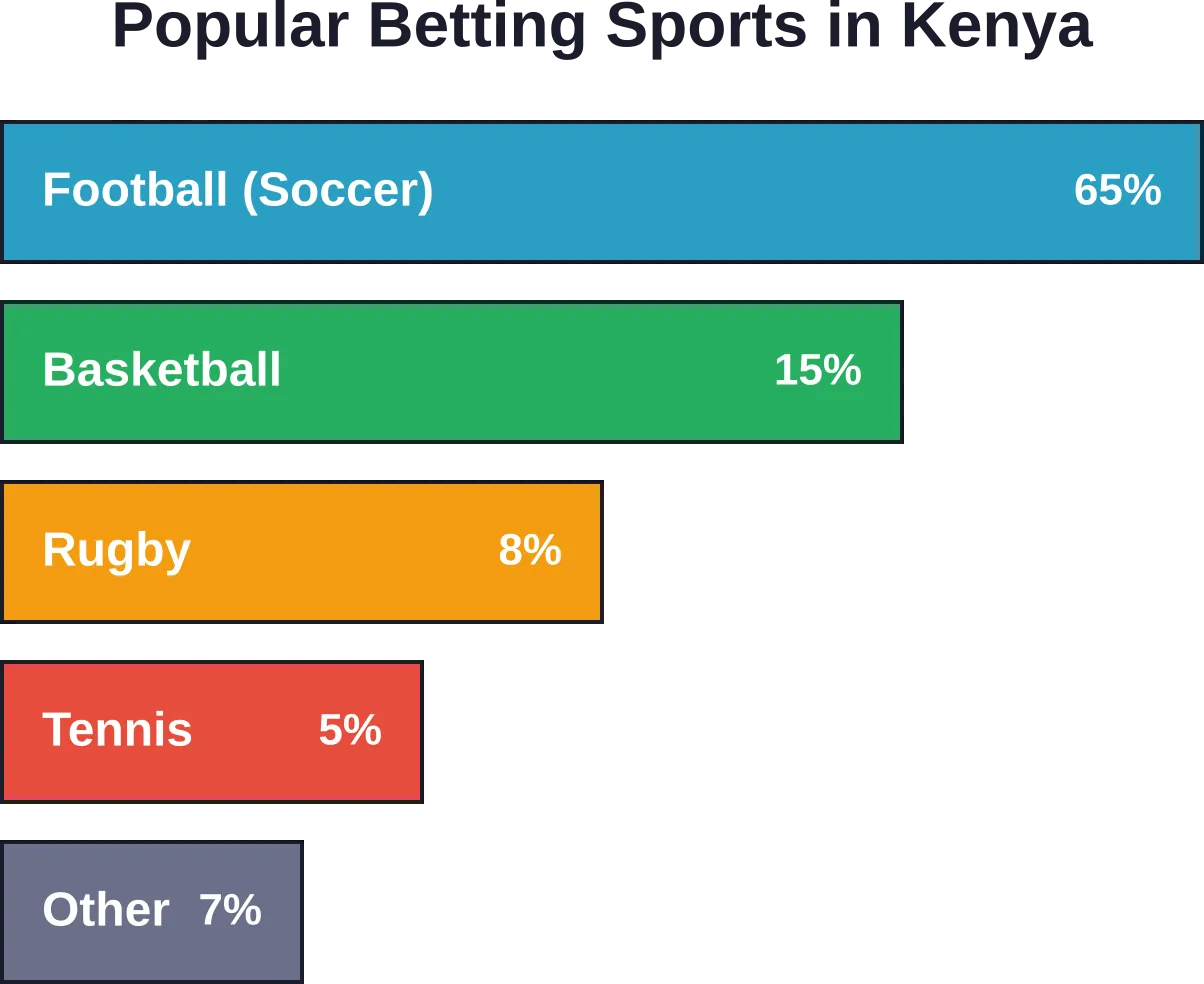
Football (soccer) accounts for the majority of betting volume in Kenya. English Premier League, Spanish La Liga, Italian Serie A, and German Bundesliga matches attract enormous betting interest, alongside Kenyan Premier League fixtures.
Basketball ranks second in popularity, particularly NBA games. The global reach of basketball combined with frequent matches makes it attractive for live betting enthusiasts.
Other popular sports include:
- Rugby: Both international tests and domestic leagues
- Cricket: Especially when Kenya competes or during major tournaments
- Tennis: Grand Slams and ATP/WTA events
- Athletics: Given Kenya’s dominance in distance running
- Esports: Growing rapidly among younger bettors
Licensed operators like 22Bet Kenya and Betwinner Kenya offer 45+ sports according to verified data from betblazers.com. That comprehensive coverage includes niche options like table tennis, darts, handball, and virtual sports.
Live Betting and Streaming
Live betting has transformed the Kenyan market. Most licensed operators now offer in-play betting with odds that update in real-time as matches progress.
Some operators provide live streaming alongside live betting options, though this feature varies by license agreements and broadcasting rights. 1xBet, for instance, positions live streaming as a key differentiator in the Kenyan market.
Bonus Offers and Promotional Terms
Welcome bonuses attract new customers, but the terms matter more than the headline numbers. Licensed betting sites in Kenya compete aggressively on bonus offers, yet the conditions attached determine actual value.
Understanding Bonus Structures
Most Kenyan bookmakers offer deposit match bonuses for new customers. A 100% match bonus up to KSh 10,000 means the operator matches the first deposit up to that amount—deposit KSh 10,000, receive KSh 10,000 in bonus funds.
But here’s the catch: bonus funds typically come with wagering requirements. A common requirement might be “10x bonus amount at minimum odds of 1.50.” That means bettors must wager the bonus amount ten times over on bets with odds of at least 1.50 before they can withdraw winnings derived from bonus funds.
The bonus comparison from earlier shows the range:
- Megapari: 130% up to 31,400 KES
- 1xBet: 200% up to 20,000 KES
- BetAndYou: 100% up to 13,000 KES
- 22Bet Kenya: KSh 19,000 welcome bonus
That 200% bonus from 1xBet sounds fantastic, but always check the turnover requirements. Higher percentage bonuses often come with stricter wagering conditions.
Ongoing Promotions and Loyalty Programs
Licensed operators don’t just focus on welcome bonuses. Ongoing promotions keep existing customers engaged through:
- Reload bonuses for subsequent deposits
- Free bets for specific matches or tournaments
- Odds boosts on selected markets
- Cashback offers that refund a percentage of losses
- Loyalty programs that reward regular betting activity
According to data from competitor sources, operators like Playabet focus on regular odds boosts as a promotional strategy, differentiating themselves through enhanced odds rather than massive bonus amounts.
Security and Data Protection
Licensed betting sites in Kenya must implement robust security measures. The BCLB mandates minimum security standards, but leading operators typically exceed these requirements.
Financial Security Measures
Payment security matters enormously when real money changes hands. Licensed operators employ SSL encryption (minimum 128-bit, often 256-bit) to protect financial transactions and personal data during transmission.
Segregated accounts represent another critical protection. Licensed operators must maintain customer funds in separate accounts from operational funds, ensuring that customer balances remain protected even if the operator faces financial difficulties.
Personal Data Protection
Kenya’s data protection regulations require licensed betting sites to implement proper data handling procedures. This includes:
- Clear privacy policies explaining data collection and use
- Secure storage of personal information
- Limited data retention periods
- User rights to access, correct, or delete personal data
- Restrictions on third-party data sharing
The BCLB can audit operators’ data protection measures as part of license compliance reviews. Operators that fail to protect customer data adequately face penalties including potential license revocation.
The Future of Licensed Betting in Kenya
Kenya’s betting market continues evolving. Regulatory changes, technological advancement, and shifting consumer preferences shape where the industry heads next.
Regulatory Trends to Watch
The 2024-2025 transition period, highlighted in Altenar’s analysis, demonstrated how quickly regulations can shift. The tax reductions that brought excise tax down to 5% and withholding tax down to 5% made Kenya more competitive regionally.
But wait. The Finance Act 2025’s provisions around taxing deposits and withdrawals suggest authorities continue searching for the optimal taxation balance—maximizing government revenue without driving operators offshore or underground.
Compliance requirements will likely tighten further. The introduction of substantial security fees indicates the BCLB’s intent to raise barriers to entry, potentially consolidating the market around fewer, better-capitalized operators.
Technological Innovation
Mobile-first betting dominates Kenya’s market and will only intensify. The proliferation of smartphones combined with improving mobile internet coverage enables betting access across urban and rural areas.
Cash-out features, allowing bettors to settle bets before events conclude, have become standard among licensed operators. Partial cash-out—settling part of a bet while leaving the rest to run—represents the next evolution.
Cryptocurrency integration remains limited in Kenya’s licensed market, though some international operators accepted into other African markets offer crypto options. Whether the BCLB will permit crypto betting depends on broader regulatory developments around digital currencies in Kenya.
Frequently Asked Questions
How can I verify if a betting site is licensed in Kenya?
Check the website footer or license page for a BCLB license number, then verify it through the official BCLB website at bclb.go.ke. Licensed operators must display their license information prominently. Cross-reference the operator’s name against reputable betting site directories that list licensed bookmakers. If license information is absent or vague, treat it as a red flag.
What taxes apply to betting winnings in Kenya?
As of 2026, Kenyan bettors pay a 5% excise tax on each stake placed and a 5% withholding tax on all withdrawals. These rates represent significant reductions from previous levels of 15% and 20% respectively. Licensed operators automatically deduct these taxes, so the payout bettors receive already reflects the tax deductions. Operators also pay a 15% tax on Gross Gaming Revenue separately.
Can I bet legally from anywhere in Kenya?
Licensed betting sites operate legally throughout Kenya, though bettors must be 18 years or older. The BCLB’s jurisdiction covers the entire country, and licensed operators can legally accept bets from any location within Kenya. Mobile betting via M-Pesa and other payment methods makes betting accessible across urban and rural areas, provided internet connectivity exists.
What happens if a licensed betting site refuses to pay winnings?
File a complaint with the Betting Control and Licensing Board, which investigates disputes between bettors and licensed operators. The BCLB has authority to compel operators to honor valid winning bets. Document all evidence including bet slips, account statements, and communication with the operator. Licensed operators maintain dispute resolution procedures as a licensing requirement, and most issues get resolved through these channels.
Do licensed betting sites in Kenya offer live betting?
Most licensed operators in Kenya offer in-play or live betting with odds that update in real-time during matches. Football, basketball, and tennis particularly suit live betting given their continuous action and frequent betting opportunities. Some operators like 1xBet also provide live streaming alongside live betting options, though streaming availability varies based on broadcasting rights and the specific matches.
Which payment methods do licensed betting sites accept?
M-Pesa dominates payment methods for licensed betting sites in Kenya, with nearly all operators supporting both deposits and withdrawals via mobile money. Other common options include Airtel Money, bank transfers, and debit/credit cards. Deposit minimums typically start around KSh 50-100, while withdrawal times vary from instant (for M-Pesa) to 1-3 business days for bank transfers.
Are betting bonuses taxed in Kenya?
Bonus funds themselves aren’t taxed separately, but winnings derived from bonus bets face the same 5% withholding tax as regular withdrawals. The 5% excise tax applies to stakes placed with bonus funds. Licensed operators handle these tax calculations automatically, deducting the appropriate amounts before crediting winnings to customer accounts.
Conclusion
Licensed betting sites in Kenya operate under structured regulatory oversight that protects bettors and ensures fair play. The Betting Control and Licensing Board has maintained this oversight since 1966, adapting regulations to match market evolution and technological change.
The 2026 Kenyan betting landscape offers bettors unprecedented choice among licensed operators. Tax reductions—bringing excise tax down to 5% and withholding tax down to 5%—make the market more attractive for both operators and bettors compared to previous years.
But choice means responsibility. Verifying a betting site’s license takes minutes and protects against the genuine risks posed by unlicensed operators. Check for BCLB license numbers, verify through official channels, and stick with established operators that demonstrate compliance with Kenya’s regulatory framework.
The best licensed betting site depends on individual priorities. Some bettors prioritize sports coverage breadth, others focus on competitive odds, and many emphasize mobile experience and M-Pesa integration. The common thread? Valid BCLB licensing that ensures regulatory oversight, consumer protection, and legitimate dispute resolution mechanisms.
Ready to start betting? Choose a licensed operator from those listed in this guide, verify their current BCLB license status, and review bonus terms carefully before depositing. Bet responsibly, set deposit limits, and remember that betting should be entertainment, not a financial strategy.
Related Articles
September 30, 2026Is Sports Betting Legal in Brazil? The Full...

September 30, 2026Is Sports Betting Legal in Iran? The Real...