 Nothing found for the request

How Profitable Is Sports Betting Business in Nigeria 2026
Sologe June 8, 2026
Share:


Quick Summary
Quick Summary: The sports betting business in Nigeria is highly profitable, with the market generating an estimated $3.86 billion in online gambling revenue in 2025 and projected to grow through 2028. The industry benefits from massive youth participation (over 60 million Nigerians engage in betting), rising mobile penetration, and relatively low regulatory barriers, though profitability depends heavily on operational efficiency, player retention, and navigating licensing requirements.
Nigeria’s sports betting industry has exploded over the past decade, transforming from a niche activity into a multi-billion-dollar market that’s catching the attention of local entrepreneurs and international operators alike. The numbers tell a compelling story: an estimated $3.86 billion in online gambling revenue in 2025, with over 60 million Nigerians—predominantly young people—actively participating in betting activities.
But here’s the question that matters most: Is the sports betting business actually profitable in Nigeria? And if so, what kind of margins can operators expect?
This comprehensive analysis breaks down the profitability landscape of Nigeria’s sports betting sector, examining revenue streams, operational costs, market dynamics, and the real numbers behind what makes this industry tick. Whether you’re considering launching a betting platform or simply curious about the economics, this guide provides the data-driven insights you need.
Nigeria's Sports Betting Market: The Revenue Picture
The Nigerian betting market sits at the heart of Africa’s gambling boom. According to verified data, Africa’s total gambling market reached $6.1 billion in revenue in 2024, with projections indicating growth through 2028. The online gambling sector is projected to grow at approximately 6.3% annually from 2024 to 2028, reaching about $2.36 billion by 2028.
Nigeria commands a substantial share of this continental market. The country’s online gambling revenue alone reached approximately $3.86 billion in 2025, positioning it as one of Africa’s largest gambling markets alongside South Africa.
The African online gambling market reached about $1.85 billion in 2024. While offline gambling still dominates—accounting for 58% of Africa’s $6.1 billion market in 2024—the rapid shift toward online platforms is reshaping profitability dynamics.
Here’s what’s driving the surge: Nigeria’s population skews young, with over 60 million people engaged in betting activities. Industry reports from 2018 showed the sector generated over $58 million annually, with some estimates suggesting the total market approaches 730 billion Naira when informal betting is included. That was 2018. The market has since multiplied several times over.
Why Nigeria Stands Out in the African Market
Several factors make Nigeria particularly attractive for sports betting operations:
- Massive youth population with high unemployment rates driving alternative income pursuits
- Widespread smartphone adoption and improving internet infrastructure
- Cultural enthusiasm for football and other international sports
- Relatively permissive regulatory environment compared to some African nations
- Growing middle class with disposable income
Industry reports indicate Nigeria’s sports betting industry involves over 60 million current participants, with potential for substantial growth as the market matures. The demographic composition is heavily male—approximately 70% of players are men—though female participation is gradually increasing.
Profitability Fundamentals: How Betting Operators Make Money
Understanding profitability requires grasping the core revenue mechanics of sports betting operations. The business model revolves around a few key metrics that determine whether an operator thrives or struggles.
Key Revenue Metrics Explained
The sports betting industry uses specific terminology to measure financial performance:
Metric | Definition | Industry Importance |
|---|---|---|
Handle | Total amount wagered by all players over a period | Measures market activity and scale |
Gross Gaming Revenue (GGR) | Total wagers minus winnings paid to players | Primary revenue metric before costs |
Net Gaming Revenue (NGR) | GGR minus bonuses, promotions, and free bets | Actual revenue available for operations |
Hold Percentage | GGR divided by Handle (typically 5-15%) | Efficiency of odds-setting and margins |
Here’s how this works in practice: If a Nigerian betting operator processes 1 billion Naira in total bets (the Handle) in a month, and pays out 900 million Naira in winnings, the GGR is 100 million Naira—a 10% hold. That’s before accounting for bonuses offered to attract players.
If that same operator gave out 20 million Naira in promotional bonuses and free bets, the NGR drops to 80 million Naira. This is the actual revenue from which operating costs—software, licensing, staff, marketing, payment processing—must be covered.
Typical Profit Margins in Nigerian Sports Betting
Real talk: profit margins in sports betting vary wildly depending on operational efficiency, market positioning, and scale.
Industry analyses suggest that well-run betting operations typically maintain gross profit margins (before marketing and acquisition costs) between 15% and 30% of GGR. The net profit margin—what’s left after all expenses—generally falls between 5% and 15% for established operators.
Smaller operators often struggle in the early years, sometimes operating at break-even or slight losses while building a player base. The economics improve dramatically with scale: a platform with 100,000 active monthly users has fundamentally better unit economics than one with 10,000 users.
Marketing costs represent the biggest variable expense. In Nigeria’s competitive market, customer acquisition costs can consume 40-60% of first-year player value. Retention becomes crucial—operators need players to remain active for 18-24 months to achieve profitability on acquisition spending.
The Cost Structure: What It Takes to Run a Betting Business
Profitability isn’t just about revenue. Understanding the cost side is equally critical for anyone evaluating the business opportunity.
Initial Setup Costs
Starting a sports betting operation in Nigeria requires significant upfront investment across several categories:
- Licensing and legal compliance: Securing proper licensing from state regulators can range from 5 million to 50 million Naira depending on jurisdiction and business structure
- Betting software platform: This is the largest technical expense, with options ranging from white-label solutions to custom builds
- Payment integration: Setting up banking relationships and payment gateways for deposits and withdrawals
- Initial marketing and branding: Launch campaigns, brand development, and initial customer acquisition
- Working capital: Reserve funds to cover player winnings during negative variance periods
According to industry guidance, total startup costs for a competitive betting operation typically range from $50,000 to $500,000 USD, depending on ambition and approach. White-label solutions sit at the lower end; fully custom platforms with advanced features push toward the higher range.
Ongoing Operating Expenses
Monthly operational costs determine whether early revenue translates to profitability:
Expense Category | Typical Monthly Cost Range | Notes |
|---|---|---|
Software/platform fees | $5,000 – $50,000 | Varies by model (white-label vs. custom) |
Odds data feeds | $2,000 – $15,000 | Essential for competitive odds |
Payment processing | 3-7% of transaction volume | Depends on payment methods used |
Marketing and acquisition | $10,000 – $100,000+ | Highly variable, scales with growth |
Customer support | $2,000 – $10,000 | Staff costs for support team |
Hosting and infrastructure | $1,000 – $5,000 | Servers, security, maintenance |
The key insight? Fixed costs remain relatively stable while revenue scales with player activity. This creates leverage: once an operator covers fixed expenses, additional revenue flows more directly to profit.
White-Label vs. Custom Solutions: Impact on Profitability
The software approach significantly impacts both startup costs and long-term profitability. Operators face a fundamental choice between speed-to-market and customization.
White-Label Solutions
White-label platforms allow operators to launch under their own brand using pre-built betting software. The provider handles technical infrastructure, updates, and often odds feeds.
Pros:
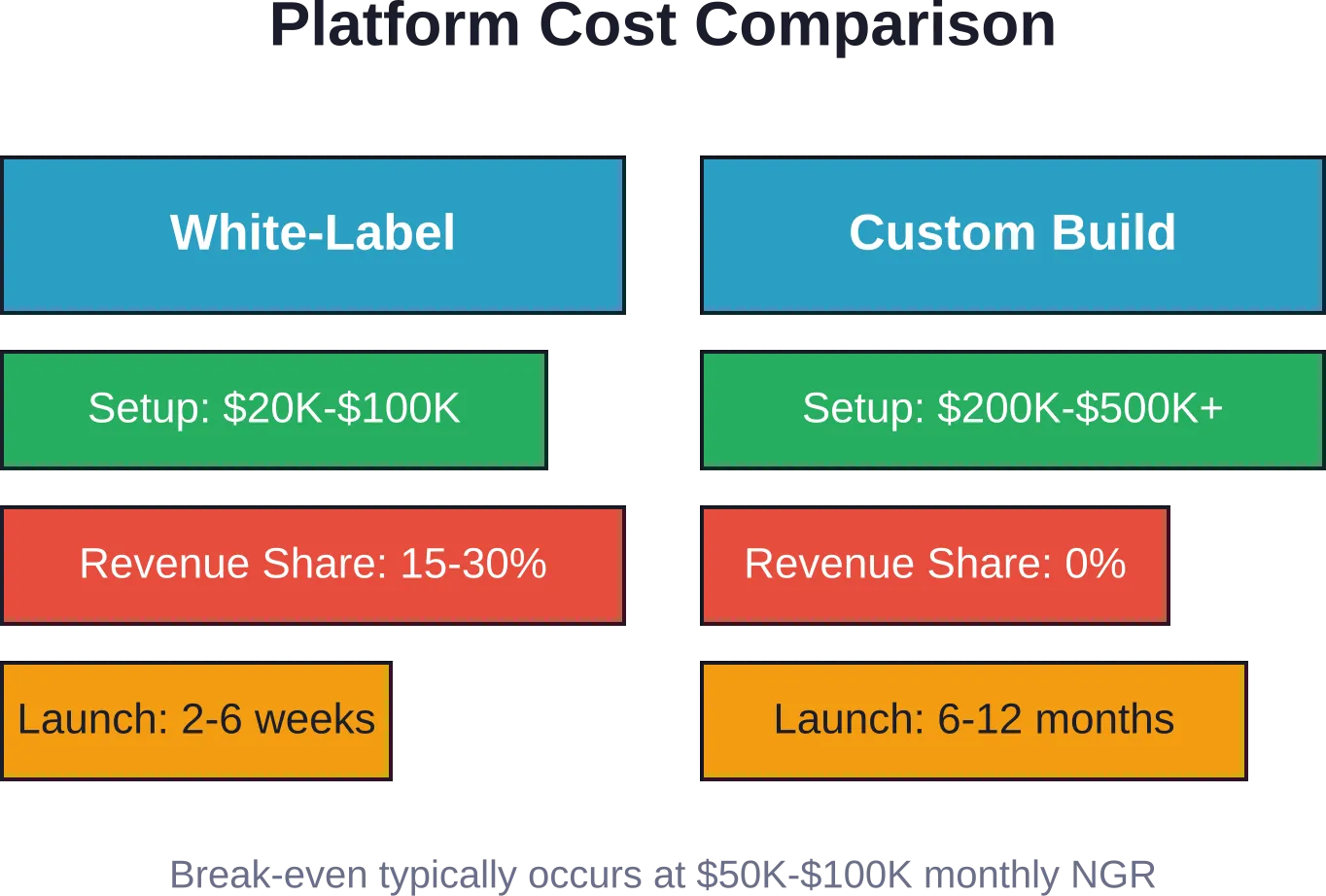
- Launch within weeks instead of months
- Lower upfront investment ($20,000-$100,000 typical)
- Provider handles technical maintenance and updates
- Proven platform reduces technical risk
Cons:
- Monthly revenue share (typically 15-30% of NGR)
- Limited differentiation—same platform as competitors
- Less control over features and user experience
- Potentially higher long-term costs at scale
For many Nigerian operators, white-label solutions represent the fastest path to market entry. The revenue share (typically 15-30% of NGR) impacts long-term profitability but eliminates technical complexity and reduces initial risk.
Custom Development
Building a proprietary platform from scratch offers maximum control but demands significantly higher investment and technical expertise.
Pros:
- Complete control over features and user experience
- Unique differentiation from competitors
- No ongoing revenue share payments
- Ability to optimize for specific market needs
Cons:
- High upfront cost ($200,000-$500,000+)
- 6-12 months development timeline
- Requires ongoing technical team
- Higher technical and execution risk
Custom solutions make most sense for well-capitalized operators planning significant scale or those with unique market positioning requiring specialized features.
Revenue Streams Beyond Sports Betting
The most profitable Nigerian betting operators don’t rely solely on sports wagering. Diversification enhances revenue stability and customer lifetime value.
Virtual Sports
Computer-generated sports simulations running 24/7 provide consistent action even when live sports aren’t in season. Virtual football, horse racing, and dog racing appeal to players seeking instant results. These games typically offer higher operator margins than traditional sports betting—often 20-30% GGR—because the operator controls the game mechanics.
Casino Games
Online slots, table games, and live dealer casino games generate substantial revenue in markets where permitted. Casino games typically produce higher GGR percentages than sports betting—frequently 3-7% of wagers compared to sports betting’s 5-15%—though the dynamics differ.
Lottery and Numbers Games
Traditional lottery-style games remain popular in Nigeria, particularly among older demographics. These games require minimal operational overhead once integrated and can attract players who might not engage with sports betting.
Affiliate and Partnership Revenue
Established platforms generate additional income by promoting complementary services or partnering with other gaming operators. These partnerships typically operate on revenue-share or CPA (cost per acquisition) models.
Data from broader gambling market analysis shows that diversified operators achieve 20-35% higher revenue per customer than single-product platforms. The key is matching product mix to customer preferences without diluting focus.
The Competitive Landscape: Market Leaders and Dynamics
Nigeria’s betting market features intense competition among domestic operators and international brands. Understanding competitive dynamics is essential for evaluating profit potential.
Major Players
Several operators dominate market share and brand recognition. Bet9ja, established as one of Nigeria’s pioneering legal betting platforms, commands significant market presence. NairaBet, another early mover, built strong brand loyalty among Nigerian bettors.
International operators including 1xBet, Betway, and 22Bet have entered the market aggressively, bringing significant marketing budgets and advanced platform features. These foreign entrants have intensified competition, particularly in urban markets where internet penetration is highest.
Market Fragmentation
Despite the presence of major brands, Nigeria’s betting market remains relatively fragmented. Dozens of smaller operators serve regional markets, niche segments, or specific customer demographics. This fragmentation creates opportunities for well-positioned new entrants.
The fragmentation stems partly from Nigeria’s decentralized regulatory structure. Different states maintain varying licensing requirements and operational rules, creating regional competitive dynamics rather than a unified national market.
Competitive Pressure on Margins
Competition directly impacts profitability through several mechanisms:
- Bonus wars: Operators compete on welcome bonuses and promotions, reducing effective NGR
- Marketing inflation: Customer acquisition costs rise as operators bid up advertising inventory
- Odds compression: Competitive pressure forces tighter odds, reducing hold percentages
- Feature escalation: Operators must continuously invest in features to maintain competitiveness
But wait—there’s a counterintuitive aspect. While competition pressures margins, it also validates market opportunity and drives overall market growth. Rising competition has coincided with Nigeria’s betting market expanding from $58 million to $3.86 billion over seven years.
Regulatory Environment and Its Impact on Profitability
Regulatory compliance shapes operational costs, market access, and long-term business viability in Nigeria’s betting sector.
Licensing Requirements
Nigeria operates a state-based licensing system. Operators must secure licenses from individual state governments rather than a single federal authority. Lagos State, through its lottery and gaming board, represents the most commercially important jurisdiction given its economic significance.
License costs vary substantially by state, ranging from several million Naira to tens of millions depending on the scope of operations. Some states require separate licenses for online and retail betting, further increasing compliance costs.
Taxation
Tax treatment significantly impacts net profitability. Nigeria has implemented various taxes on betting operations, though specific rates and structures vary by jurisdiction.
Operators typically face taxes on GGR rather than revenue or profit, with rates commonly falling between 10% and 20% depending on state regulations. Some jurisdictions also impose withholding taxes on customer winnings, which operators must administer.
Tax compliance adds administrative overhead but provides legitimacy and market access that unlicensed operators cannot achieve. Licensed operators can partner with banks for payment processing, advertise openly, and build sustainable brands—advantages that underground operators lack.
Regulatory Risk
The regulatory environment remains somewhat fluid. States periodically revise licensing requirements, tax rates, or operational rules. This regulatory uncertainty represents a risk factor that operators must consider in profitability projections.
However, the overall trend points toward greater regulatory structure rather than prohibition. States recognize betting operations as significant revenue sources and employment generators, creating incentives for regulated markets rather than prohibition.
Customer Acquisition and Retention Economics
Player economics determine whether betting operations achieve sustainable profitability or burn through capital chasing growth.
Customer Acquisition Cost (CAC)
Acquiring new players represents the single largest variable cost for growth-stage betting operators. CAC in Nigeria’s market varies dramatically based on channel and competition level.
Digital advertising through social media, search engines, and affiliate networks might cost 2,000 to 10,000 Naira per acquired player who completes registration and makes a first deposit. Offline channels including agent networks, retail outlets, and street-level marketing can achieve lower CACs in certain markets but require different operational infrastructure.
Traffic sources matter enormously. Analysis of Nigerian betting traffic patterns indicates that operators leveraging multiple channels—combining digital advertising with affiliate partnerships and community-level marketing—achieve more efficient acquisition than those relying on single channels.
Customer Lifetime Value (CLV)
Profitability depends on CLV exceeding CAC by a healthy margin. In Nigeria’s market, active betting customers typically generate between 15,000 and 50,000 Naira in NGR over their lifetime with an operator, though this varies based on player segment.
High-value players—those making larger deposits and betting more frequently—can generate several times these amounts. Operators who successfully identify and retain high-value segments achieve superior economics compared to those treating all customers identically.
Retention Strategies
Retention directly impacts profitability because retained players generate revenue without additional acquisition cost. Effective operators employ several retention mechanisms:
- Loyalty programs rewarding continued play
- Personalized bonuses based on player behavior
- Responsive customer support reducing frustration
- Smooth payment processing for both deposits and withdrawals
- Engaging content including betting tips, statistics, and sports news
Industry data suggests that improving customer retention by just 5% can increase profits by 25-95% due to the compounding effects of reduced churn and increased lifetime value.
Technology and Infrastructure Considerations
Platform reliability and performance directly impact revenue and profitability. Technical failures during major sporting events cost operators both revenue and customer trust.
Platform Uptime and Reliability
When a platform goes down during a World Cup match or Premier League weekend, the revenue impact is immediate and severe. Players expecting to place bets cannot access the site, leading to lost wagers and potential permanent customer loss to competitors.
Industry best practice targets 99.9% uptime (less than 9 hours downtime annually). Achieving this requires robust infrastructure including redundant servers, load balancing, DDoS protection, and comprehensive monitoring.
Mobile Optimization
Mobile devices account for the vast majority of betting activity in Nigeria. Platforms that provide clunky mobile experiences or slow loading times hemorrhage players to better-optimized competitors.
Both mobile-responsive websites and native mobile applications play important roles. Smartphone penetration in the United Kingdom reached 89.77% in 2023 and is projected to rise to 96.83% by 2028. Nigeria’s rising mobile penetration follows similar patterns, driving gambling market growth.
Payment Processing
Seamless payment processing is non-negotiable. Players must be able to deposit funds quickly and withdraw winnings reliably, or they’ll find operators who provide better financial experiences.
Nigerian operators must integrate multiple payment methods including bank transfers, mobile money, USSD banking, and increasingly cryptocurrency options. Payment processing fees typically consume 3-7% of transaction volume, representing a significant cost factor that must be managed carefully.
Review Profit-Side Vendors With Sologe

Profit in sports betting depends on more than the operator brand – it also depends on technology, payments, traffic, and business support. Sologe is useful for companies studying the commercial side of iGaming. It brings together suppliers across categories that affect how gaming businesses are built and managed, including platform technology, sportsbook software, payment systems, affiliate services, analytics, marketing tools, and operational providers.
Sologe can help businesses look at:
- suppliers involved in payments and transaction flow
- tools for analytics, reporting, and performance review
- platform vendors serving sportsbook projects
- affiliate and traffic companies used in customer acquisition
- B2B providers that support gaming company operations
👉Contact Sologe to compare iGaming suppliers, review business-side categories, or place your company in front of industry buyers.
Risk Management and Profitability Protection
Sports betting involves inherent variance. Effective risk management separates profitable operators from those who suffer catastrophic losses.
Odds Compilation and Margin Management
Setting odds involves balancing competitiveness against profit margin. Odds that are too generous attract bettors but erode profitability; odds that are too tight drive players to competitors.
Professional operators use sophisticated algorithms and data feeds to set odds that balance both concerns. They also adjust odds dynamically based on betting patterns to manage exposure on specific outcomes.
Liability Management
Operators face potential losses when too much money lands on winning outcomes. A major upset—say, a heavy underdog winning—can create significant payout obligations if liability wasn’t properly managed.
Larger operators hedge risks by laying off exposure to betting exchanges or other operators. They also implement maximum payout limits and bet size restrictions to cap potential losses on single events.
Fraud Prevention
Fraudulent activity—from bonus abuse to account takeovers to collusive betting schemes—threatens profitability. Operators must invest in fraud detection systems, identity verification, and suspicious activity monitoring.
The cost of fraud prevention must be balanced against the cost of fraud itself. Overly restrictive systems frustrate legitimate customers; insufficient systems allow exploitation that erodes margins.
Success Factors for Profitable Operations
So what separates highly profitable Nigerian betting operators from struggling ones? Analysis of successful platforms reveals common patterns.
Strong Brand and Trust
In a market where players entrust operators with their money, brand reputation directly impacts acquisition cost and retention. Operators known for reliable payouts, fair odds, and responsive support achieve better economics than those with poor reputations.
Building trust requires consistency—paying winnings promptly, handling customer issues professionally, and operating transparently.
Efficient Marketing and Customer Targeting
The most profitable operators don’t just spend on marketing—they spend intelligently. This means identifying high-value customer segments, optimizing acquisition channels based on actual CLV data, and avoiding wasteful spending on low-quality traffic.
According to analysis of Nigerian betting traffic patterns, successful operators combine multiple acquisition channels rather than over-relying on any single source. They also track player quality by source, continuously optimizing their marketing mix.
Product Diversity
Operators offering sports betting, virtual games, and casino products (where permitted) generate higher revenue per customer than single-product platforms. Diversification also reduces revenue volatility since different products experience different seasonal patterns.
Operational Efficiency
Keeping fixed costs lean while maintaining quality separates profitable operators from unprofitable ones. This includes smart technology choices (not overbuilding initially), efficient customer support structures, and careful expense management.
Local Market Understanding
Nigeria isn’t a monolithic market. Successful operators understand regional preferences, payment method adoption, and cultural factors that influence betting behavior. They tailor offerings to local preferences rather than importing foreign models unchanged.
Challenges and Risks to Profitability
Profitability isn’t guaranteed. Several factors can undermine betting business economics in Nigeria’s market.
Regulatory Changes
Changes to licensing requirements, tax rates, or permitted activities can dramatically impact profitability. Operators must maintain flexibility to adapt to regulatory shifts while lobbying for reasonable frameworks.
Payment Infrastructure Limitations
Nigeria’s payment infrastructure, while improving, still presents challenges. Banking restrictions, payment processing delays, and transaction failures create friction that drives players away and increases support costs.
Economic Volatility
Currency fluctuations, inflation, and economic downturns affect player spending. Betting is somewhat recession-resistant—people continue gambling even in difficult times—but severe economic stress does impact betting volumes and deposit sizes.
Competition Intensity
As more operators enter Nigeria’s attractive market, competitive pressure on margins intensifies. Maintaining profitability requires continuous improvement in products, marketing efficiency, and operational excellence.
Technical Debt
Operators who cut corners on initial platform development often accumulate technical debt that becomes costly to address. Unreliable systems, poor scalability, and security vulnerabilities create ongoing issues that increase costs and reduce revenue.
Global Context: How Nigeria Compares to Other Markets
Understanding Nigeria’s profitability within the global context provides a useful perspective for potential operators.
Comparison to Developed Markets
The United Kingdom recorded approximately $10.45 billion in online gambling revenue in 2025, significantly larger than Nigeria’s $3.86 billion. However, the UK market is highly mature with compressed margins, heavy regulation, and intense competition.
According to the American Gaming Association, the global casino industry generated over $261 billion in revenue in 2022. These massive markets offer enormous revenue potential but require substantial capital and operate under strict regulatory frameworks.
African Regional Context
Africa’s online gambling market reached about $1.85 billion in 2024, with projections indicating growth to $3-4 billion by 2030. Nigeria commands a substantial share of this regional market alongside South Africa.
Over 7 million Africans are expected to be active online gamblers by 2028. Nigeria’s population, youth demographics, and improving internet infrastructure position it as one of the continent’s most attractive markets.
Global Growth Trajectory
The global online sports betting market is projected to reach USD 163.78 billion by 2033, growing at a CAGR of 11.2% during the forecast period (2025-2033). The broader online gambling market was valued at $143.17 billion in 2026 with projections reaching $212.44 billion by 2030.
Nigeria’s 7% CAGR through 2032 positions it as a high-growth market within the global gambling sector. While growth rates don’t automatically translate to operator profitability, they indicate expanding opportunity and market development.
Is Sports Betting Business Profitable in Nigeria? The Verdict
Here’s the thing: the answer isn’t simply yes or no. Sports betting in Nigeria can be highly profitable, but profitability depends entirely on execution quality, market positioning, and operational efficiency.
The market fundamentals are strong. Nigeria’s $3.86 billion online gambling market, over 60 million betting participants, and continued growth trajectory create genuine opportunity. The country’s young population, rising mobile penetration, and cultural enthusiasm for sports provide favorable conditions for betting operations.
Well-run operations with efficient customer acquisition, strong retention, and tight cost management can achieve net profit margins of 10-15% or higher. At scale, this translates to substantial absolute profits. An operator generating 500 million Naira monthly in NGR and operating at 12% net margin produces 60 million Naira monthly profit—720 million Naira annually.
But the path to profitability isn’t automatic. Many operators struggle or fail due to excessive customer acquisition costs, poor platform choices, inadequate capitalization, or weak operational execution. The market’s attractiveness has drawn numerous competitors, creating margin pressure and making differentiation more challenging.
Success requires several elements working together: appropriate initial capital (typically $50,000-$500,000 depending on ambition), smart platform selection aligned with budget and capabilities, efficient marketing focused on quality customer acquisition, robust technology infrastructure, proper licensing and compliance, and strong management focused on unit economics rather than vanity metrics.
Operators who master these elements can build highly profitable businesses in Nigeria’s growing market. Those who don’t will find themselves burning through capital in an increasingly competitive environment.
Frequently Asked Questions
How much money do you need to start a betting business in Nigeria?
Startup costs for a betting business in Nigeria typically range from $50,000 to $500,000 depending on your approach. A white-label solution requires lower upfront investment ($20,000-$100,000) but includes ongoing revenue share of 15-30%. Custom development demands $200,000-$500,000+ but eliminates revenue sharing. Additional costs include licensing (5-50 million Naira depending on state), marketing budget, payment integration, and working capital reserves. Most operators need 12-24 months of operating capital to reach profitability while building a customer base.
What is the profit margin in sports betting?
Gross profit margins in sports betting typically range from 15-30% of Gross Gaming Revenue (GGR) before marketing and operational expenses. Net profit margins—what remains after all costs—generally fall between 5-15% for established operators running efficient operations. These margins vary significantly based on operational efficiency, marketing costs, platform fees, and competitive positioning. Newer operators often operate at break-even or slight losses during growth phases before achieving profitability as they scale and improve unit economics.
How big is the Nigerian betting market?
Nigeria’s online gambling market reached approximately $3.86 billion in revenue in 2025, making it one of Africa’s largest betting markets. Over 60 million Nigerians participate in betting activities, with projections suggesting growth toward 100 million participants as the market matures. The market has grown explosively from just $58 million in 2018 to its current multi-billion dollar size. As part of Africa’s broader $6.1 billion gambling market in 2024, Nigeria commands substantial regional market share and is projected to continue growing at approximately 7% CAGR through 2032.
What are the risks of running a betting business in Nigeria?
Key risks include regulatory changes affecting licensing costs or operational permissions, intense competition driving up customer acquisition costs and compressing margins, payment infrastructure challenges creating friction in deposits and withdrawals, fraud and bonus abuse eroding profitability, technical failures during major events causing revenue loss and customer churn, economic volatility affecting player spending patterns, and undercapitalization leading to inability to sustain operations through early growth phases. Successful operators manage these risks through proper capitalization, strong compliance practices, robust technology, and efficient operations.
Which sports are most profitable for betting operators in Nigeria?
Football dominates Nigerian betting activity, particularly European leagues like English Premier League, Spanish La Liga, and UEFA Champions League. Football betting generates the highest volume but also faces most competition. Other profitable sports include basketball (especially NBA), tennis, virtual sports, and local football leagues. Operators offering diverse sports options see higher customer engagement and lifetime value. Virtual sports provide consistent action 24/7 regardless of live sports schedules and typically generate higher margins (20-30% GGR) than traditional sports betting.
How long does it take for a betting business to become profitable in Nigeria?
Most betting operators require 12-24 months to reach profitability, though timelines vary significantly based on initial capital, operational efficiency, and market positioning. The first year typically involves heavy customer acquisition spending while building a player base. Profitability improves as customer base scales, retention kicks in, and marketing efficiency improves through testing and optimization. Well-capitalized operators with efficient operations can reach profitability faster, while undercapitalized operations may struggle indefinitely. Break-even typically occurs around $50,000-$100,000 in monthly Net Gaming Revenue for most operational models.
Is a betting license required to operate legally in Nigeria?
Yes, operating a betting business legally in Nigeria requires proper licensing from state gaming authorities. Nigeria uses a state-based licensing system rather than federal licensing, meaning operators must secure licenses from individual state governments where they operate. Lagos State represents the most commercially important jurisdiction. License costs range from several million to tens of millions of Naira depending on state and scope. Operating without proper licensing creates significant legal, financial, and operational risks including inability to partner with banks for payment processing, restrictions on advertising, and potential legal penalties.
Conclusion: Seizing the Opportunity Strategically
Nigeria’s sports betting market presents genuine profit opportunities for operators who approach it strategically. The market fundamentals—billions in revenue, millions of participants, continued growth trajectory—demonstrate that betting businesses can thrive in this environment.
But profitability isn’t inevitable. It requires smart platform choices aligned with budget and capabilities, efficient customer acquisition focused on quality over quantity, strong retention strategies that maximize customer lifetime value, robust technology infrastructure that maintains reliability during critical moments, proper regulatory compliance that enables sustainable operations, and tight financial management focused on unit economics.
The operators winning in this market aren’t necessarily the largest or most heavily funded. They’re the ones executing efficiently, understanding their customers deeply, managing costs tightly, and building operations that generate consistent profits rather than chasing unsustainable growth.
For entrepreneurs, investors, or operators considering entry into Nigeria’s betting market, the opportunity is real—but success demands preparation, adequate capital, and commitment to operational excellence. Those willing to invest in understanding the market, building properly, and executing with discipline can build profitable businesses in one of Africa’s most dynamic betting markets.
The question isn’t whether sports betting can be profitable in Nigeria. The evidence clearly shows it can. The real question is whether you have the strategy, resources, and execution capability to capture that profitability in an increasingly competitive environment.
Related Articles

September 30, 2026Is Sports Betting Legal in Brazil? The Full...

September 30, 2026Is Sports Betting Legal in Iran? The Real...