 Nothing found for the request

Nigeria Sports Betting Market Size 2026: Growth & Revenue
Sologe June 8, 2026
Share:


Quick Summary
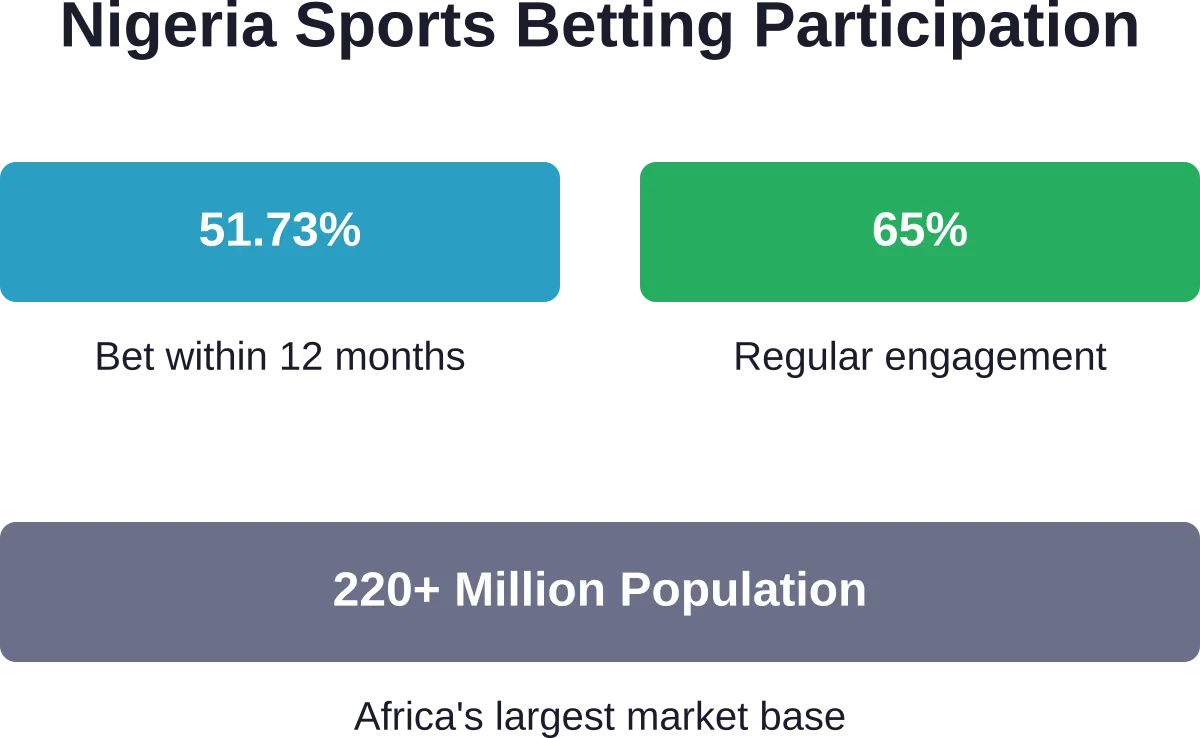
Quick Summary: Nigeria’s sports betting market is projected to reach significant scale in 2026 as part of the global sports betting industry valued at USD 125.12 billion. With over 220 million people and according to SOFTSWISS, approximately 65% of the Nigerian population engages in sports betting activities, though TGM Research found 51.73% participated in the previous 12 months, Nigeria represents one of Africa’s most dynamic iGaming markets, driven by mobile penetration, youthful demographics, and strong demand for football wagering.
The Nigerian sports betting landscape has transformed dramatically over the past five years. What started as a niche activity confined to physical betting shops has exploded into a digital phenomenon reshaping entertainment, technology, and commerce across Africa’s most populous nation.
By 2026, the convergence of mobile technology, regulatory evolution, and unprecedented youth engagement has positioned Nigeria as a powerhouse in the African iGaming sector. But what do the numbers actually reveal?
This analysis examines the market size, growth trajectory, regulatory framework, and competitive dynamics defining Nigeria’s sports betting industry in 2026.
Global Sports Betting Context: Where Nigeria Fits
Understanding Nigeria’s position requires context within the broader global sports betting ecosystem.
According to Grand View Research, the global sports betting market reached USD 100.9 billion in 2024 and is projected to grow to USD 187.39 billion by 2030, representing a compound annual growth rate of 11% from 2025 to 2030. The sports betting segment dominated the overall online gambling market with a revenue share of over 50% in 2024.
Research and Markets reported that the sports betting market size is expected to grow from $119.26 billion in 2025 to $125.12 billion in 2026 at a compound annual growth rate of 4.9%. The market is then projected to reach $153.44 billion by 2030, growing at a CAGR of 5.2%.
Europe captured around 48% of the global sports betting market revenue share in 2024, establishing itself as the dominant regional player. However, emerging markets—particularly in Africa and Asia—are driving the next wave of expansion.
Online Betting Dominates Growth
The shift to digital platforms explains much of the explosive growth. Online sports betting segments are projected to grow at a CAGR of 12.9% from 2025 to 2030, significantly outpacing traditional offline betting channels.
Live or in-play betting emerged as the leading segment in 2024, reflecting changing consumer preferences for real-time engagement. This betting type allows wagers during ongoing matches, creating immersive experiences that drive higher engagement and betting frequency.
Mobile devices have become the primary access point for betting activities globally. The convenience of placing bets from anywhere, combined with improved internet infrastructure, has democratized access to sports betting markets.
Nigeria's Sports Betting Market: Size and Scale
Nigeria stands as one of Africa’s most significant sports betting markets, though precise market sizing requires careful analysis.
With a population exceeding 220 million people, Nigeria provides the demographic foundation for substantial market activity. Research from SOFTSWISS indicates that approximately 65% of the Nigerian population engages in sports betting activities, though TGM Research found 51.73% participated in the previous 12 months, representing one of the highest participation rates globally.
Market intelligence firm H2 Gambling Capital projected Nigerian iGaming revenue would reach €675 million by 2025, with segment breakdowns suggesting sports betting at approximately $294 million, online casinos at $254 million, and the lottery at $92 million.
The Nigerian Tax Act 2025 (effective from 1 January 2026) introduced greater clarity to the taxation of gaming and lottery activities by exempting player stakes from VAT and subjecting operators to the general corporate income tax regime. This signals a governmental move toward formalizing and better integrating the sector into the tax system. However, the market’s actual size likely exceeds initial estimates due to the significant presence of unlicensed operators.
Growth Drivers Fueling Expansion
Several factors converge to accelerate market growth in Nigeria:
- Demographics: Over 60% of Nigeria’s population is under 35 years old, creating a massive youth cohort comfortable with digital platforms and mobile technology. This demographic naturally gravitates toward sports betting as entertainment and potential income.
- Mobile Penetration: Smartphone adoption has reached critical mass, with 83% of bettors accessing platforms via mobile devices. The proliferation of affordable Android devices combined with expanding 4G coverage has removed barriers to participation.
- Football Culture: Nigeria’s passionate football fandom, particularly surrounding the English Premier League and domestic leagues, creates organic demand for betting markets. Football dominates betting volumes, though basketball, tennis, and virtual sports are gaining traction.
- Payment Infrastructure: Digital payment platforms like PalmPay and OPay have simplified deposits and withdrawals, addressing previous friction points. Bank transfers, USSD codes, and mobile wallets enable seamless transactions even for users without traditional banking relationships.
The Competitive Landscape: Major Operators
Nigeria’s sports betting market features intense competition among domestic and international operators.
Three platforms dominate market share: Bet9ja, SportyBet, and BetKing. These operators have invested heavily in brand recognition, technology infrastructure, and localized offerings tailored to Nigerian preferences.
Bet9ja maintains the longest market presence and strongest brand recognition, particularly among older demographics. The platform offers extensive pre-match and live betting markets, with particular strength in football coverage.
SportyBet has rapidly gained market share through aggressive marketing, user-friendly interfaces, and generous bonuses. The operator targets younger demographics with simplified betting processes and social features.
BetKing differentiates through celebrity endorsements and sponsorships of local football teams, building grassroots brand awareness. The platform emphasizes community engagement and local relevance.
International operators face barriers entering the Nigerian market. Licensing requirements, localization demands, and entrenched competition create significant hurdles.
Market Consolidation Trends
The Nigerian betting market is experiencing consolidation as operators seek scale advantages.
Smaller operators struggle to compete with the marketing budgets, technology investments, and payment processing capabilities of established players. Many niche platforms have existed or been acquired since 2024.
Technology platforms providing white-label solutions enable new entrants to launch quickly, but sustainable profitability requires substantial user acquisition investment. Customer acquisition costs remain elevated due to intense competition for attention.
Nigeria's Regulatory Framework: Complex and Evolving
Understanding Nigeria’s sports betting market requires navigating a complicated regulatory environment featuring both federal and state-level authorities.
The National Lottery Regulatory Commission (NLRC) serves as the federal regulatory body with nationwide jurisdiction. However, individual states maintain their own lottery boards and regulatory authorities, creating jurisdictional complexity.
Licensing Requirements and Costs
According to the FCT Lottery Regulation Office (published 2025-10-18), sports betting permit applications require substantial documentation and fees.
Applicants must submit:
- Completed application forms
- Application letter stating business intentions
- Non-refundable application and processing fee of N2,000,000 (Two Million Naira)
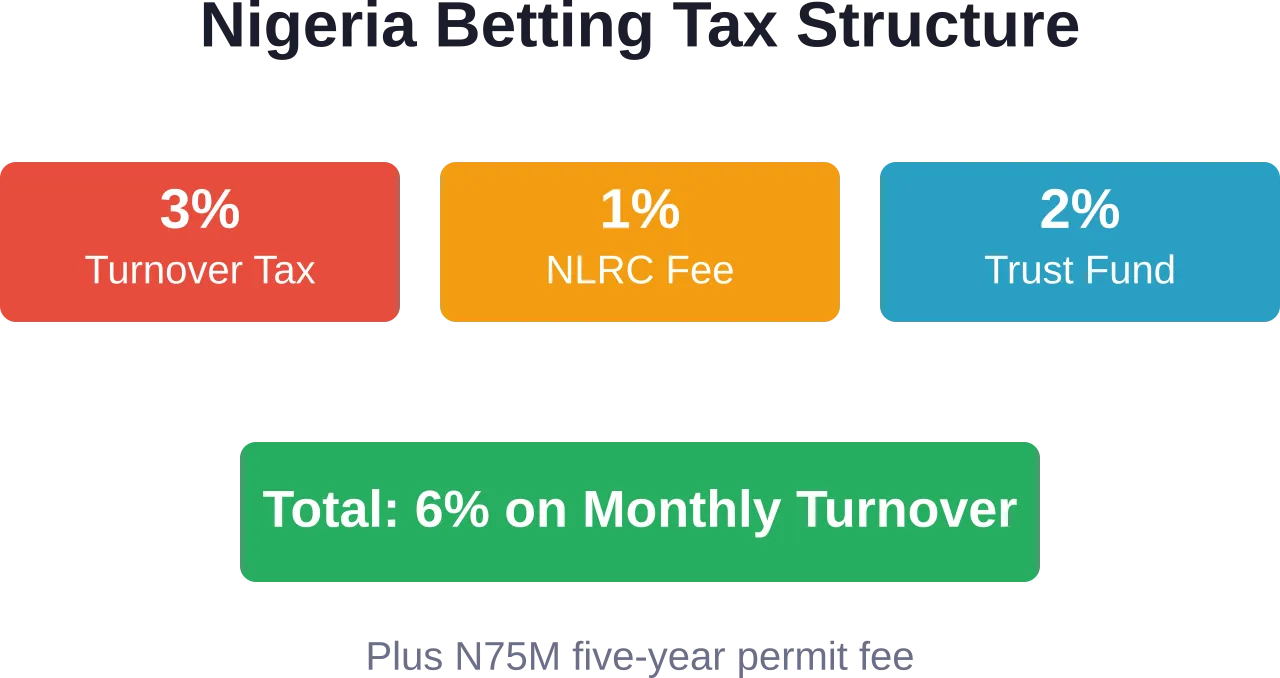
- Permit fee of N75,000,000 (Seventy-Five Million Naira) valid for 5 year upon successful completion of documentary processes
Beyond initial licensing, operators face ongoing compliance obligations including:
- 3% gross monthly turnover remittance
- 1% fee to the National Lottery Regulatory Commission on monthly sales turnover
- 2% contribution to the National Lottery Trust Fund on monthly sales turnover
These tax obligations significantly impact operator economics, particularly for smaller platforms operating on thin margins.
State vs. Federal Jurisdiction Conflicts
A persistent challenge involves conflicts between federal and state regulatory authorities.
Some state regulators refuse to acknowledge federal licenses issued by the NLRC, requiring separate state-level permits for operation within their territories. This resembles jurisdictional complexity seen in U.S. sports betting markets following the repeal of PASPA.
The Universal Reciprocity Certificate (URC) was introduced to address these conflicts, theoretically allowing operators with federal licenses to operate across multiple states. However, implementation remains inconsistent, with some states continuing to assert exclusive jurisdiction.
This regulatory fragmentation increases compliance costs and legal uncertainty for operators attempting nationwide expansion. Harmonization efforts continue, but progress is gradual.
Player Demographics and Betting Behavior
Understanding who bets and how they engage reveals critical market dynamics.
The core demographic consists of males aged 18-35, though female participation is rising steadily. TGM Research found that 38% of men bet several times weekly compared to 27% of women, indicating growing gender diversity in betting participation.
Approximately 30% of Nigerian bettors engage daily, reflecting high-frequency betting patterns driven by live/in-play options and virtual sports available around the clock.
Preferred Sports and Bet Types
Football dominates betting volumes, with the English Premier League generating the highest wagering activity. Nigerian Professional Football League matches also attract substantial betting, particularly for teams with strong local followings.
Basketball has gained traction, especially NBA betting during the season. Tennis provides year-round betting opportunities with its continuous tournament schedule. Virtual sports fill gaps when live events aren’t available, offering computer-generated matches with rapid results.
Fixed odds betting remains the most common format, though live/in-play betting is growing fastest. The ability to bet on events as they unfold—next goal scorer, corner kicks, cards—creates engagement that traditional pre-match betting cannot match.
Accumulator bets (parlays) are extremely popular among Nigerian bettors seeking high returns from small stakes. While these bets carry lower win probabilities, the potential for substantial payouts from minimal investment appeals to recreational bettors.
Betting Frequency and Stake Sizes
Nigerian bettors typically favor low-stake, high-frequency betting patterns. Minimum bets often start at N100-200, making betting accessible to lower-income participants.
This contrasts with European markets where average stakes are substantially higher. The Nigerian model relies on volume rather than large individual wagers, requiring operators to process massive transaction volumes efficiently.
Mobile-first design is non-negotiable. With 83% of access occurring via smartphones, operators optimize interfaces for small screens, limited bandwidth, and interrupted connectivity common in developing markets.
Market Challenges and Risks
Despite impressive growth, Nigeria’s sports betting market faces significant headwinds.
Regulatory Uncertainty
The unresolved tension between federal and state regulatory authorities creates ongoing compliance challenges. Operators cannot confidently plan national expansion when state-level requirements remain unpredictable.
Tax policy changes pose risks to operator economics. The 6% combined tax rate on turnover (rather than gross gaming revenue) significantly impacts margins, particularly during promotional periods when operators accept higher costs to acquire customers.
Payment Processing Difficulties
While digital payment infrastructure has improved, challenges persist. Bank transaction failures, delayed settlements, and fraud prevention require constant attention.
Currency volatility affects operators with international parent companies or technology providers paid in foreign currencies. Naira depreciation can quickly erode margins on contracts priced in USD or EUR.
Problem Gambling Concerns
Rising betting participation has triggered social concerns about gambling addiction and financial harm, particularly among young people.
Responsible gambling measures remain underdeveloped compared to mature markets. Self-exclusion tools, deposit limits, and reality checks are inconsistently implemented across operators.
Regulatory pressure is mounting for stronger player protection measures. Future regulations may mandate cooling-off periods, mandatory age verification enhancements, and restrictions on advertising and promotions.
Competition and Customer Acquisition Costs
Intense competition drives customer acquisition costs higher, squeezing profitability for all operators. Bonus abuse—where users create multiple accounts to exploit welcome offers—inflicts financial losses.
Brand loyalty remains low, with bettors readily switching platforms for better odds, promotions, or user experience. This churn requires continuous marketing investment to maintain market position.
Technology Infrastructure Powering Growth
Behind Nigeria’s betting boom lies sophisticated technology infrastructure enabling millions of transactions daily.
Platform Providers and White-Label Solutions
Many Nigerian operators license technology from specialized platform providers rather than building proprietary systems. Companies like SOFTSWISS provide comprehensive white-label solutions including sportsbook software, payment processing, risk management tools, and regulatory compliance features.
This approach reduces time-to-market and capital requirements for new entrants. However, it also means multiple operators often run on similar underlying technology, differentiating primarily through branding and marketing.
Odds Compilation and Trading
Sophisticated odds compilation requires real-time data feeds, pricing algorithms, and experienced trading teams. Most Nigerian operators source odds from third-party providers rather than maintaining in-house trading operations for all markets.
Risk management systems automatically adjust odds based on betting patterns, limiting exposure to potential losses from imbalanced books. During major events, operators may reduce maximum bet limits or suspend markets temporarily to manage risk.
Mobile Optimization Imperatives
Given mobile dominance, platforms must perform flawlessly on low-end Android devices with limited memory and processing power. Progressive web apps (PWAs) offer app-like experiences without requiring downloads from restricted app stores.
Data compression and efficient code reduce bandwidth consumption, critical in markets where users purchase limited data packages. Offline functionality allows bet slips to be prepared during connectivity gaps and submitted when connection resumes.
Technology Component | Purpose | Provider Type |
|---|---|---|
Sportsbook Platform | Core betting engine and user interface | White-label or proprietary |
Odds Feed | Real-time pricing data for events | Third-party data providers |
Payment Gateway | Deposit and withdrawal processing | Local payment processors |
CRM System | Customer management and marketing | Integrated or standalone |
Risk Management | Liability monitoring and fraud detection | Platform-integrated tools |
Map Reliable iGaming Vendors With Sologe

Market size research is more useful when businesses also understand which suppliers support the industry. Sologe is a B2B marketplace for iGaming companies, software vendors, and service providers. For teams studying Nigeria’s sports betting market in 2026, it can help connect market research with real business categories — platforms, sportsbook software, payment systems, analytics tools, marketing services, affiliate solutions, and operational support.
Use Sologe to move from market research to supplier review:
- find vendors connected to sportsbook and gaming platforms
- compare payment, analytics, and traffic-related providers
- review supplier profiles before starting outreach
- understand which business services support operators
- list your company if you serve iGaming businesses
Contact Sologe to explore iGaming vendors, compare supplier categories, or list your business for industry buyers.
Revenue Models and Operator Economics
Understanding how betting operators generate revenue and manage costs illuminates market sustainability.
Gross Gaming Revenue vs. Turnover
The fundamental revenue metric is Gross Gaming Revenue (GGR), calculated as total stakes minus payouts to winners. This represents the operator’s theoretical revenue before expenses.
Hold percentage—GGR divided by total stakes—typically ranges from 8-12% for sports betting, though this varies by sport, bet type, and market maturity. Football generally delivers lower hold percentages due to high liquidity and efficient pricing, while niche markets yield higher margins.
Nigeria’s tax structure complicates economics by taxing turnover rather than GGR. The 3% turnover tax plus additional fees means operators pay 6% of total stakes regardless of actual profitability. During high-payout periods, this structure can render operations unprofitable.
Cost Structure Breakdown
Major operational expenses include:
- Marketing and Customer Acquisition: The largest expense category, often consuming 30-40% of GGR in competitive markets. This includes advertising, affiliate commissions, welcome bonuses, and ongoing promotions.
- Technology and Platform: Licensing fees for white-label solutions, data feed subscriptions, hosting infrastructure, and development resources typically account for 15-25% of GGR.
- Payment Processing: Transaction fees for deposits and withdrawals, particularly for mobile money and card payments, can reach 5-8% of GGR.
- Regulatory Compliance: Beyond taxes, operators incur costs for licensing renewals, compliance monitoring, reporting systems, and legal counsel.
- Personnel: Customer service teams, marketing staff, risk management, finance, and administrative functions require substantial headcount.
Future Outlook: Where Is Nigeria's Market Heading?
Several trends will shape Nigeria’s sports betting landscape through the remainder of 2026 and beyond.
Regulatory Harmonization Progress
Pressure is mounting for clearer, more consistent regulatory frameworks. The economic benefits of a well-regulated betting sector—tax revenue, employment, technology investment—provide incentives for federal and state authorities to resolve jurisdictional conflicts.
Successful harmonization could unlock significant market expansion as operators gain confidence to invest in nationwide infrastructure and marketing. International operators currently hesitant about regulatory complexity might enter if frameworks stabilize.
Product Diversification
While sports betting dominates currently, operators are diversifying into adjacent products. Online casino games are growing rapidly with players preferring low-stake, high-frequency games similar to their sports betting patterns.
Virtual sports provide betting opportunities during off-peak hours when live events aren’t available. eSports betting is emerging, though current volumes remain modest compared to traditional sports.
Payment Innovation
Cryptocurrency adoption for betting deposits and withdrawals may accelerate as users seek alternatives to traditional banking channels. Stablecoins could address currency volatility concerns while maintaining digital convenience.
Biometric authentication and improved identity verification will enhance security while streamlining user experiences. Facial recognition and fingerprint scanning reduce friction in account creation and transaction authorization.
Artificial Intelligence Applications
AI and machine learning are transforming multiple aspects of betting operations. Personalized marketing uses behavioral data to target promotions to individual preferences, improving conversion rates while reducing wasteful spending.
Fraud detection algorithms identify suspicious betting patterns, multiple account abuse, and bonus exploitation more effectively than manual review. Risk management systems use machine learning to price niche markets and detect sharp betting syndicates.
Responsible gambling tools powered by AI can identify problematic betting patterns and intervene with warnings, limits, or self-exclusion suggestions before severe harm occurs.
Infrastructure Development
Continued improvements in Nigeria’s internet infrastructure will expand market accessibility. 5G network rollout in urban centers will enable richer content delivery, including high-definition live streaming integrated with betting interfaces.
Electricity grid reliability improvements reduce interruptions affecting both users and operator data centers. Solar-powered charging solutions and battery technology advances extend device usage in areas with inconsistent power supply.
Comparing Nigeria to Other African Markets
Nigeria’s market characteristics differ from neighboring African countries in important ways.
Kenya has a more mature regulatory framework with clearer federal authority, though recent tax increases have stressed operator profitability. South Africa’s market is highly regulated with significant barriers to entry, limiting competition compared to Nigeria’s more fragmented landscape.
Ghana’s market remains smaller due to lower population but features growing sophistication. Tanzania and Uganda are emerging markets with regulatory frameworks still developing.
Nigeria’s combination of massive population, high engagement rates, and improving infrastructure positions it as the continent’s most valuable betting market despite regulatory complexity.
Key Success Factors for Operators
What separates successful operators from struggling competitors in Nigeria’s market?
- Localization: Deep understanding of Nigerian culture, sports preferences, and behavioral patterns. Marketing messaging, customer service, and product features must reflect local context rather than importing international approaches wholesale.
- Mobile Excellence: Superior mobile experiences optimized for Nigerian connectivity constraints and device limitations. Fast loading times, intuitive navigation, and reliable transaction processing build trust and retention.
- Payment Flexibility: Supporting the full range of payment methods Nigerians use—bank transfers, mobile money, USSD codes, prepaid cards, and potentially cryptocurrency. Minimizing transaction failures and delays reduces friction.
- Brand Building: Sustained investment in brand recognition through advertising, sponsorships, and community engagement. Trust matters significantly in markets where customer protection is underdeveloped.
- Responsible Operations: Implementing genuine responsible gambling measures ahead of regulatory mandates. This reduces social backlash risk and positions operators favorably as regulations tighten.
- Customer Service: Responsive, helpful support via channels Nigerian users prefer—phone, WhatsApp, social media. Quick resolution of payment issues and bet disputes builds loyalty in competitive markets.
Investment Considerations and Market Entry
For investors evaluating Nigeria’s sports betting market, several factors warrant consideration.
Market Opportunity
The combination of Africa’s largest population, high betting participation rates, and relatively early-stage market development presents substantial growth potential. Market penetration can expand significantly as internet access and smartphone ownership continue rising.
Existing operators have demonstrated ability to build profitable businesses despite regulatory challenges, validating commercial viability. The passion for sports, particularly football, provides durable demand unlikely to diminish.
Risk Factors
Regulatory uncertainty remains the primary risk. Unclear jurisdiction, inconsistent enforcement, and potential policy changes create unpredictable operating environments. Tax rates on turnover rather than profit can render businesses unprofitable during high-payout periods.
Currency volatility poses financial risks, particularly for operators with foreign currency obligations. Economic instability could reduce disposable income available for betting activities.
Competition intensity squeezes margins through customer acquisition costs and promotional expenses. Achieving sustainable unit economics requires scale that many operators struggle to reach.
Entry Strategies
International operators considering Nigerian market entry typically choose between:
Acquisition: Purchasing existing licensed operators with established customer bases and infrastructure. This bypasses licensing complexity and accelerates market entry but requires substantial capital and thorough due diligence.
Partnership: Joint ventures with local entities familiar with regulatory landscape and market dynamics. This mitigates regulatory risk while providing local expertise but requires alignment on strategy and governance.
Independent Entry: Obtaining licenses and building operations from scratch. This maintains full control but faces the longest time-to-market and highest regulatory navigation challenges.
Entry Strategy | Advantages | Challenges |
|---|---|---|
Acquisition | Immediate market presence, existing licenses, customer base | High capital requirement, integration complexity, hidden liabilities |
Partnership | Local expertise, shared risk, regulatory navigation | Alignment challenges, shared control, profit sharing |
Independent Entry | Full control, brand building from scratch, operational flexibility | Slow market entry, regulatory complexity, customer acquisition from zero |
Frequently Asked Questions
What is the size of Nigeria’s sports betting market in 2026?
While Nigeria-specific figures for 2026 are not publicly disclosed by regulatory authorities, the market represents a significant portion of Africa’s betting industry. Market intelligence estimates suggested Nigerian iGaming revenue would reach €675 million by 2025, with sports betting comprising the largest segment at approximately $294 million. With according to SOFTSWISS, approximately 65% of Nigeria’s 220+ million population engaging in sports betting activities, though TGM Research found 51.73% participated in the previous 12 months, and the global sports betting market reaching $125.12 billion in 2026, Nigeria constitutes one of Africa’s most valuable markets. The actual market size likely exceeds official estimates due to unlicensed operator activity.
How is sports betting regulated in Nigeria?
Nigeria operates a dual regulatory system with both federal and state-level authorities. The National Lottery Regulatory Commission (NLRC) serves as the federal regulator, but individual states maintain their own lottery boards with regulatory authority. This creates jurisdictional complexity as some states don’t recognize federal licenses. Operators must obtain appropriate licenses and pay a permit fee of N75,000,000 for five years, plus ongoing taxes including 3% on monthly turnover, 1% NLRC fee, and 2% to the National Lottery Trust Fund. The Universal Reciprocity Certificate was introduced to enable cross-state operations, but implementation remains inconsistent.
Which sports betting companies dominate the Nigerian market?
Three operators dominate Nigeria’s sports betting market: Bet9ja, SportyBet, and BetKing. Bet9ja maintains the longest market presence and strongest overall brand recognition. SportyBet has gained substantial market share rapidly through aggressive marketing and user-friendly mobile interfaces targeting younger demographics. BetKing differentiates through celebrity endorsements and local football team sponsorships. These three platforms account for the majority of market share, though numerous smaller operators also compete. International operators face significant barriers to entry due to licensing complexity, localization requirements, and entrenched local competition.
What percentage of Nigerians participate in sports betting?
Research indicates exceptionally high participation rates in Nigeria. According to SOFTSWISS, approximately 65% of the Nigerian population engages in sports betting activities. TGM Research’s comprehensive survey conducted in October 2022 found that 51.73% of the population was involved in sports betting within the previous 12 months. Approximately 30% of Nigerian bettors engage daily, reflecting high-frequency betting patterns. Male participation exceeds female participation, with 38% of men betting several times weekly compared to 27% of women, though the gender gap is narrowing as the market matures.
What are the biggest challenges facing Nigeria’s betting market?
The primary challenge is regulatory complexity stemming from federal-state jurisdictional conflicts. Operators face uncertainty about which licenses apply where and must navigate inconsistent state-level requirements. The tax structure taxing turnover rather than gross gaming revenue creates profitability challenges, particularly during promotional periods. Payment processing difficulties including transaction failures, settlement delays, and fraud management require constant attention. Currency volatility affects operators with foreign currency obligations. Problem gambling concerns are rising with limited responsible gambling infrastructure in place. Finally, intense competition drives customer acquisition costs higher, squeezing margins for all operators while low brand loyalty drives continuous churn.
How does mobile technology impact Nigerian sports betting?
Mobile technology is the primary driver of Nigeria’s betting market growth, with 83% of bettors accessing platforms via smartphones. The proliferation of affordable Android devices combined with expanding 4G coverage has democratized access to betting platforms. Operators optimize platforms specifically for mobile experiences, designing for small screens, limited bandwidth, and interrupted connectivity common in developing markets. Digital payment platforms like PalmPay and OPay integrated with mobile devices have simplified transactions. Mobile-first design is non-negotiable for market success, as users expect fast loading times, intuitive navigation, and reliable functionality on low-end devices with limited memory and processing power.
What is the future outlook for Nigeria’s sports betting industry?
The outlook remains strongly positive despite challenges. Nigeria’s massive population, youthful demographics, and high engagement rates provide durable growth fundamentals. Continued improvements in internet infrastructure and smartphone penetration will expand market accessibility. Regulatory harmonization progress between federal and state authorities could unlock significant expansion as operators gain confidence for nationwide investment. Product diversification into online casino games and alternative betting products will provide additional revenue streams. Payment innovation including potential cryptocurrency adoption may address current friction points. However, success requires operators to maintain excellent mobile experiences, build trusted brands, navigate regulatory complexity effectively, and implement responsible gambling measures ahead of tightening regulations.
Conclusion: A Market of Tremendous Potential
Nigeria’s sports betting market in 2026 stands at a pivotal moment. The fundamentals—massive population, high participation rates, passionate sports culture, improving infrastructure—position Nigeria as Africa’s premier betting market.
The numbers tell a compelling story. With over 220 million people and according to SOFTSWISS, approximately 65% engaging in betting activities, though TGM Research found 51.73% participated in the previous 12 months, the addressable market is enormous. As part of the global sports betting industry projected to reach $125.12 billion in 2026, Nigeria represents one of the fastest-growing segments.
But realizing this potential requires navigating genuine challenges. Regulatory complexity demands sophisticated compliance capabilities and local expertise. The competitive intensity requires substantial capital for customer acquisition and retention. Payment infrastructure, while improving, still presents operational challenges.
Operators who succeed in this market share common characteristics: deep localization, mobile excellence, payment flexibility, strong brands, and genuine commitment to responsible operations. Those who treat Nigeria as simply another market to conquer with imported strategies will struggle against competitors who understand the unique dynamics at play.
For investors, Nigeria offers substantial opportunities balanced against real risks. The market is proven viable with multiple profitable operators demonstrating sustainable business models. Growth potential remains significant as internet penetration and smartphone adoption continue expanding.
The coming years will determine whether Nigeria’s sports betting industry achieves its full potential or remains constrained by regulatory fragmentation and operational challenges. Regulatory harmonization progress will be the critical factor unlocking nationwide expansion and attracting larger international investment.
What’s certain is that sports betting has become deeply embedded in Nigerian popular culture and entertainment. The market isn’t disappearing—it’s evolving, maturing, and attracting increasing attention from global operators seeking the next major growth opportunity.
Understanding this market requires looking beyond simple statistics to appreciate the complex interplay of regulation, technology, culture, and competition that defines Africa’s largest betting market.
Related Articles

September 30, 2026Is Sports Betting Legal in Brazil? The Full...

September 30, 2026Is Sports Betting Legal in Iran? The Real...