 Nothing found for the request

Sports Betting Addiction Nigeria Statistics 2026
Sologe June 8, 2026
Share:


Quick Summary
Quick Summary: Sports betting addiction has become a severe public health crisis in Nigeria, with studies showing 36% of adults have gambled and research indicating that among those who gamble, a significant proportion engage in daily gambling activities. Youth participation rates are alarmingly high, with significant impacts on mental health, academic performance, and financial stability. The crisis is fueled by weak regulation, aggressive online gambling platforms, and economic hardship.
Nigeria is experiencing an unprecedented gambling crisis that’s tearing through communities, destroying families, and devastating young lives. What started as legalized entertainment has morphed into a silent epidemic that health experts now call one of the country’s most urgent public health emergencies.
The statistics paint a grim picture. And the human cost? It’s mounting every single day.
The Scope of Sports Betting Addiction in Nigeria
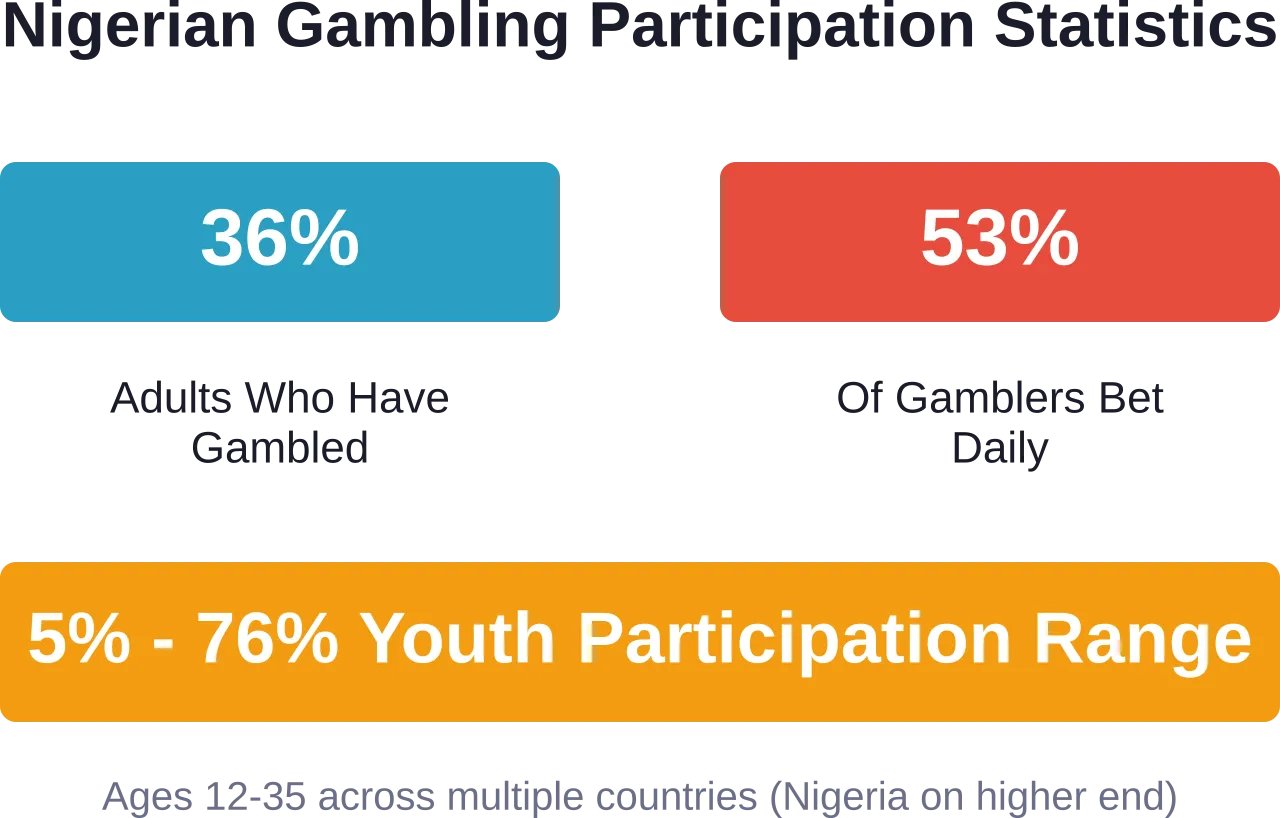
Recent research from authoritative medical sources reveals the true scale of Nigeria’s gambling problem. According to research published in medical literature, 36% of adult respondents in the Nigerian general population had gambled. But here’s where it gets worse.
Research indicates that among those who gamble, a significant proportion engage in daily gambling activities. That’s a substantial portion of all gamblers betting frequently.
The most alarming data concerns young people. Global research examining youth sports betting shows participation rates ranging from 5% to 76% among ages 12-35 years across multiple countries, with Nigeria falling on the higher end of this spectrum.
A 2022 survey found that 51.7% of the Nigerian adult population was involved in sports betting activities within the previous 12 months. That’s essentially one out of every two Nigerians.
How Nigeria's Gambling Industry Exploded
The gambling crisis didn’t emerge overnight. In the late 1990s, the Nigerian government legalized certain forms of gambling through Chapter 22, section 236 of the Criminal Code Act, primarily to generate tax revenues.
That decision opened the floodgates.
The legislation made gambling more acceptable to the public—including the under-aged, despite the legal minimum age of 18 years to gamble. Online betting platforms capitalized on weak enforcement and flooded the market with aggressive advertising campaigns that specifically targeted young people.
The timing couldn’t have been worse. Nigeria has grappled with rising inflation, skyrocketing youth unemployment, and a devastating cost-of-living crisis, particularly after gasoline subsidies were removed in May 2023. Desperate for income, many young Nigerians turned to gambling as what they perceived to be their last option.
Impact on Nigerian University Students and Youth
The university student population has been hit particularly hard. Research examining patterns and correlates of sports betting among Nigerian students indicates high prevalence of both sports betting participation and problem gambling behaviors.
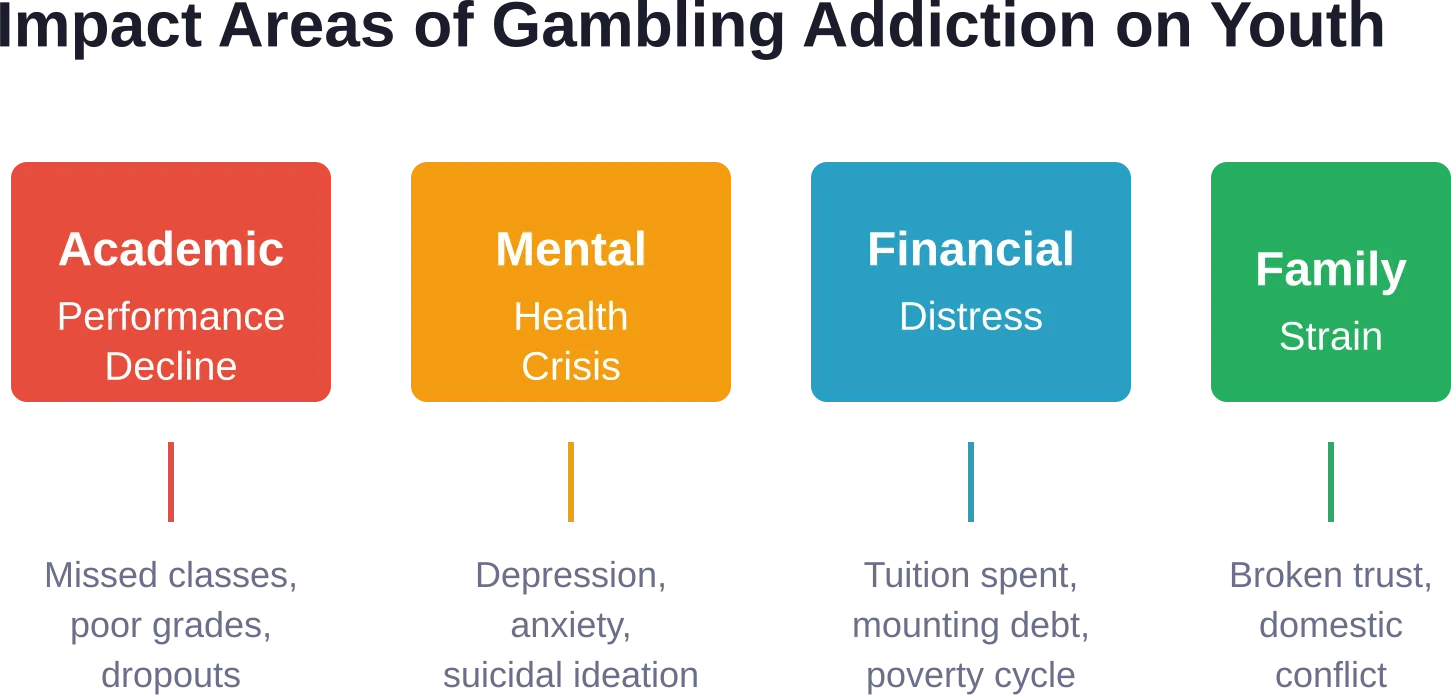
The academic implications are severe. Students report:
- Missing classes to place bets or monitor games
- Using tuition fees to gamble
- Declining academic performance and grades
- Inability to concentrate on studies
- Dropping out due to financial losses
But the damage extends far beyond academics. Mental health impacts include increased rates of depression, anxiety, suicidal ideation, and actual suicide attempts among student gamblers who’ve experienced significant losses.
The Economic Trap: Poverty to Gambling to Deeper Poverty
Here’s the cruel irony. Many Nigerians turn to gambling because they’re struggling financially. They see it as their only shot at escaping poverty.
Instead, gambling drives them deeper into financial ruin.
Reports across Nigeria document families where gamblers have used rent money, food budgets, and even their children’s school fees to place bets. The economic impacts ripple outward—affecting not just the gambler but entire households and communities.
In Uganda, families report similar patterns, with some cases directly linked to suicide. A 2023 study in Ghana found that 40% of university students gamble, with many reporting financial distress as a direct result.
The pattern is consistent across Sub-Saharan Africa, but Nigeria—as Africa’s most populous nation—faces the crisis at the largest scale.
Regulatory Failures and Industry Exploitation
The lack of stringent regulation and enforcement has created an environment where gambling operators face few consequences for predatory practices. Online gambling platforms have proliferated with minimal oversight, using sophisticated psychological tactics to keep users betting.
These platforms employ:
- Aggressive targeted advertising on social media
- Celebrity endorsements that glamorize gambling
- Easy mobile payment integration
- Bonus schemes that encourage continued betting
- Minimal age verification systems
The result? A generation of young Nigerians developing gambling addictions before they’ve even finished their education.
Treatment Services: Critically Inadequate
Research from psychiatry experts highlights a devastating gap: treatment services for problem gamblers in Nigeria are virtually non-existent. The few mental health facilities that exist are already overwhelmed with other psychiatric needs.
Most Nigerians struggling with gambling addiction have nowhere to turn for professional help. The problem is dismissed as a personal failing rather than the public health emergency that it truly represents.
This lack of treatment infrastructure means that even when individuals recognize they have a problem, getting help remains nearly impossible.
Comparison with Global Sports Betting Trends
Region | Youth Participation Rate | Problem Gambling Rate | Regulatory Strength |
|---|---|---|---|
Nigeria | High (upper range of 5-76%) | Significant among participants | Weak enforcement |
Sub-Saharan Africa | Rapidly increasing | Growing crisis | Generally weak |
United States | Increasing post-legalization | Monitored | State-level varies |
European Union | Moderate | Established support systems | Stronger regulation |
What separates Nigeria from regions with lower harm rates isn’t the availability of gambling—it’s the presence or absence of robust regulation, enforcement, and treatment services.
The Path Forward: A Public Health Approach
Experts emphasize that problem gambling merits a multipronged public health prevention approach. That means treating gambling addiction not as individual moral failure but as a systemic health crisis requiring coordinated intervention.
Recommended strategies include:
- Developing comprehensive educational campaigns targeting youth
- Implementing financial literacy programs in schools and universities
- Creating accessible support services and treatment facilities
- Enforcing age restrictions and advertising limitations
- Requiring gambling operators to fund addiction treatment programs
- Establishing national helplines and counseling services
Some advocates call for stricter measures, including bans on gambling advertising during sports broadcasts and near educational institutions.
Find Responsible iGaming Support Vendors

Sports betting addiction statistics in Nigeria should lead businesses toward safer operations, stronger controls, and responsible market practices. Sologe is focused on the business side of iGaming. The marketplace helps companies discover suppliers across software, platforms, payments, analytics, marketing, affiliate tools, licensing-related services, and operational support. For issues involving addiction and player risk, the most relevant angle is responsible vendor selection and proper business controls.
Sologe can help businesses review the support side of safer iGaming operations:
- look for analytics tools that help track activity patterns
- compare platform providers with business control features
- review licensing-related and operational service companies
- find payment providers suited to regulated environments
- connect with suppliers serving professional iGaming teams
Contact Sologe to find iGaming vendors that support structured, business-side operations or list your company for relevant industry buyers.
The Human Cost Beyond Statistics
Behind every percentage and statistic are real people. Students who’ve lost their futures. Families torn apart by financial devastation. Young people who’ve taken their own lives after catastrophic gambling losses.
Community discussions reveal heartbreaking patterns. Parents discovering their children have gambled away university fees. Graduates unable to find work who’ve descended into gambling addiction. Young men and women trapped in cycles of debt, chasing losses they’ll never recover.
The statistics are alarming. But the human cost? It’s incalculable.
Frequently Asked Questions
What percentage of Nigerian adults gamble?
According to research published in medical literature, 36% of adult respondents in the Nigerian general population had gambled. Among those who gamble, research indicates a significant proportion engage in daily gambling activities.
When did gambling become legal in Nigeria?
In the late 1990s, the Nigerian government legalized certain forms of gambling through Chapter 22, section 236 of the Criminal Code Act. The minimum legal age to gamble in Nigeria is 18 years, though enforcement of age restrictions remains weak.
How does sports betting affect Nigerian students?
Research shows high prevalence of sports betting and problem gambling among Nigerian undergraduates, with significant academic impacts including missed classes, declining grades, use of tuition fees for gambling, and increased dropout rates. Mental health consequences include depression, anxiety, and suicidal ideation.
What is the youth sports betting participation rate in Nigeria?
Global research on youth sports betting shows participation rates ranging from 5% to 76% among ages 12-35 years across multiple countries, with Nigeria falling on the higher end of this spectrum. A 2022 survey found 51.7% of the Nigerian adult population was involved in sports betting activities within the previous 12 months.
Are there treatment services for gambling addiction in Nigeria?
Treatment services for problem gamblers in Nigeria are critically inadequate and virtually non-existent. The few mental health facilities that exist are already overwhelmed, leaving most Nigerians struggling with gambling addiction without access to professional help.
Why has gambling become so popular in Nigeria?
Multiple factors contribute: legalization in the late 1990s increased public acceptance; weak regulation allowed aggressive online gambling platforms to proliferate; economic hardship including rising inflation, youth unemployment, and cost-of-living crisis pushed desperate Nigerians toward gambling as a perceived escape.
How does Nigeria’s gambling crisis compare to other African countries?
Nigeria faces the crisis at the largest scale due to being Africa’s most populous nation. Similar patterns appear across Sub-Saharan Africa—Uganda reports families using tuition fees to gamble with cases linked to suicide; Ghana found 40% of university students gamble with many experiencing financial distress. The crisis is dismissed as personal failing rather than the public health emergency it represents.
Conclusion
The statistics on sports betting addiction in Nigeria reveal a public health emergency that demands immediate, coordinated action. With 36% of adults having gambled and research indicating that a significant proportion of those who gamble engage in frequent gambling activities, the human cost continues mounting.
This isn’t just about numbers. It’s about an entire generation at risk—students losing their futures, families destroyed by financial ruin, and communities devastated by a crisis that receives far too little attention.
Nigeria needs a comprehensive public health approach that includes prevention, education, regulation enforcement, and accessible treatment services. Without urgent intervention, the statistics will only worsen, and more lives will be lost to this silent epidemic.
The time for action isn’t tomorrow. It’s now.
Related Articles

September 30, 2026Is Sports Betting Legal in Brazil? The Full...

September 30, 2026Is Sports Betting Legal in Iran? The Real...