 Nothing found for the request

How to Start a Betting Business in South Africa 2026
Sologe June 9, 2026
Share:


Quick Summary
Quick Summary: Starting a betting business in South Africa requires obtaining a license from the National Gambling Board, established under the National Gambling Act of 2004, and complying with provincial regulations. Operators must choose between online or retail betting models, select reliable software providers, secure adequate capital, and implement responsible gambling measures to succeed in this regulated market.
South Africa’s gambling industry has transformed dramatically since 1673, when betting was first heavily restricted. The Gambling Act of 1965 officially banned all forms of gambling except horse racing. But things changed.
Today, the betting business in South Africa represents a significant economic sector. According to available market data, the industry realized a Gross Gambling Revenue (GGR) of €2.920 billion in recent financial periods, with revenues projected for continued growth.
Here’s the thing though — breaking into this market isn’t as simple as renting a shopfront and taking bets. The regulatory framework is complex, the competition is fierce, and the startup costs can be substantial. But for those who navigate it correctly, the average net profitability of a betting shop makes up 7 to 15% of total income, with potential for much more.
This guide walks through everything needed to launch a legal, profitable betting operation in South Africa.
Understanding South Africa's Gambling Regulatory Framework
Before spending a single rand, understanding the legal landscape is crucial.
The National Gambling Board of South Africa is a juristic person established by the National Gambling Act 33 of 1996, which was repealed by the National Gambling Act 7 of 2004. This legislation fundamentally restructured how gambling operates in the country.
The National Gambling and Liquor Policy Council, constituted by the Minister of Trade and Industry and provincial MECs of Economic Development, oversees policy coordination. But here’s where it gets interesting — South Africa operates a dual-licensing system.
National vs Provincial Licensing
Betting businesses must navigate both national and provincial regulations. The National Gambling Board sets overarching standards, but each province maintains its own licensing authority. This means the specific requirements, fees, and application processes vary depending on where operations are based.
What’s consistent across provinces? The commitment to preventing illegal gambling, protecting vulnerable populations, and ensuring fair play. The National Gambling Amendment Act, introduced in 2008, further tightened these standards.
Real talk: the application process isn’t quick. Expect several months from initial application to license approval, assuming all documentation is in order.
Choosing Between Online and Retail Betting Models
Two primary paths exist for entering the South African betting market: online platforms or physical betting shops. Each comes with distinct advantages and challenges.
Online Betting Platforms
Over 90% of gamers access games on gaming sites using smartphones in South Africa. Mobile-first strategy isn’t optional — it’s critical for survival.
Online betting requires lower overhead than retail operations. No physical premises to maintain, fewer staff members, and scalability that retail can’t match. But the competition online is brutal, marketing costs are substantial, and technical infrastructure demands are high.
Popular forms of gambling in South Africa have included the National Lottery (96.9% participation), slot machines (27.7% participation), and scratchcards (22.7% participation), according to 2006 research. Sports betting has grown significantly since then, driven by mobile accessibility and strong appetite for football and rugby wagering.
Retail Betting Shops
Physical betting shops offer tangible presence and trust factors that online-only operations struggle to replicate. They serve demographics less comfortable with digital platforms and provide social environments many bettors prefer.
Location is everything for retail. High foot traffic areas, proximity to sports venues, and visibility make or break profitability. Capital requirements are higher — premises, terminals, staff, security — but customer acquisition can be more straightforward.
Many successful operators use hybrid models, combining retail locations with online platforms to capture both markets.
Factor | Online Platform | Retail Shop |
|---|---|---|
Initial Capital | Lower (software and licensing) | Higher (premises, equipment, staff) |
Overhead Costs | Lower ongoing costs | Rent, utilities, maintenance |
Customer Reach | National/unlimited | Local community |
Marketing Costs | High (digital competition) | Moderate (local advertising) |
Technical Demands | High (platform maintenance) | Lower (terminal support) |
Scalability | Easy to scale | Requires new locations |
Selecting Reliable Betting Software and Technology Partners
Technology forms the backbone of any modern betting operation. The software provider chosen will determine capabilities, reliability, and ultimately, success or failure.
South African bookmakers have access to multiple white-label sports betting platforms. These solutions include turnkey sportsbook packages, self-service betting terminals, and fully managed solutions that handle technical operations while operators focus on customer acquisition and brand building.
White Label vs Custom Development
White-label casino solutions include powerful bonus engines, affiliate tools, and multilingual support — allowing operators to launch and scale branded platforms instantly. Custom development offers more control but costs significantly more and takes longer to market.
For most new operators, white-label makes sense. The technology is proven, regulatory compliance is built-in, and time-to-market is measured in weeks rather than months or years.
Essential Software Features
What separates mediocre betting software from exceptional platforms? Several key features:
- Comprehensive sportsbook with local and international markets
- Live betting and streaming capabilities
- Mobile-responsive design (non-negotiable given South African usage patterns)
- Payment gateway integration supporting local methods
- Risk management and trading tools
- Customer management system with responsible gambling controls
- Reporting and analytics dashboards
- Affiliate and bonus management systems
Leading betting software providers offer licensed and innovative platforms specifically tailored for the South African market. These include advanced online and retail-betting tools designed for local conditions.
Self-service betting terminals represent another technology option, particularly for retail operations. These terminals reduce staff requirements while providing customers with direct betting interfaces.
Integration and Support Considerations
Software is only as good as the support behind it. When evaluating providers, consider technical support availability, update frequency, and responsiveness to issues.
Integration capabilities matter too. The platform should connect seamlessly with payment processors, odds feeds, regulatory reporting systems, and marketing tools. Clunky integrations create operational headaches and customer frustration.
Build Your Vendor Shortlist With Sologe

Starting a betting business in South Africa should begin with licensing review, compliance planning, software selection, and reliable supplier checks. Sologe gives iGaming companies a marketplace for finding business-side providers. Teams can use it to search across platform vendors, sportsbook software companies, payment providers, analytics tools, affiliate systems, traffic services, marketing support, and licensing-related categories before reaching out.
Sologe helps teams move from planning to supplier discovery:
- find platform vendors for iGaming projects
- compare sportsbook software providers
- review payment and business support companies
- explore affiliate, traffic, and marketing tools
- list your company if you serve operators or suppliers
👉Contact Sologe to find relevant iGaming vendors, compare business-side solutions, or list your company on the marketplace.
Capital Requirements and Financial Planning
How much capital does launching a betting business actually require? The answer varies dramatically based on the chosen model and scale.
Startup Costs Breakdown
For online operations, initial costs include:
- Licensing fees (varies by province)
- Software licensing or white-label setup
- Website development and branding
- Initial marketing budget
- Working capital for payouts
- Legal and compliance consulting
- Payment processing setup
Retail betting shops add significant costs: premises lease or purchase, renovation to meet regulatory standards, betting terminals, furniture and fixtures, security systems, and staff salaries.
Working capital deserves special attention. Betting businesses must maintain sufficient reserves to cover customer payouts during periods when winners exceed losers. This float varies based on betting volume but represents a substantial ongoing requirement.
Revenue Expectations and Profit Margins
The average net profitability of a betting shop ranges from 7 to 15% of total income. Online operations typically achieve higher margins due to lower overhead, potentially reaching 20-25% for well-managed platforms.
But these are averages. New operations often operate at break-even or losses for the first 6-12 months while building customer base and brand recognition. Patient capital is essential.
Revenue depends on multiple factors: customer acquisition rate, average stake size, betting frequency, house edge management, and marketing effectiveness. Established operators measure success in customer lifetime value rather than single-transaction metrics.
Funding Options
Most betting businesses launch through personal savings, investor funding, or business loans. Banks scrutinize gambling businesses carefully due to regulatory complexity and risk profiles, making traditional financing challenging.
Investor funding offers advantages but requires sharing equity and accepting oversight. Partnership structures can spread risk and bring complementary expertise — one partner handling operations while another manages marketing, for instance.
Building Operations and Risk Management Systems
Technology and licensing create the foundation, but operational excellence determines survival.
Odds Compilation and Trading
Bookmaking requires sophisticated odds compilation. Most new operators use odds feeds from established providers rather than compiling odds in-house. These feeds supply competitive pricing across thousands of markets.
Trading tools monitor betting patterns and flag unusual activity. When sharp bettors identify value, books must respond quickly by adjusting odds or limiting stakes. Risk management isn’t about preventing all losses — it’s about maintaining balanced books and acceptable margins.
Payment Processing and Cash Flow
South African bettors expect multiple payment options. The most successful platforms support bank transfers, credit cards, mobile money, and voucher systems. Fast withdrawals build trust; slow payments destroy it.
Cash flow management separates successful operators from failures. Customer deposits create short-term liquidity, but payouts can spike unpredictably. Conservative operators maintain reserves equal to 30-40% of outstanding liability.
Responsible Gambling Compliance
South African regulations mandate responsible gambling measures. These aren’t optional features — they’re legal requirements.
Required controls include self-exclusion mechanisms, deposit limits, time-out options, and clear problem gambling resources. Staff training on identifying problem gambling signs is mandatory for retail operations.
Anti-money laundering procedures must be rigorous. Know-your-customer verification, transaction monitoring, and suspicious activity reporting protect businesses from regulatory penalties and criminal exploitation.
Marketing Your Betting Business
Even the best platform fails without customers. Marketing betting businesses in South Africa requires navigating advertising restrictions while building brand awareness.
Digital Marketing Strategies
Search engine optimization and content marketing provide cost-effective customer acquisition. Creating valuable content around popular sports, betting guides, and match previews attracts organic traffic.
Social media presence is essential but tricky. Advertising regulations restrict gambling promotion on some platforms. Community management and engagement work better than aggressive selling.
Affiliate marketing drives significant volume for established operators. Affiliates promote betting platforms in exchange for commission on referred customers. Quality affiliates bring genuine value; poor affiliates bring bonus abusers and problem customers.
Promotional Offers and Bonuses
Welcome bonuses attract new customers but require careful structuring. Overly generous bonuses attract professional bonus hunters who rarely become profitable long-term customers. Balanced offers provide genuine value without exposing the business to excessive risk.
Retention promotions keep existing customers engaged. Free bet clubs, cashback offers, and loyalty programs build long-term value more effectively than front-loaded acquisition bonuses.
Traditional Marketing Channels
Retail betting shops benefit from local marketing. Sponsoring community sports teams, placing signage in high-traffic areas, and building relationships with local sporting clubs create grassroots awareness.
Radio advertising reaches broad audiences in South Africa’s diverse market. Television advertising offers impact but comes with high costs and regulatory scrutiny.
Marketing Channel | Cost | Effectiveness | Best For |
|---|---|---|---|
SEO & Content | Low-Medium | High (long-term) | Online operators |
Affiliate Marketing | Performance-based | High | Established brands |
Social Media | Low-Medium | Medium | Brand building |
Local Sponsorships | Medium | Medium-High | Retail shops |
Radio Advertising | Medium-High | Medium | Broad reach |
Television | High | High | Major operators |
Common Challenges and How to Overcome Them
Every betting business faces obstacles. Knowing them beforehand helps.
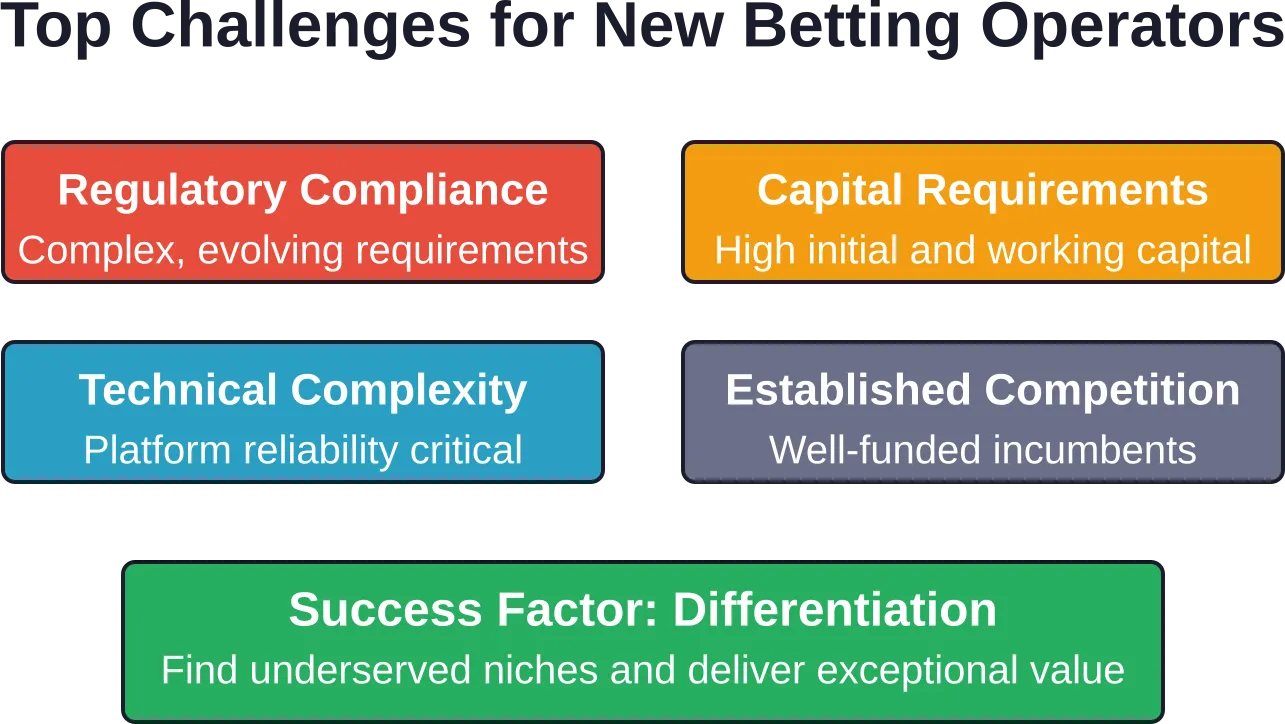
Regulatory Compliance Complexity
Staying compliant requires ongoing attention. Regulations evolve, reporting requirements change, and enforcement tightens. Hiring compliance expertise or outsourcing to specialized consultants prevents costly violations.
Record-keeping must be meticulous. Audits happen, and inadequate documentation leads to penalties or license suspension. Automated systems that log transactions, customer interactions, and operational decisions create defensible audit trails.
Technical Issues and Downtime
Platform crashes during major sporting events destroy customer trust. Redundant systems, robust hosting, and disaster recovery plans aren’t luxuries — they’re necessities.
Testing under load before major events prevents embarrassing failures. Partnering with experienced technology providers reduces technical risk compared to building custom solutions.
Managing Customer Disputes
Disputes over settled bets, payment delays, and bonus terms are inevitable. Clear terms and conditions provide protection, but customer service quality determines reputation.
Responding quickly and fairly builds loyalty. Even when refusing a customer claim, explaining reasoning professionally maintains relationships. Escalation processes and dispute resolution procedures should be documented and consistent.
Competition from Established Operators
Competing against well-funded, established brands is daunting. New operators succeed through differentiation — better odds on specific markets, superior customer service, niche sport focus, or community connection.
Trying to out-spend major operators on marketing rarely works. Finding underserved segments and delivering exceptional value creates sustainable competitive advantage.
Scaling and Growth Strategies
Once operational, smart operators think about growth.
Expanding Product Offerings
Starting with sports betting, many operators add casino games, virtual sports, or eSports. Product diversification attracts different customer segments and smooths revenue volatility.
Casino integration through white-label solutions allows operators to add hundreds of games without game development expertise. The casino vertical appeals to different demographics than sports betting and provides consistent revenue.
Geographic Expansion
Operators successful in one province often expand to others. Each province requires separate licensing, but operational lessons transfer. National reach provides brand recognition and economies of scale in marketing and technology.
International expansion represents a longer-term opportunity. African markets show growing interest in betting, and South African operators possess relevant expertise. But international licensing and cultural adaptation add complexity.
Retail Network Development
Online operators sometimes add retail locations for brand visibility and customer acquisition. Conversely, retail operators expand online to capture digital-native customers. Omnichannel presence serves the complete market.
Franchise models allow rapid retail expansion without proportional capital requirements. Franchisees handle local operations while benefiting from established brand, technology, and support.
Technology Trends Shaping the Future
South Africa’s betting industry continues evolving rapidly. Several trends deserve attention.
Mobile-First Evolution
With over 90% of gamers accessing sites via smartphones, mobile isn’t just important — it’s everything. Progressive web apps, native applications, and mobile-optimized experiences separate leaders from laggards.
Mobile payment integration, one-click betting, and push notifications for promotions drive engagement. Operators investing in superior mobile experiences capture disproportionate market share.
Live Betting and Streaming
In-play betting during live matches represents the fastest-growing segment. Customers increasingly expect real-time odds updates and live match streaming integrated into betting platforms.
Live streaming rights are expensive but drive engagement. Partnerships with sports leagues and content providers create competitive advantages.
Data Analytics and Personalization
Sophisticated operators use data analytics to understand customer behavior, optimize marketing spend, and detect problem gambling early. Machine learning models predict customer lifetime value and identify at-risk accounts.
Personalized offers based on betting history increase engagement without excessive bonus costs. Generic mass promotions yield diminishing returns compared to targeted campaigns.
Frequently Asked Questions
How much does a betting license cost in South Africa?
Betting license costs vary significantly by province. Provincial gambling boards set their own fee structures. Beyond initial license fees, operators must budget for annual renewal fees, compliance audits, and regulatory reporting costs. Consulting with licensing consultants familiar with specific provincial requirements provides accurate estimates for target markets.
Can foreigners start a betting business in South Africa?
Foreign investors can participate in South African betting businesses, but licensing authorities typically require local directorship and significant South African ownership. Requirements vary by province. Partnering with local expertise navigates regulatory requirements and provides market knowledge. Legal consultation specializing in gaming law clarifies specific ownership structures permitted in target provinces.
What’s the difference between a bookmaker license and a betting operator license?
Terminology varies by province, but generally bookmaker licenses authorize accepting bets from the public, while operator licenses may cover broader gambling activities including casino games. Some provinces issue integrated licenses covering multiple gambling types, while others require separate licenses for sports betting versus other gambling forms. The National Gambling Board and provincial authorities provide specific license category definitions.
How long does it take to get a betting license in South Africa?
License approval typically takes 3 to 6 months from complete application submission, assuming all documentation is in order and no complications arise. Background checks, financial audits, and compliance reviews consume significant time. Incomplete applications or issues discovered during review extend timelines considerably. Starting the application process well before planned launch prevents delays.
What are the tax obligations for betting businesses in South Africa?
Betting businesses face multiple tax obligations including corporate income tax, value-added tax, and gambling-specific taxes. Provincial gambling taxes typically apply to gross gambling revenue at rates varying by province. Additionally, withholding tax may apply to customer winnings above certain thresholds. Tax obligations are complex and province-specific — consulting with accountants specializing in gambling taxation ensures compliance.
Do I need a physical office to operate an online betting business?
Most provinces require online betting operators to maintain physical offices within South Africa for regulatory purposes, even if customer-facing operations are entirely digital. Licensing authorities need a physical location for inspections, audits, and regulatory oversight. The office must house operational staff, servers may be required on-premises depending on provincial regulations, and business records must be accessible. Remote-only operations generally don’t satisfy licensing requirements.
What responsible gambling measures are legally required?
South African regulations mandate multiple responsible gambling protections. Required measures include self-exclusion mechanisms allowing customers to ban themselves, deposit and loss limits that customers can set, clear display of responsible gambling information and problem gambling resources, staff training on identifying problem gambling signs for retail operations, and prohibition of marketing to minors. Regular compliance audits verify implementation. Failures result in penalties ranging from fines to license suspension.
Conclusion
Starting a betting business in South Africa offers substantial opportunity within a growing market. The industry’s financial scale is significant, with billions in annual gambling revenue and continued expansion driven by mobile adoption and sports betting popularity.
But success requires more than recognizing opportunity. Navigating the National Gambling Board’s regulatory framework, securing provincial licensing, choosing between online and retail models, selecting reliable technology partners, and maintaining adequate capital form foundational requirements.
The average net profitability of 7 to 15% sounds modest until scaled across high transaction volumes. Online operations achieve higher margins but face intense digital competition. Retail shops require more capital but offer community presence and trust advantages.
Technology selection determines operational capabilities. White-label solutions provide fastest time-to-market with proven compliance, while custom development offers control at higher cost and longer timelines. Mobile-first design isn’t optional — it’s critical given that over 90% of South African gamers access platforms via smartphones.
Operational excellence separates survivors from failures. Risk management, payment processing, responsible gambling compliance, and customer service quality matter as much as marketing and technology. Building sustainable competitive advantage requires differentiation — competing on service, niche markets, or community connection rather than attempting to outspend established operators.
The challenges are real: regulatory complexity, capital intensity, technical demands, and established competition. But operators who approach the market professionally, commit to compliance, invest in quality technology, and focus on customer value build profitable, sustainable businesses.
Ready to start? Begin with thorough provincial research, connect with experienced gaming lawyers, and develop a realistic business plan. The National Gambling Board and provincial gambling authorities provide official guidance. Technology providers offering white-label solutions can demonstrate platforms and discuss implementation timelines.
The South African betting market continues growing. Those who enter prepared, compliant, and customer-focused position themselves to capture meaningful market share in this dynamic industry.
Related Articles

September 30, 2026Is Sports Betting Legal in Brazil? The Full...

September 30, 2026Is Sports Betting Legal in Iran? The Real...