 Nothing found for the request
Is Sports Betting Legal in Bolivia? The 2026 Answer
Sologe September 30, 2026
Share:


Quick Summary
Sports betting in Bolivia sits in a legal grey zone: Law No. 060 (2010) technically covers online gambling but never set up a licensing system for it, so no operator is officially authorized while no law explicitly bans bettors either. In practice, Bolivians bet freely on offshore sites licensed in Curaçao or Malta, and a 2026 reform pushed by the Paz administration could finally bring clear online regulation.
Ask around La Paz or Santa Cruz whether betting on a football match is legal, and answers will vary wildly. Some say it’s totally fine. Others insist it’s banned outright. Both are sort of right, and that’s exactly the problem.
Bolivia’s gambling framework was built for casinos and lottery kiosks, not for a smartphone app that takes wagers on the Champions League final. That mismatch is why the country keeps showing up in “is it legal” searches year after year. Here’s what the law actually says, how it’s enforced in practice, and what’s changing in 2026.
The Legal Foundation: Law No. 060
Bolivia’s gambling sector runs on a single piece of legislation: Law No. 060, promulgated in November 2010. It replaced a patchwork of older rules dating back to the Lotería Nacional de Beneficencia y Salubridad, founded in 1928, and it created the country’s first modern regulator.
Law 060 does two things at once. It prohibits any gambling activity that isn’t explicitly authorized by the state, and it sets up the Autoridad de Fiscalización y Control Social del Juego, commonly known as the AJ, as the body responsible for licensing, inspecting, and sanctioning operators. On paper, that sounds strict. In practice, the law’s language mentions games conducted through “mechanical, electromechanical, digital or technological means,” a phrase broad enough that the AJ itself has interpreted it, at times, as covering online betting.
The catch? Broad language isn’t the same as a working licensing procedure. Bolivia published an online licensing regulation in 2021 (RR-01-00001-21), but the AJ has not granted operating licences to online sportsbooks, and officials have treated standalone sports betting as outside the authorised catalogue.
So, Is It Legal or Not?
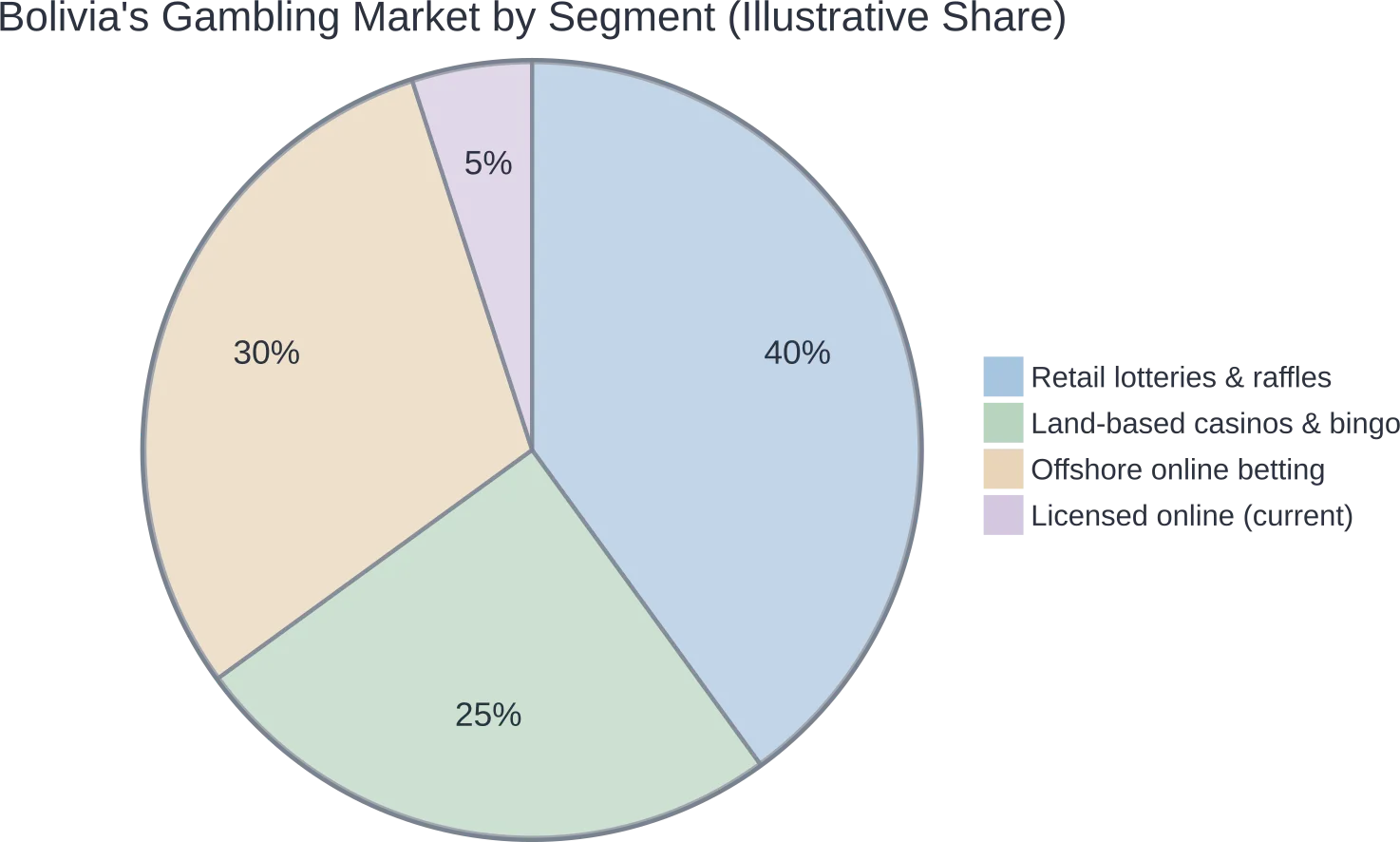
The honest answer: it’s unregulated rather than clearly legal or clearly illegal. Land-based gambling — casinos, bingo halls, the national lottery — is regulated and taxed under the AJ. Online sports betting is a different animal entirely.
No international sportsbook holds a Bolivian license, because none exists to hold. At the same time, there’s no specific statute that criminalizes an individual bettor for placing a wager on a site licensed elsewhere, say in Curaçao or Malta. The AJ has historically focused enforcement on unlicensed physical venues and local operators, not on individual players using offshore platforms from home.
That’s why millions of Bolivians place bets through international apps every week without facing legal consequences, even though those platforms technically operate without domestic authorization.
Why This Grey Area Exists
Law 060 predates the smartphone betting boom by several years. Back in 2010, “online gambling” meant desktop poker rooms, not live in-play wagering pushed through a mobile app during a match. Lawmakers simply didn’t anticipate how fast the online market would grow, and nobody has fully rewritten the law since.
Add to that Bolivia’s fragmented legal codes across different sectors, and enforcement becomes inconsistent. One region’s AJ office might crack down on an unlicensed betting kiosk; a national regulator might issue a statement about online betting one month and stay silent the next. The result is a system that regulators, operators, and bettors all read differently depending on who’s asking.
What’s Changing in 2026
Under President Rodrigo Paz’s administration, the AJ has floated a reform package aimed at modernizing the sector. The proposal reportedly includes simplifying the tax structure — dropping or restructuring the Impuesto al Juego (30% on operator revenue) and the Impuesto a la Participación en Juegos (15% on the player’s participation price) — with the stated goal of pulling international operators out of the grey market and into a licensed, taxed system.
Whether this reform actually produces a working online license by year’s end is still uncertain. Reform proposals in Bolivia’s gambling sector have a history of stalling; a similar push was floated back in 2020 and went nowhere fast. That said, the political appetite this time looks stronger, driven partly by the government’s interest in capturing tax revenue currently flowing to operators based abroad.
Current Tax Structure for Licensed Operators
Tax | Applies to | Current rate |
|---|---|---|
Impuesto al Juego (IJ) | Operators, gross gaming revenue | 30% |
Impuesto a la Participación en Juegos (IPJ) | Players, on the stake / participation price (sale price minus VAT) | 15% |
Licensing fee | Land-based operators | Varies by category |
For current, verified rates, always check the AJ’s official portal rather than relying on secondhand summaries — tax figures in this sector shift as reforms move through Bolivia’s legislature.
Betting on International Sites: What Bettors Should Know
Since no domestic online sportsbook is licensed, anyone betting online in Bolivia today is almost certainly using an offshore platform. That’s not inherently dangerous, but it does shift responsibility onto the bettor to pick a reputable site.
- Look for a license from an established regulator — Curaçao, Malta Gaming Authority, or the UK Gambling Commission are common examples among sites accepting Bolivian traffic.
- Check for local currency support (BOB) and realistic withdrawal times before depositing.
- Avoid platforms with no visible licensing information or unclear ownership — that’s the biggest red flag in any unregulated market.
- Be aware that consumer protection is limited. If a dispute arises with an offshore operator, Bolivian courts generally have no jurisdiction to intervene.

Put Your Sports Betting Product on Sologe
AtSologe, we provide a dedicated marketplace for sports betting technology, platforms, payment products, software, services, and other iGaming solutions. We make it easier for people already searching for industry suppliers to come across your company and see what you provide.
Want to Make Your Business Easier to Discover?
With Sologe, you can:
- add your products or services to an industry-specific marketplace
- select the category that fits your offer best
- give buyers a straightforward overview of what you provide
- make it easier for interested partners to find your company
👉Get in touch with us to get your offer listed on Sologe.
Bolivia in Regional Context
Bolivia isn’t unique in facing this kind of legislative lag. Several Latin American countries have wrestled with the same problem — laws written for physical casinos suddenly asked to cover a digital industry that didn’t exist when they were drafted.
Country | Online sports betting status | Dedicated online law? |
|---|---|---|
Bolivia | Grey market / unregulated | No |
Colombia | Regulated and licensed | Yes |
Peru | Regulated and licensed | Yes |
Argentina | Regulated at provincial level | Yes (varies by province) |
Paraguay | Regulated, single national operator model | Yes |
Neighboring markets like Colombia and Peru moved early to license and tax online operators directly, capturing revenue Bolivia currently loses to offshore books. That contrast is part of what’s pushing Bolivia’s own reform conversation forward.
Risks Worth Weighing
Betting in a grey market isn’t the same as betting in a fully banned one, but it’s not risk-free either. Bettors should think through a few things before depositing anywhere.
- No local recourse. Disputes over withheld winnings or account closures generally can’t be escalated to a Bolivian regulator, since none oversees these platforms.
- Payment friction. Some offshore sites route deposits through international payment processors, which can complicate refunds or add fees.
- Policy could shift fast. If the 2026 reform passes, some offshore operators might exit the market rather than pursue a local license, leaving existing account holders scrambling.
- Responsible gambling tools vary. Not every offshore platform offers deposit limits or self-exclusion, features that regulated markets typically require by law.
FAQ: Sports Betting in Bolivia
Is online sports betting illegal in Bolivia?
Not exactly. Law No. 060 doesn’t explicitly criminalize individual bettors, and enforcement has focused on unlicensed local operators rather than players using offshore apps. It’s more accurate to call the activity unregulated than illegal.
Can Bolivians legally use sites like Bet365 or 1xBet?
There’s no Bolivian law that specifically bans access to offshore betting platforms, and no domestic license exists for these brands either way. Millions of Bolivians use such sites without facing legal action, though the situation could change if new regulation is passed.
Does Bolivia have a licensed local sportsbook?
No licensed domestic online sportsbook currently operates. A 2021 AJ regulation exists for online games of chance and raffles, but it has not produced a working sports-betting licence in practice.
Will Bolivia legalize and regulate online betting soon?
A reform pushed under President Rodrigo Paz’s government has floated simplifying gambling taxes and potentially opening a licensing path for online operators in 2026. Nothing is finalized yet, so bettors should check the AJ’s official announcements for updates.
What government body oversees gambling in Bolivia?
The Autoridad de Fiscalización y Control Social del Juego, known as the AJ, is Bolivia’s gambling regulator. It operates under the Ministry of Economy and Public Finance and issues licenses, conducts inspections, and imposes sanctions.
Is land-based casino gambling legal in Bolivia?
Yes. Physical casinos, bingo halls, and the national lottery are regulated and licensed under Law No. 060, making land-based gambling the clearest legal category in the country’s gambling landscape.
The Bottom Line
So, is sports betting legal in Bolivia? The short answer: it’s neither fully legal nor fully banned. Law No. 060 gives the state authority over gambling broadly, but it never built out rules for licensing online sportsbooks, leaving bettors and operators in a grey zone that’s persisted for over a decade.
That’s likely to change, at least partially, as the 2026 reform effort moves through Bolivia’s legislative process. Until an official licensing framework exists, anyone betting online should stick to well-established, transparently licensed international platforms, keep an eye on official AJ announcements, and treat any claims about new local betting apps with a healthy dose of skepticism. When in doubt, check the AJ’s own website for the latest legal status before placing a single wager.
Related Articles
September 30, 2026Is Sports Betting Legal in Brazil? The Full...

September 30, 2026Is Sports Betting Legal in Iran? The Real...