 Nothing found for the request
Is Sports Betting Legal in Kenya? Full 2026 Guide
Sologe September 30, 2026
Share:


Quick Summary
Yes, sports betting is legal in Kenya, but only through operators licensed under the Gambling Control Act, 2025. The Gambling Regulatory Authority (GRA) now oversees licensing, taxation, and advertising rules that replaced the old Betting Control and Licensing Board framework. Bettors must be 18 or older, and both deposits and winnings are taxed.
Kenya has one of the liveliest betting markets on the continent, and the question of whether it’s actually legal comes up constantly—especially now that the rules have changed. The short answer is yes. Sports betting is legal in Kenya, provided the platform holds a valid licence from the country’s gambling regulator. What’s changed recently is how that licensing works, who enforces it, and how much tax gets deducted along the way.
For years, the Betting, Lotteries and Gaming Act of 1966 governed the industry. That law is now history. In August 2025, President William Ruto assented to the Gambling Control Act, 2025, a sweeping overhaul designed to modernize regulation for an industry that had outgrown its decades-old legal framework. This guide walks through what’s legal, what isn’t, who regulates the space now, and what bettors and operators need to know heading into the rest of 2026.
The Legal Status of Sports Betting in Kenya, Explained
Sports betting sits squarely in the “legal but regulated” category. Kenya doesn’t ban betting outright—it licenses it. Anyone operating a betting platform, whether a physical shop or a mobile app, needs authorization from the regulator. Anyone placing a bet needs to be at least 18 years old and should ideally be using a licensed operator, since unlicensed platforms offer zero legal protection if something goes wrong with a payout.
The 1966 Act has now been repealed by the Gambling Control Act, 2025, though a handful of its tax and anti-money-laundering provisions remain in force until new regulations fully take over. That’s a legal nuance worth knowing, but practically speaking, it doesn’t change what an ordinary bettor experiences day to day.
From BCLB to GRA: Kenya’s New Regulatory Body
For nearly six decades, the Betting Control and Licensing Board (BCLB) was the name everyone associated with gambling oversight in Kenya. That’s no longer accurate. The Gambling Control Act, 2025 dissolved the BCLB and created the Gambling Regulatory Authority (GRA) in its place, giving the sector a single, better-resourced body to handle licensing, compliance, and enforcement.
The transition hasn’t been instant. BCLB announced a formal handover process in October 2025, and a moratorium was placed on new licence applications while the GRA worked out detailed regulations covering everything from advertising to remote gaming platforms. Five sets of implementing regulations were eventually published between late June and early July 2026, finally giving the new regime real teeth. The GRA reopened licence applications in August 2026, so operators are now working through a fresh approval cycle under the new rules.
What Counts as Legal Gambling Activity in Kenya
The Gambling Control Act, 2025 doesn’t just cover sports betting—it sets out a broader menu of licensed activities. Among the forms currently permitted, provided the operator holds the right licence class:
- Online sports betting and pool betting
- Land-based bookmaking at licensed premises
- Online and physical casino games, including slots and table games
- Lotteries and prize competitions
- Certain lottery-style promotional games run by businesses
Notably, there isn’t a licence category called “sports betting” in isolation. Instead, bookmakers—operators who take or negotiate bets on outcomes, sporting or otherwise—fall under bookmaking licence classes. So while sports betting itself isn’t singled out by name in the licensing structure, any company facilitating it needs a bookmaker’s licence to operate lawfully.
Games and Formats That Face Extra Scrutiny
Fast-paced formats like aviator-style crash games have drawn specific regulatory attention. In 2025, the then-BCLB required operators running these games to resubmit documentation on game mechanics, random number algorithms, and provider certification—a response to concerns about transparency in games that move too quickly for players to meaningfully assess odds.

Get Your Sports Betting Offer Seen with Sologe
AtSologe, we give sportsbook and iGaming vendors a dedicated place to present betting platforms, payment solutions, software, services, and other industry products. We help make your offer easier to find for buyers already researching sports betting suppliers.
Want More Buyers to Discover Your Product?
With Sologe, you can:
- add your solution to an iGaming-focused marketplace
- choose the category that best fits what you provide
- make your business easier to find during supplier research
- give potential partners a simple way to review your offer
👉Get in touch with us to add your product to Sologe.
Licensing Requirements Under the New Framework
Getting licensed in Kenya isn’t cheap, and it’s gotten more demanding under the 2025 Act. Online operators—covering bookmaking, casino, and lottery licence classes—now face a considerably higher bar than under the old regime. Here’s a snapshot of what’s currently required, based on the regulations rolled out in mid-2026:
Requirement | Detail |
|---|---|
Licence duration | One year, renewable annually |
Initial licence fee | KES 50 million (online bookmaker/casino) |
Annual renewal fee | KES 5 million |
Minimum gambling capital | KES 100 million |
Performance bond | KES 100 million |
Local ownership requirement | At least 30% Kenyan citizen ownership |
Data localization | Player data stored in Kenya unless exempted |
Figures like these change as regulations get amended, so operators evaluating a licence application should always confirm current fee schedules directly with the GRA before budgeting. What’s clear is the direction of travel: Kenya wants fewer, better-capitalized, more accountable operators rather than a crowded field of loosely regulated startups.
Taxes on Betting: What Actually Gets Deducted
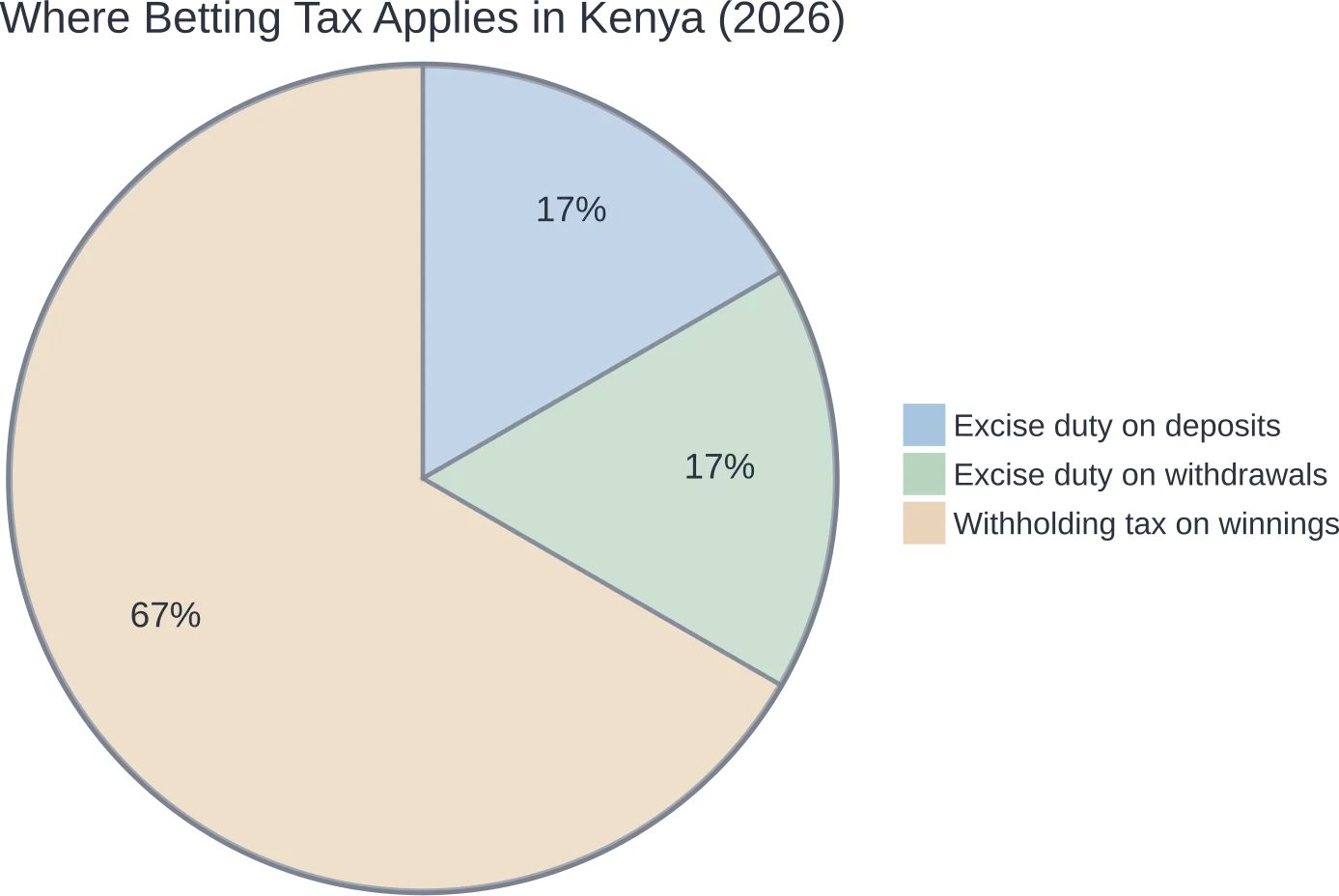
Tax is where the rules have shifted the most, and honestly, where most bettors get confused. There are two separate tax touchpoints to understand: excise duty on transactions, and withholding tax on winnings.
Under the Finance Act, 2025, excise duty on betting was changed from 15% of the amount staked to 5% of the amount deposited into a customer’s betting wallet. Separately, the Finance Act, 2026 provides for a 20% withholding tax on winnings. Bettors should confirm the current combination of deductions with KRA or a licensed operator, as the exact stack of charges has been revised more than once.
Operators who fail to withhold and remit these taxes correctly aren’t just risking a fine—they’re in direct violation of tax law, which can jeopardize their licence. Bettors don’t need to file anything themselves in most cases since deductions happen automatically, but it’s worth checking payout statements to confirm the math looks right.
Legal vs. Illegal Platforms: How to Tell the Difference
Plenty of offshore betting sites accept Kenyan customers without holding a local licence. Using them isn’t necessarily a criminal act for the individual bettor, but it comes with real risk: no local recourse if a platform refuses to pay out, no guarantee of fair game mechanics, and no oversight on how customer funds are handled.
Factor | Licensed Kenyan Operator | Unlicensed Offshore Site |
|---|---|---|
Regulatory oversight | GRA-supervised | None applicable in Kenya |
Tax compliance | Excise duty and WHT deducted automatically | Unclear or absent |
Dispute resolution | Recourse through GRA and Kenyan courts | Limited to foreign jurisdiction, if any |
Advertising restrictions | Must follow GRA advertising rules | Not bound by local rules |
Data protection | Data localization obligations apply | No guarantee of local data handling |
The simplest verification step: check whether an operator’s licence is listed as current with the GRA before depositing money. If a platform can’t point to an active Kenyan licence, that’s a red flag worth taking seriously.
Advertising Rules Bettors Should Know About
Kenya has tightened gambling advertising restrictions considerably. Key rules include:
- Celebrity and influencer endorsements are banned, preventing betting brands from using public figures to promote gambling products.
- Advertisements require pre-approval before they can be published or broadcast.
- Promotions cannot be placed near schools, reducing exposure to children and teenagers.
- Advertising near religious institutions is also restricted under the newer rules.
- Youth protection is a central policy goal, reflecting wider concern about gambling harm among younger Kenyans.
These restrictions featured prominently in the debate around the 2025 Act, with regulators framing tighter advertising controls as part of a broader effort to reduce gambling exposure and related harm.
Responsible Gambling and Minimum Stakes
Age verification matters more under the new Act than it did before. Operators are required to confirm users are 18 or older, and there was actually a legislative fight over minimum stake amounts—the Senate pushed to lower the minimum bet from KSh 20 to KSh 1 as a way of protecting minors from being drawn into betting through tiny, seemingly harmless wagers. That proposal was rejected, and the KSh 20 minimum stayed in place, reflecting Parliament’s view that keeping a modest entry barrier still serves a protective purpose.
Problem gambling remains a genuine concern in Kenya, and the GRA has signaled interest in responsible gambling tools—deposit limits, self-exclusion options, and clearer risk warnings—though the practical rollout of these tools across every licensed operator is still a work in progress as of late 2026.
FAQ: Sports Betting Laws in Kenya
Is online sports betting legal in Kenya?
Yes. Online sports betting is legal as long as the platform holds a valid bookmaking licence from the Gambling Regulatory Authority. Betting through an unlicensed offshore app carries no legal protection.
What replaced the Betting Control and Licensing Board?
The Gambling Regulatory Authority (GRA) replaced the BCLB following the Gambling Control Act, 2025. The GRA now handles licensing, compliance, and enforcement across the entire gambling sector.
What is the minimum age for betting in Kenya?
18 years old. Licensed operators are required to verify age before allowing account registration or deposits.
Can Kenyans legally use foreign betting sites?
Using an offshore platform isn’t automatically a criminal offence for the individual, but those sites operate outside GRA oversight. That means no dispute resolution support, no guaranteed tax compliance, and no consumer protection if a payout dispute arises.
Is the minimum betting stake still KSh 20?
Yes. Despite a Senate push to lower it to KSh 1 for child-protection reasons, Parliament kept the minimum stake at KSh 20 in the final version of the Gambling Control Act, 2025.
Do operators need a specific “sports betting” licence?
Not exactly. There’s no standalone licence labeled “sports betting.” Instead, companies that take or negotiate sports wagers need a bookmaker’s licence, which covers betting activity more broadly under the current framework.
The Bottom Line
Sports betting is legal in Kenya—that part hasn’t changed. What has changed is the machinery behind it: a new regulator, tighter licensing thresholds, revised tax rates, and stricter advertising rules all landed within the same eighteen-month window. For bettors, the practical takeaway is simple. Stick to platforms carrying a current GRA licence, expect automatic tax deductions on both deposits and winnings, and treat any site that can’t confirm its licensing status as one to avoid. For operators, the compliance bar has risen substantially, and staying current with GRA regulations—which are still being refined—is now a cost of doing business, not an afterthought. Check the GRA’s official listings before signing up anywhere new, and keep an eye on tax law changes since Kenya’s Finance Acts have shown a habit of adjusting betting-related rates from one year to the next.
Related Articles

September 30, 2026Is Sports Betting Legal in Brazil? The Full...

September 30, 2026Is Sports Betting Legal in Iran? The Real...