 Nothing found for the request

Do You Have to Report Gambling Winnings? 2026 Tax Guide
Sologe April 28, 2026
Share:


Quick Summary
Quick Summary: Yes, you must report all gambling winnings to the IRS, regardless of amount. Gambling income is fully taxable and must be reported on your tax return, whether you receive a Form W-2G or not. Casinos and other payers issue Form W-2G for certain winnings that meet specific thresholds, but even smaller amounts require reporting.
Had a lucky night at the casino? Hit it big on a sports bet? Scored a lottery jackpot?
Here’s the reality: the IRS wants to know about it. Every dollar you win from gambling activities counts as taxable income, and failing to report those winnings can lead to serious consequences.
But the tax rules around gambling can get confusing fast. When does the casino send you a form? What about that $500 you won on slots? And can you deduct your losses?
This guide breaks down everything you need to know about reporting gambling winnings in 2026, straight from IRS guidelines.
All Gambling Winnings Are Taxable Income
According to the IRS, gambling winnings are fully taxable and must be reported on your tax return. This applies to casual gamblers who aren’t in the trade or business of gambling.
The IRS defines gambling income broadly. It includes winnings from lotteries, raffles, sports betting, horse races, casinos, poker tournaments, and even office pools. Both cash winnings and the fair market value of prizes count—so if you win a car or a trip, that’s taxable too.
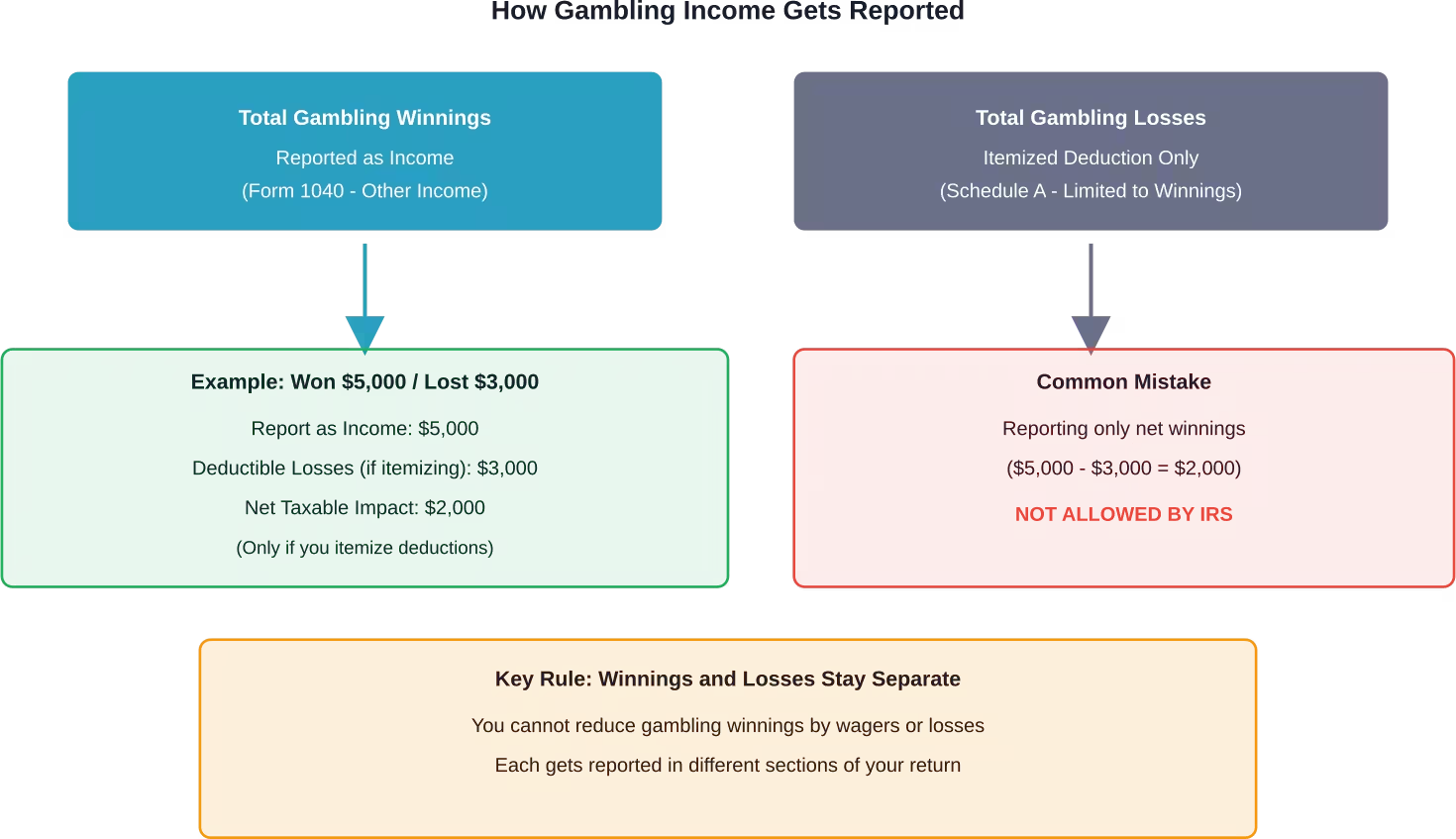
Here’s what trips people up: you can’t just report your net winnings. If you won $5,000 but lost $3,000 throughout the year, you still report the full $5,000 as income. Losses get handled separately, and the rules there are restrictive.
Form W-2G: When Casinos and Payers Must Report
Payers like casinos, sportsbooks, and lottery operators must issue Form W-2G, Certain Gambling Winnings, when your winnings hit specific thresholds. According to IRS instructions, these thresholds apply for calendar year 2026:
Type of Gambling | Reporting Threshold | Additional Conditions |
|---|---|---|
Horse Racing | $600 or more | Win must be at least 300 times the wager |
Slot Machines | $2,000 or more | Before wager reduction |
Bingo | $2,000 or more | Before wager reduction |
Keno | $2,000 or more | Reduced by wager amount |
Electronic Gaming Machines | $2,000 or more | Per IRS 2026 threshold update |
Poker Tournaments | $5,000 or more | Reduced by buy-in amount |
The IRS updated reporting thresholds for 2026. According to the Instructions for Forms W-2G and 5754, the minimum threshold for certain payments and backup withholding is now $2,000 for calendar year 2026, adjusted for inflation. This affects electronic gaming machine jackpots and certain other categories.
But here’s the critical point: even if you don’t receive a W-2G, you still must report the income. That $800 you won on blackjack? Still taxable. Those $50 lottery scratch-off wins? Taxable.
How to Report Gambling Winnings on Your Tax Return
Reporting gambling winnings happens on different parts of your tax return than reporting losses. This separation matters.
For casual gamblers, gambling winnings get reported as “Other Income” on Form 1040. The IRS requires you to include the full amount of your winnings, not reduced by any wagers or losses.
If you received a Form W-2G, the amount shown in Box 1 represents your reportable winnings. Some forms show federal income tax withheld in Box 4—this gets credited against your total tax liability when you file.
The reporting process looks like this:
- Gather all W-2G forms from casinos, sportsbooks, and lottery operators
- Compile records of all other gambling winnings not reported on W-2G
- Report the total gambling income on your Form 1040
- If applicable, report gambling losses separately as itemized deductions
Gambling winnings and losses get reported on different sections of the tax return. Winnings go on the main form as income. Losses only help if you itemize deductions, and even then, only up to the amount of your winnings.
What You Can’t Do With Gambling Winnings
The IRS is clear about what doesn’t work. You can’t subtract the cost of gambling from your winnings. If you win $620 from a horse race but it costs $20 to bet, your taxable winnings are $620, not $600. You aren’t permitted to “net” your winnings and losses on the income side.
This creates a tax situation that surprises many casual gamblers. Someone who breaks even for the year—winning $10,000 and losing $10,000—still reports $10,000 in income. They can deduct the $10,000 in losses only if they itemize, and only up to their winnings amount.
Deducting Gambling Losses: Limited Options
Gambling losses are deductible, but only under specific conditions that don’t help everyone.
First, you must itemize deductions on Schedule A. If you take the standard deduction—which many taxpayers do—you get no benefit from gambling losses. The standard deduction amounts for tax year 2025 should be verified against current IRS guidance, as these figures are not confirmed in the source material provided. Your itemized deductions need to exceed those amounts to make itemizing worthwhile.
Second, you can only deduct losses up to the amount of your winnings. If you won $2,000 and lost $5,000, you can deduct $2,000 in losses, not the full $5,000. You can’t use gambling losses to create a net loss or reduce other income.
Third, documentation matters. The IRS expects you to maintain detailed records: diary entries, receipts, tickets, statements, and other proof of both winnings and losses. Without proper records, deductions get denied.
Recordkeeping Requirements for Gamblers
The IRS doesn’t take your word for gambling losses. Proper documentation is mandatory.
For winnings, keep all Forms W-2G, payment slips, winning tickets, and statements from gambling establishments. Note the date, type of gambling, and amount won.
For losses, maintain a gambling log or diary that records:
- Date and type of gambling activity
- Name and location of the gambling establishment
- Names of people you gambled with
- Amounts won and lost
Supporting documents strengthen your records: casino statements, credit card records, bank withdrawal records, and tickets. For slot machine or video poker play, some casinos provide year-end win/loss statements—these help but don’t replace your own records.
When Federal Income Tax Gets Withheld
For certain large winnings, payers must withhold federal income tax automatically. This withholding appears in Box 4 of Form W-2G.
Regular withholding happens when gambling winnings meet specific thresholds, typically at a rate of 24% for U.S. residents. Backup withholding at 24% applies if you don’t provide a valid taxpayer identification number.
The withheld amount isn’t extra tax—it’s a prepayment toward your total tax liability. When you file your return, this withholding gets credited. If too much was withheld, you get a refund. If too little, you owe the difference.
Professional vs. Casual Gamblers: Different Tax Treatment
The IRS distinguishes between casual gamblers and professional gamblers, and the tax treatment differs significantly.
Casual gamblers—the vast majority of people—report winnings as other income and can only deduct losses as itemized deductions, limited to winnings.
Professional gamblers, those in the trade or business of gambling, report winnings and losses on Schedule C as business income and expenses. This allows them to deduct ordinary and necessary business expenses, use losses to offset other income, and potentially deduct amounts exceeding winnings.
But qualifying as a professional gambler requires meeting strict IRS criteria. The activity must be conducted with continuity, regularity, and the primary purpose of income generation. Occasional big wins don’t make you a professional.
State Tax Implications for Gambling Winnings
Federal reporting is just part of the picture. State taxes on gambling winnings vary widely.
Some states tax gambling winnings at the regular income tax rate. Others have specific withholding requirements. A handful of states—Alaska, Florida, Nevada, New Hampshire, South Dakota, Tennessee, Texas, Washington, and Wyoming—have no state income tax, so gambling winnings escape state taxation there.
Complications arise when you win in a state where you don’t reside. Some states require nonresidents to file returns and pay tax on gambling winnings earned in that state. Your home state may offer credits for taxes paid to other states, but the rules differ.
For significant winnings, consulting a tax professional familiar with multi-state gambling income becomes valuable.
What Happens If You Don't Report Gambling Winnings
Failing to report gambling winnings carries serious consequences.
The IRS receives copies of all Forms W-2G issued by casinos and other payers. Their systems match these forms to tax returns. When winnings don’t appear on a return, the IRS notices.
Penalties for underreporting income include accuracy-related penalties of 20% of the underpaid tax, plus interest. In cases of intentional tax evasion, criminal penalties can apply.
The IRS can audit returns going back three years normally, or six years if substantial income was omitted. No statute of limitations exists if you didn’t file a return at all.
Real talk: the IRS takes gambling income seriously. With sports betting growing rapidly—$136 billion has been placed in legal sports betting markets since the 2018 Supreme Court ruling according to research in the Journal of Gambling Studies—enforcement around gambling income reporting has intensified.
Special Situations and Considerations
Nonresident Aliens
Gambling winnings for nonresident aliens face different tax treatment. Generally, gambling winnings are subject to 30% withholding for nonresident aliens, with limited ability to deduct losses. Tax treaties between the U.S. and other countries may modify these rules.
Cash Prizes vs. Non-Cash Prizes
Both cash and non-cash prizes are taxable at fair market value. If you win a car valued at $30,000, that’s $30,000 of taxable income—even though you didn’t receive cash to pay the tax. Some winners decline non-cash prizes for this reason.
Jackpots Paid Over Time
Some lottery jackpots pay out over many years. Each annual payment counts as income in the year received, not when you won. This can provide tax benefits by spreading income across multiple years and potentially staying in lower tax brackets.
Make Your Gambling Setup Ready for Reporting

Reporting winnings depends on how the system behind it is built, not just on player actions. Sologe is used by companies to find platforms, services, and partners needed to run gambling products without gaps. It gives direct access to the business side of the industry, where you can choose who to work with and move forward without relying on scattered contacts.
Pick the Right Partners and Move Forward
Sologe helps you build a working structure:
- Find companies by role, not guesswork
- Understand what each one provides
- Reach them without intermediaries
- Keep everything in one place
If you’re building or fixing a gambling product, contact Sologe and discuss it.
Frequently Asked Questions
Do I have to report gambling winnings under $600?
Yes. All gambling winnings are taxable regardless of amount. The $600 threshold only determines when a payer must issue Form W-2G—it does not affect your obligation to report income.
Can I deduct my gambling losses if I don’t itemize?
No. Gambling losses are only deductible if you itemize deductions on Schedule A. If you take the standard deduction, losses provide no tax benefit.
What if I broke even gambling for the year?
You must still report all winnings as income. If you itemize, you can deduct losses up to the amount of winnings. If you take the standard deduction, you pay tax on the full winnings amount.
How long should I keep gambling records?
Keep records for at least three years after filing your tax return, or two years after paying the tax, whichever is later. For larger amounts, keeping records for up to six years is recommended.
Are online sports betting winnings taxed the same way?
Yes. Online and in-person gambling winnings are taxed the same. You must report all winnings, even if no tax form is issued by the platform.
What happens if I receive a W-2G but have already spent the money?
You still owe taxes on the winnings. The IRS taxes income when received, regardless of whether it has been spent. Any withholding shown on the form may reduce your tax liability.
Do I need to report winnings from casual bets with friends?
Technically, yes. All gambling winnings are considered taxable income. While informal bets may not always be tracked, the legal requirement to report them still exists.
Planning for Tax Obligations on Big Wins
When a substantial win happens, immediate tax planning makes sense.
Set aside funds for taxes right away. Depending on your total income and tax bracket, federal taxes could claim 22% to 37% of your winnings. State taxes add more in most locations.
Consider making estimated tax payments to avoid underpayment penalties. If gambling winnings substantially increase your income for the year, you may need to pay quarterly estimated taxes.
For very large wins—lottery jackpots, major tournament prizes—professional tax advice becomes essential. Decisions about lump sum versus annuity payments, charitable giving strategies, and multi-year tax planning can significantly impact your after-tax proceeds.
The Bottom Line on Reporting Gambling Winnings
The answer to whether you must report gambling winnings is unambiguous: yes, always.
Every dollar you win from gambling activities counts as taxable income under federal law. The IRS requires reporting regardless of amount, whether you receive a Form W-2G or not, and whether you broke even or lost money overall.
The tax system for gambling creates challenges for casual players. You report gross winnings as income but can only deduct losses if you itemize, and even then only up to your winnings. This structure means many taxpayers pay tax on gambling activity even when they don’t profit.
Proper recordkeeping isn’t optional—it’s essential. Document all winnings and losses throughout the year. Keep W-2G forms, tickets, statements, and maintain a gambling diary. Without documentation, you lose the ability to deduct losses and face problems in an audit.
When in doubt, consult a tax professional. Gambling income intersects with many complex tax rules, especially for large winnings, multi-state situations, or professional gambling activities.
Stay compliant, keep good records, and understand the rules before you play. The IRS is watching, and the consequences of underreporting aren’t worth the risk.
Related Articles

September 30, 2026Is Sports Betting Legal in Brazil? The Full...

September 30, 2026Is Sports Betting Legal in Iran? The Real...