 Nothing found for the request
![How Many Betting Sites Are in Kenya? [2026 Official Count]](https://sologe.net/wp-content/uploads/2026/06/How-Many-Betting-Sites-Are-in-Kenya_converted.webp )
How Many Betting Sites Are in Kenya? [2026 Official Count]
Sologe June 8, 2026
Share:


Quick Summary
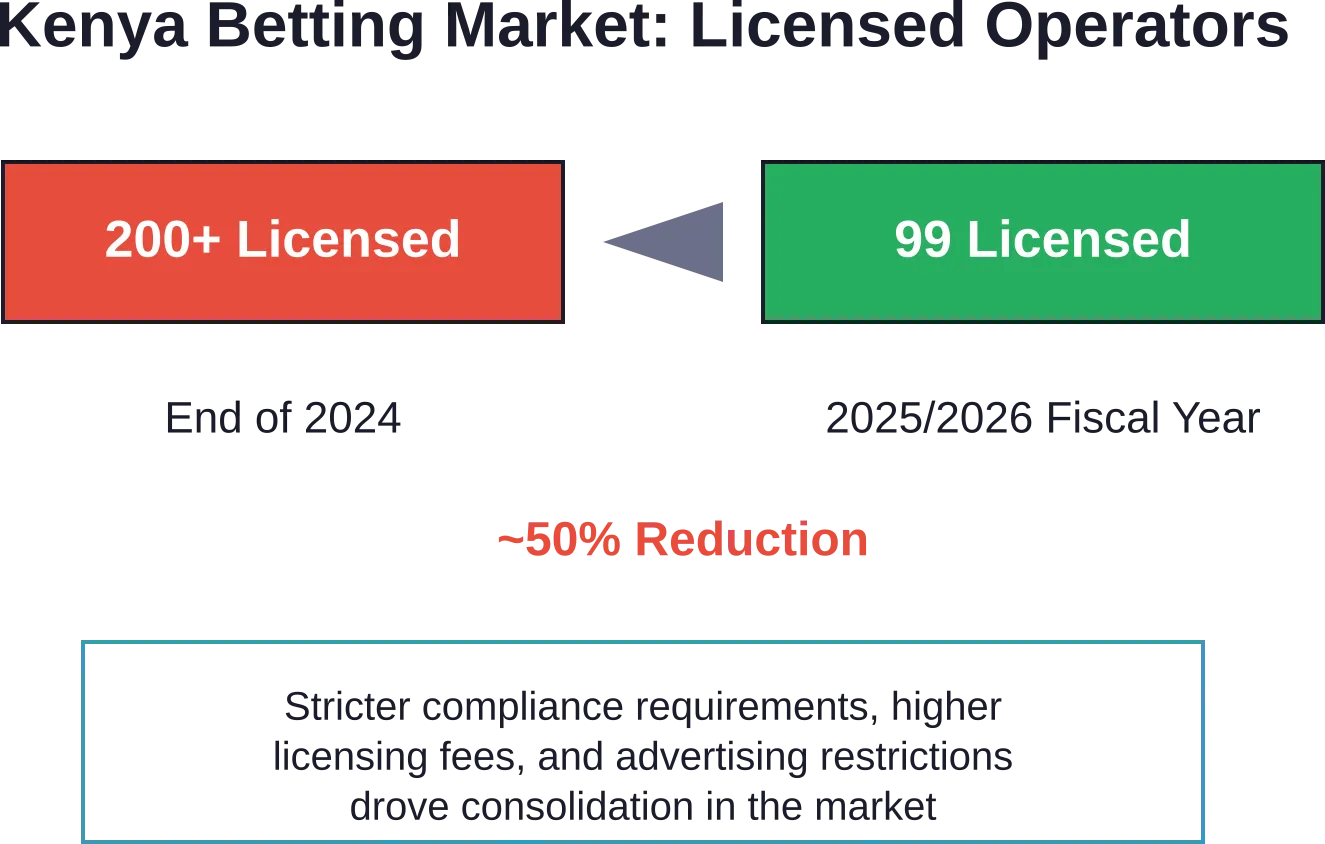
Quick Summary: As of 2026, Kenya has 99 licensed betting companies operating legally, according to the official list released by the Betting Control and Licensing Board (BCLB) for the 2025/2026 fiscal year. This number represents a significant decrease from the over 200 licensed operators that existed in 2024, reflecting stricter regulatory oversight and compliance requirements in Kenya’s betting industry.
Kenya’s betting industry has experienced dramatic shifts over the past few years. What was once a market flooded with hundreds of operators has consolidated into a more regulated, smaller pool of licensed companies.
The question “how many betting sites are there in Kenya?” doesn’t have a simple answer anymore. The landscape has changed significantly.
According to official data from the Betting Control and Licensing Board, the number of licensed operators has been drastically reduced. Here’s what the current state looks like and why these changes matter for anyone interested in betting in Kenya.
The Official Number: 99 Licensed Betting Companies
On July 29, 2025, the Betting Control and Licensing Board released the official list of licensed operators for the 2025-2026 fiscal year. The list contains exactly 99 companies that have met all regulatory requirements and received approval to operate legally in Kenya.
This marks a sharp decline from previous years. Industry reports indicate that over 200 licensed betting firms were operating in Kenya as of the end of 2024. The reduction to 99 operators represents a roughly 50% decrease in just one year.
But here’s the thing—not all betting sites Kenyans can access are on this list. Some international operators accept Kenyan customers without local licenses, operating in a legal gray area. The BCLB number only counts officially licensed, Kenya-based operators.
Major Licensed Operators in Kenya
The 99 licensed companies include both well-known international brands and popular local operators. Some of the most prominent names on the official list include:
- 1xBet
- SportPesa
- Betika
- Melbet
- Dafabet
- BC.GAME Official
- BetLion
- Mayfair Casino Ltd
- Odibets
- Betpawa
- 22Bet
These operators have demonstrated compliance with Kenya’s increasingly stringent regulatory framework. They’ve paid licensing fees, met capital requirements, and agreed to follow advertising restrictions and responsible gambling measures.
Understanding Kenya's Betting Regulation
The Betting, Lotteries and Gaming Act (Cap. 131) has been repealed by the Gambling Control Act, 2025, which replaces the BCLB with the new Gambling Regulatory Authority of Kenya (GRA).
The board’s primary functions include authorizing legal gambling activities and eradicating illegal operations. Over the past several years, enforcement has become significantly more aggressive.
Recent Regulatory Changes
Kenya has implemented sweeping reforms to address concerns about problem gambling and aggressive marketing practices. These changes explain why the number of licensed operators has decreased so dramatically.
The Finance Act 2025 introduced major shifts in how betting operations are taxed. The focus moved toward taxing betting-related deposits and withdrawals, while the standard 15% tax on Gross Gaming Revenue (GGR) remains in place.
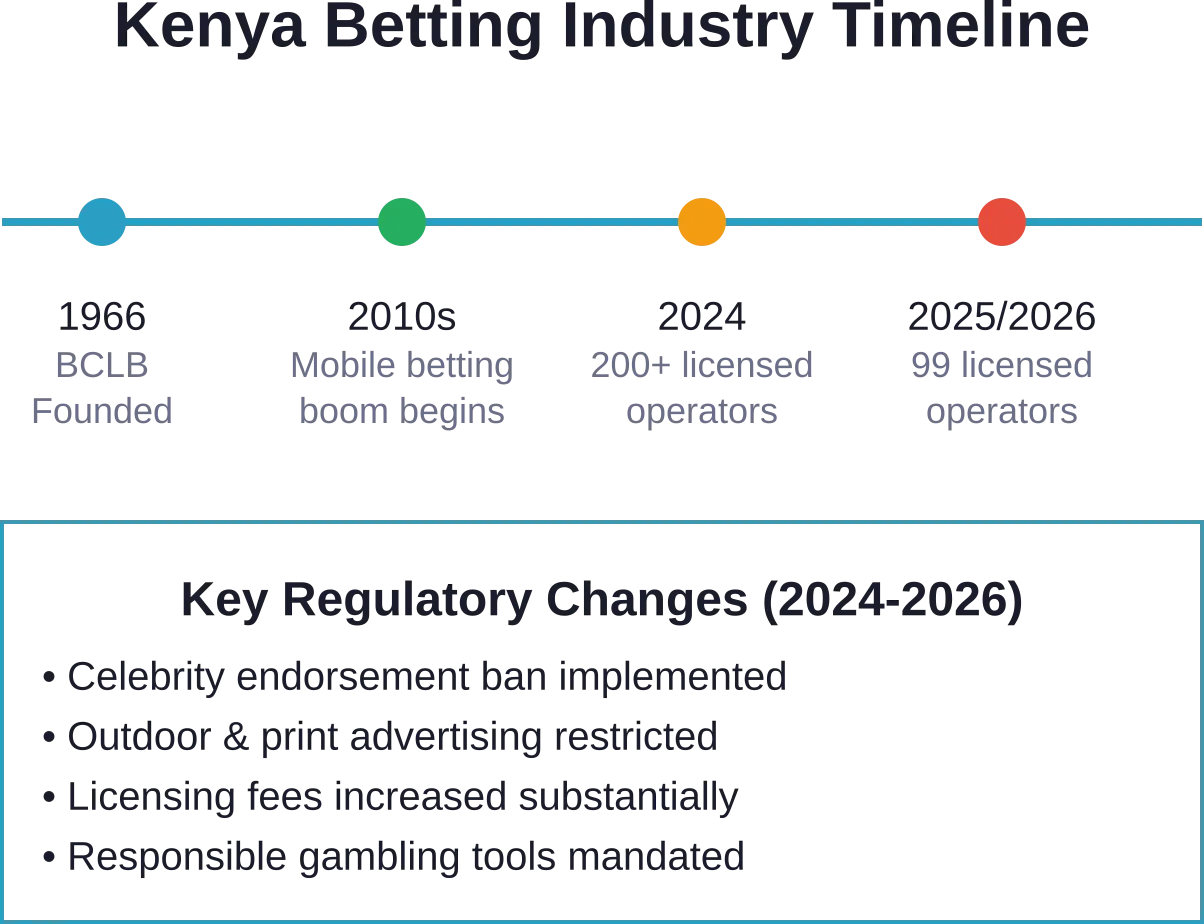
Advertising restrictions now ban celebrity endorsements of betting brands entirely. Outdoor advertising and print media ads face severe limitations. These measures aim to reduce the visibility of gambling promotions, particularly to young people.
Proposed legislation seeks to raise the legal betting age from 18 to 21. Licensing capital requirements have increased substantially, making it more expensive for smaller operators to enter or remain in the market.
Why Did the Number of Betting Sites Decrease?
The reduction from 200+ operators to 99 wasn’t accidental. Several factors contributed to this consolidation.
Higher Compliance Costs
Licensing fees have increased substantially. Reports indicate that security fees and other compliance costs now reach into hundreds of thousands of dollars. Smaller operators simply can’t afford these expenses.
The BCLB has targeted reforms including security fees and tougher licensing rules. These financial barriers prevent undercapitalized companies from obtaining or renewing licenses.
Stricter Operational Requirements
Beyond financial requirements, operators must now implement robust responsible gambling measures. This includes self-exclusion tools, deposit limits, and customer support for problem gambling.
Anti-money laundering compliance has become more rigorous. Operators need sophisticated systems to monitor transactions and report suspicious activity. Many smaller companies lacked the technical infrastructure to meet these standards.
Advertising Restrictions
The ban on celebrity endorsements and outdoor advertising fundamentally changed how betting companies acquire customers. Companies that relied heavily on aggressive marketing found their business models no longer viable.
Without the ability to advertise freely, brand recognition became harder to build. This favored established operators with existing customer bases over newer entrants.
Market Consolidation
Some operators chose to exit voluntarily rather than navigate the new regulatory environment. Others merged with larger competitors or sold their operations entirely.
The remaining 99 operators represent the most financially stable and compliance-ready companies in the market. Despite the reduced number, these operators still compete vigorously for market share.
Licensed vs Unlicensed: What Bettors Need to Know
The 99 licensed operators represent the legal betting market in Kenya. However, Kenyan bettors can technically access many more betting sites—international operators that accept Kenyan customers without BCLB licenses.
Understanding the difference matters for several important reasons.
Legal Betting Sites in Kenya
Licensed operators on the BCLB list operate under Kenyan jurisdiction. They pay taxes to the Kenyan government, follow local consumer protection laws, and face oversight from regulatory authorities.
If disputes arise, bettors have recourse through Kenyan legal channels. Licensed operators must maintain local banking partnerships and offer payment methods popular with Kenyan customers, particularly M-Pesa and Airtel Money.
Winnings from licensed operators are subject to Kenyan tax law. Currently, betting taxes in Kenya have been reduced significantly—the excise tax on stakes dropped from 15% to 5%, and withholding tax decreased from 20% to 5%.
International Operators
Many international betting sites accept Kenyan customers despite lacking BCLB licenses. These operators are based offshore, typically in jurisdictions like Curaçao, Malta, or Gibraltar.
Using these sites isn’t explicitly illegal for Kenyan bettors, but it exists in a gray area. These operators don’t pay Kenyan taxes, and bettors have limited legal recourse if problems occur.
Some international sites offer advantages like higher bonuses or better odds. However, payment processing can be more complicated, and customer support may be less responsive to Kenya-specific issues.
How to Verify a Licensed Operator
The BCLB maintains an official list of licensed operators on its website at bclb.go.ke. Before depositing money, bettors should verify that an operator appears on this list.
Licensed operators typically display their BCLB license number prominently on their websites. This number can be cross-referenced against the official registry.
Community discussions often highlight which operators are licensed and reputable. But the official BCLB list remains the authoritative source.
Kenya's Betting Market in Numbers
Beyond just counting operators, several metrics help illustrate the size and activity of Kenya’s betting market.
Metric | Value | Context |
|---|---|---|
Licensed Operators (2025/2026) | 99 | Down from 200+ in 2024 |
Excise Tax on Stakes | 5% | Reduced from 15% in recent years |
Withholding Tax | 5% | Replaces from 20% in recent years |
GGR Tax Rate | 15% | Standard industry benchmark |
Daily Visits (Kenya traffic) | 3,221,000 | Total visits to online bookmakers |
These numbers reveal a market that remains extremely active despite the reduced operator count. Over three million daily visits to betting sites demonstrate sustained interest in sports betting among Kenyan consumers.
Market Size and Growth
The Kenyan betting market has experienced explosive growth over the past decade. By 2019, gross revenue of the Kenyan betting market was expected to grow to over $50 million USD, according to The Daily Nation.
Mobile technology drove much of this expansion. The widespread availability of smartphones and mobile money platforms like M-Pesa made betting accessible to millions of Kenyans who previously had no easy way to participate.
The market has likely grown further since 2019, though exact figures for 2026 aren’t publicly available. The high number of operators seeking licensure despite stringent requirements suggests the sector remains highly profitable.
Compare Reliable Vendors Around Betting Sites

The number of betting sites in Kenya says something about market activity, but the stronger business question is which suppliers help those sites run. Sologe is built for companies working inside the iGaming industry, including software vendors, platform providers, payment companies, traffic partners, and service suppliers. For businesses studying the Kenyan market, it can help map the types of providers usually connected to betting sites, from technical infrastructure to marketing and transaction support.
Sologe can support market research in a practical way:
- browse provider categories related to betting and gaming businesses
- compare software, payment, traffic, and support companies
- see what kinds of suppliers serve operators in different markets
- identify possible partners before contacting them directly
Contact Sologe to compare iGaming vendors, check relevant provider categories, or add your business to the marketplace.
Popular Betting Sites Among Kenyan Bettors
While 99 operators hold licenses, not all enjoy equal popularity. Certain brands dominate market share based on reputation, odds quality, payment options, and promotional offers.
Top Operators by Market Presence
Betika stands out as one of the most popular local operators. The platform offers extensive sports coverage, competitive odds, and seamless M-Pesa integration.
SportPesa, despite past regulatory challenges, remains a household name in Kenya. The brand’s return to the licensed operator list marked a significant development for the market.
International brands like 1xBet and 22Bet have built substantial Kenyan user bases. These operators offer diverse betting markets and generous welcome bonuses, with 22Bet advertising bonuses of 100% up to KSh 19,000.
Odibets and Betpawa target value-conscious bettors with straightforward platforms and regular promotions. Both have invested heavily in local market understanding and customer support.
What Makes a Betting Site Popular in Kenya
Several factors determine whether a betting site succeeds in the Kenyan market:
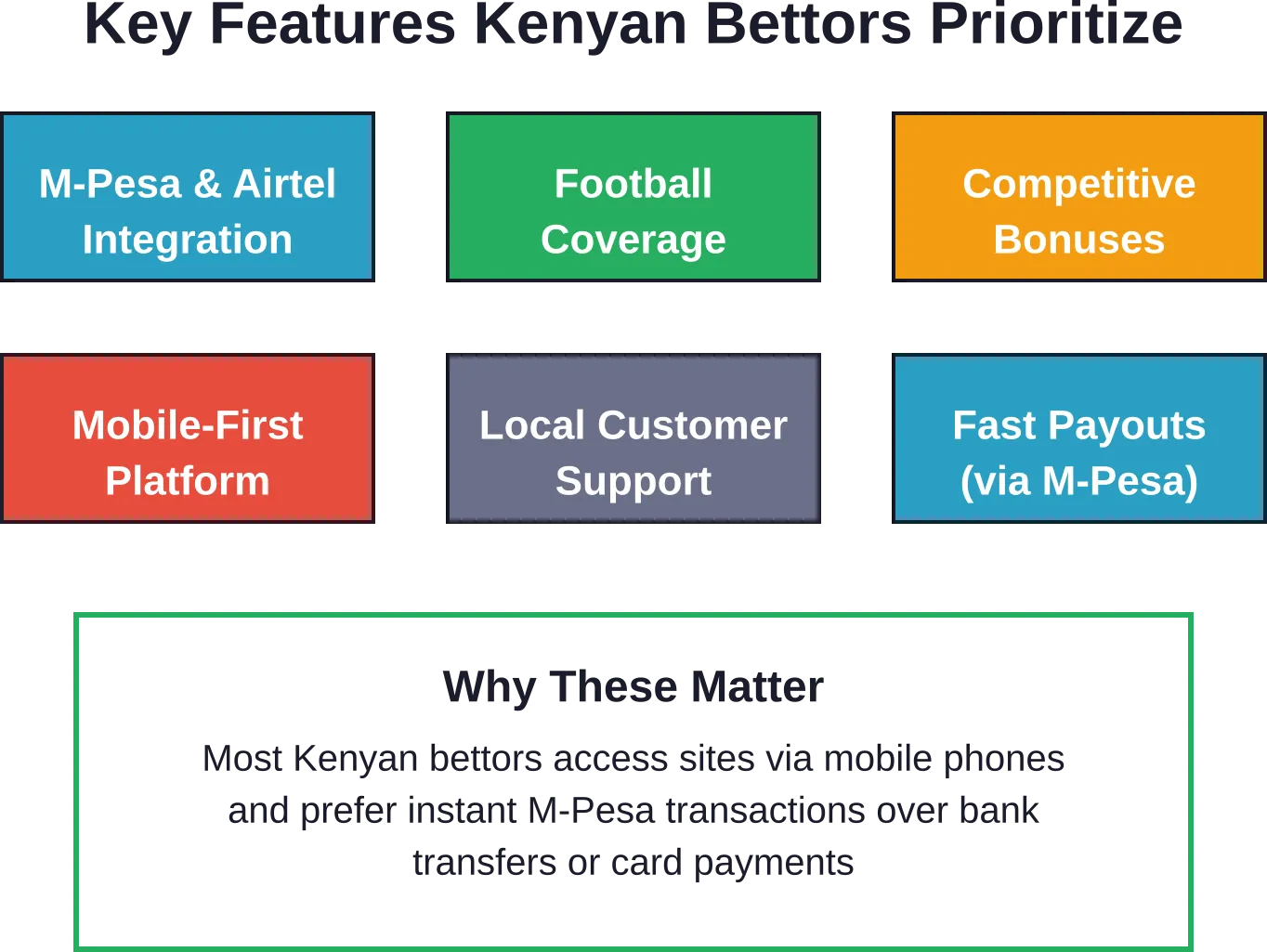
- Mobile money integration: Support for M-Pesa and Airtel Money is essentially mandatory. Kenyans overwhelmingly prefer these payment methods over bank transfers or international e-wallets.
- Football coverage: Football remains by far the most popular sport for betting in Kenya, particularly English Premier League matches. Sites with extensive football markets and competitive odds gain advantage.
- Bonus offers: Welcome bonuses and ongoing promotions attract new customers. Offers ranging from 100% to 200% deposit matches are common, with specific turnover requirements.
- User experience: Mobile-optimized platforms are critical since most Kenyans access betting sites via smartphones. Fast loading times and intuitive navigation matter enormously.
- Customer support: Local customer service teams that understand Kenyan market specifics build trust and loyalty.
Payment Methods and Mobile Money Dominance
Payment infrastructure distinguishes the Kenyan betting market from many other countries. Mobile money platforms dominate transactions in a way that’s rare globally.
M-Pesa: The Dominant Payment Method
M-Pesa, operated by Safaricom, is the overwhelmingly preferred payment method for online betting in Kenya. The platform’s ubiquity—millions of Kenyans use it for everyday transactions—makes it the natural choice for deposits and withdrawals.
Bettors can deposit funds instantly via M-Pesa from their mobile phones without needing bank accounts or credit cards. Withdrawals process equally quickly, with funds appearing in M-Pesa wallets within minutes.
Every serious betting operator in Kenya offers M-Pesa integration. Sites without this capability struggle to attract customers regardless of their other features.
Airtel Money as the Alternative
Airtel Money, operated by Airtel Kenya, serves as the primary alternative to M-Pesa. While Safaricom holds dominant market share, Airtel maintains a substantial user base.
Many betting sites support both M-Pesa and Airtel Money to maximize market reach. Some operators advertise specific Airtel Money promotions to attract this segment of bettors.
Traditional Banking and International Methods
Bank transfers and credit/debit card payments exist as options on most platforms but see minimal use compared to mobile money. The convenience gap is simply too large.
International payment methods like Skrill, Neteller, or cryptocurrency remain niche options. Some international operators without Kenyan licenses rely on these methods since they lack direct mobile money integrations.
Most Popular Sports for Betting in Kenya
Sports betting in Kenya centers overwhelmingly on football, though other sports maintain followings.
Football Dominates
European football, particularly the English Premier League, attracts the vast majority of betting activity. Kenyans follow these leagues passionately, creating strong betting interest.
Other popular football leagues include La Liga (Spain), Serie A (Italy), Bundesliga (Germany), and the UEFA Champions League. Local Kenyan football generates some betting interest but far less than European competitions.
International football tournaments like the World Cup and Africa Cup of Nations create massive betting spikes during their windows.
Other Popular Sports
Basketball, particularly the NBA, has grown as a betting option. The sport’s increasing global popularity extends to the Kenyan market.
Rugby attracts betting interest, especially when the Kenyan national team competes. Tennis, particularly Grand Slam tournaments, draws some action.
Cricket maintains a small but dedicated betting following, mostly connected to the Kenyan Indian community.
Responsible Gambling Measures and Concerns
The reduction in licensed operators connects directly to growing concerns about problem gambling in Kenya. Regulatory changes aim to address these issues.
Problem Gambling in Kenya
The rapid expansion of betting availability raised concerns about gambling addiction and its social costs. Stories of individuals losing significant sums and families suffering financial hardship became increasingly common.
Young men in particular showed concerning gambling patterns, with some spending disproportionate portions of their income on betting.
New Protective Measures
Recent reforms require operators to implement responsible gambling tools. These include deposit limits that bettors can set on their accounts, self-exclusion programs allowing people to ban themselves from platforms, and reality checks that remind bettors how long they’ve been active.
Proposed legislation seeks to establish rehabilitation programs for problem gamblers, funded by industry levies. Raising the legal betting age to 21 remains under consideration.
Advertising restrictions also aim to reduce gambling’s cultural prominence and appeal to young people.
Operator Responsibilities
Licensed operators must train staff to identify problem gambling behaviors and provide resources to affected customers. Customer service teams should direct problem gamblers toward support services.
Operators face requirements to display responsible gambling messages prominently and provide easy access to self-exclusion tools.
The Future of Kenya's Betting Industry
The consolidation to 99 licensed operators likely isn’t the end of regulatory evolution. Several trends will shape the industry going forward.
Continued Regulatory Scrutiny
Expect authorities to maintain strict oversight of licensed operators. Compliance requirements may increase further, potentially reducing the operator count even more.
The proposed betting age increase to 21 could significantly impact market size if implemented. This would exclude a substantial demographic that currently participates in betting.
Technology and Innovation
Mobile technology will continue driving innovation. Operators will invest in better mobile apps, faster payment processing, and more sophisticated betting features like cash-out options and live betting.
Data analytics and AI may enable more personalized betting experiences, though this raises additional responsible gambling concerns.
Tax Policy Changes
Taxation remains a moving target. The Finance Act 2025 shifted focus toward deposits and withdrawals, but future acts may adjust rates or structures further.
The government views betting taxes as a significant revenue source. Balancing revenue needs against industry health and consumer protection will remain challenging.
Market Maturation
As the market matures with fewer but stronger operators, competition may shift from customer acquisition to customer retention. Loyalty programs and value-added services could become more important.
The remaining operators have demonstrated long-term commitment to the Kenyan market. This stability may benefit consumers through improved service quality and more consistent experiences.
How to Choose a Licensed Betting Site in Kenya
With 99 licensed options, Kenyan bettors still face meaningful choices. Several criteria help identify the best operator for individual needs.
Verify the License
First and foremost, confirm the operator appears on the official BCLB list. Visit bclb.go.ke and check the current licensed operators.
Legitimate operators display their license numbers prominently, usually in the footer of their websites. Cross-reference this number with the BCLB registry.
Check Payment Options
Ensure the site supports M-Pesa or Airtel Money, depending on personal preference. Check deposit and withdrawal limits to confirm they align with betting plans.
Review processing times for withdrawals. The best operators process M-Pesa withdrawals within minutes.
Compare Odds and Markets
Different operators offer varying odds for the same events. Even small differences in odds impact long-term profitability significantly.
Check that the site covers preferred sports and leagues adequately. If betting primarily on English Premier League matches, ensure comprehensive market coverage for those games.
Evaluate Bonuses Carefully
Bonus offers attract attention, but terms matter more than headline numbers. A 200% bonus with impossible turnover requirements provides less value than a 100% bonus with reasonable conditions.
Review wagering requirements, minimum odds restrictions, and time limits. Some bonuses effectively can’t be cleared given their conditions.
Test Customer Support
Before depositing significant funds, test customer support responsiveness. Send questions via available channels and evaluate response times and helpfulness.
Verify that support operates in hours convenient for Kenyan time zones and that representatives understand local context.
Read Community Feedback
Community discussions on platforms like social media and forums provide insights into operator reliability. Pay attention to withdrawal experiences particularly—operators that delay or complicate withdrawals should be avoided.
Look for patterns in feedback rather than isolated complaints. Every operator receives some negative reviews, but systematic issues indicate problems.
Frequently Asked Questions
How many licensed betting companies are currently operating in Kenya?
According to the Betting Control and Licensing Board, 99 companies hold valid licenses to operate betting services in Kenya for the 2025/2026 fiscal year. This official list was released on July 29, 2025, and represents a significant reduction from the over 200 licensed operators that existed at the end of 2024.
Are all betting sites that accept Kenyan customers licensed by BCLB?
No. While 99 operators hold BCLB licenses, many international betting sites accept Kenyan customers without local licenses. These offshore operators aren’t illegal for Kenyans to use but operate outside Kenyan regulatory oversight. Licensed operators on the BCLB list offer stronger consumer protections and legal recourse if disputes arise.
What are the current betting taxes in Kenya?
Betting taxes in Kenya were significantly reduced in recent years. The excise tax on stakes decreased from 15% to 5%, and the withholding tax dropped from 20% to 5%. Operators also pay a 15% tax on Gross Gaming Revenue (GGR). The Finance Act 2025 introduced additional focus on taxing betting-related deposits and withdrawals.
Why did the number of licensed betting sites decrease so dramatically?
The reduction from 200+ to 99 operators resulted from stricter regulatory requirements implemented between 2024 and 2026. Higher licensing fees, increased compliance costs, advertising restrictions (including celebrity endorsement bans), and mandatory responsible gambling measures made the market less accessible to smaller or less-capitalized operators. Many chose to exit rather than meet these requirements.
Which payment methods do Kenyan betting sites accept?
M-Pesa dominates as the preferred payment method for online betting in Kenya, with nearly all licensed operators offering this integration. Airtel Money serves as the primary alternative mobile money option. Traditional methods like bank transfers and credit/debit cards are available but see far less usage due to convenience differences. International operators may accept e-wallets like Skrill or Neteller, and some accept cryptocurrency.
What sports do Kenyans bet on most frequently?
Football overwhelmingly dominates betting activity in Kenya, particularly European leagues like the English Premier League, La Liga, Serie A, and Bundesliga. The UEFA Champions League and international tournaments like the World Cup and Africa Cup of Nations generate massive betting interest. Other sports like basketball (especially NBA), rugby, tennis, and cricket maintain smaller but dedicated followings among Kenyan bettors.
How can I verify if a betting site is legally licensed in Kenya?
Visit the official Betting Control and Licensing Board website at bclb.go.ke to access the current list of licensed operators. Licensed sites should display their BCLB license number prominently, typically in the website footer. Cross-reference this number with the official registry before depositing funds. Only operators appearing on the official BCLB list are legally licensed to operate in Kenya.
Conclusion: A More Regulated, Consolidated Market
Kenya’s betting industry has undergone dramatic transformation in just a few years. The current count of 99 licensed operators represents a more regulated, compliance-focused market compared to the fragmented landscape of 200+ operators that existed in 2024.
This consolidation isn’t necessarily negative for Kenyan bettors. The remaining operators are financially stable, technologically capable, and committed to meeting regulatory standards. They offer robust mobile platforms, seamless M-Pesa integration, and comprehensive sports coverage.
But the market evolution isn’t finished. Regulatory changes will continue as authorities balance competing priorities—consumer protection, problem gambling prevention, tax revenue generation, and industry health.
For anyone interested in betting in Kenya, the key takeaway is clear: stick with BCLB-licensed operators. The official list of 99 companies represents the legal, regulated market where consumer protections apply and disputes have recourse.
Verify licenses before depositing funds. Compare operators based on payment options, odds quality, and bonus terms rather than marketing promises alone. And always bet responsibly, using the self-exclusion tools and deposit limits that licensed operators are now required to provide.
The Kenyan betting market remains vibrant and competitive despite—or perhaps because of—stricter regulation. The 99 licensed operators compete vigorously for customers, creating opportunities for value-conscious bettors willing to do their research.
Related Articles

September 30, 2026Is Sports Betting Legal in Brazil? The Full...

September 30, 2026Is Sports Betting Legal in Iran? The Real...