 Nothing found for the request

How Much Betting Companies Make in Kenya (2026 Data)
Sologe June 8, 2026
Share:


Quick Summary
Quick Summary: Betting companies in Kenya generate billions of shillings annually, with the market processing over Sh88 billion in stakes in 2023 (and significantly higher in subsequent years). Major firms earn millions per month through stake volumes, though exact profit margins vary widely due to operational costs, taxes (5% excise duty on deposits and 5% withholding tax on withdrawals), 15% tax on Gross Gaming Revenue, and high payout ratios that typically return 85-95% of stakes to winners.
The betting industry in Kenya has exploded into a billion-shilling phenomenon that rivals traditional financial markets. With 63.82% of the population involved in sports betting activities within the last 12 months according to the TGM Sports Betting Survey conducted in October 2022, the question isn’t whether betting companies are making money—it’s how much.
And the numbers? They’re staggering.
But here’s the thing: raw stake volumes don’t tell the whole story. The difference between what Kenyans wager and what betting firms actually pocket as profit involves a complex web of payouts, taxes, operational costs, and razor-thin margins that most gamblers never see.
The Size of Kenya's Betting Market
Kenya’s betting market processes approximately Sh2,800 every single second. Let that sink in for a moment.
Kenyans staked a record Sh88.5 billion through online bets in the full year to June 2023, and the trajectory has only climbed since. The market has become so substantial that it now rivals the Nairobi Securities Exchange in transaction volumes—a remarkable shift for an industry that barely existed two decades ago.
The sports betting sector dominates this landscape. According to research data, 63.82% of Kenyans participated in betting activities within a 12-month period, making Kenya one of the most active betting markets in Africa.
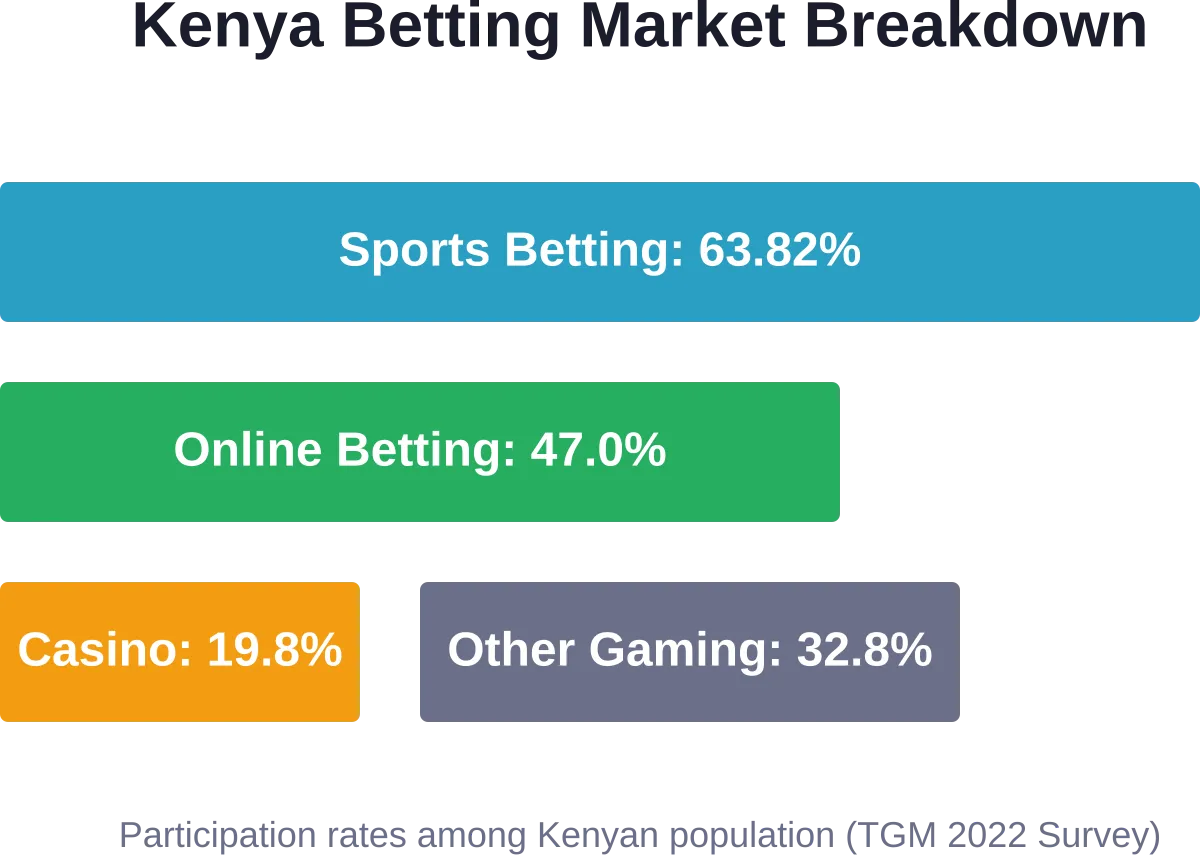
This massive participation rate translates directly into revenue opportunities for betting firms. But participation doesn’t equal profit.
Revenue vs. Profit: Understanding the Difference
Here’s where most people get confused.
When Kenyans stake Sh88 billion annually, that’s gross gaming revenue—the total amount wagered. Betting companies don’t keep all of that. Not even close.
The typical payout ratio in sports betting ranges from 85% to 95%. That means for every Sh100 staked, betting firms pay out Sh85-95 to winners. The remaining Sh5-15 is the gross margin before any costs.
From that margin, companies must cover:
- Withholding tax on withdrawals (5% of all payouts as mandated by KRA)
- Excise duty on stakes (5% regardless of the betting category)
- Operating expenses (staff, technology, marketing, licenses)
- Payment processing fees
- Customer acquisition and retention costs
Betting companies must now deduct 5% withholding tax on customer withdrawals, as per the updated tax framework. This significantly impacts the actual take-home for both gamblers and betting firms.
What Major Betting Firms Actually Earn
While specific company financials aren’t always publicly disclosed, industry analyses indicate that major betting companies in Kenya generate substantial monthly revenues.
The largest firms process hundreds of millions of shillings in stakes each month. With margins typically between 5-15% after payouts but before taxes and costs, the math starts to clarify the picture.
Real talk: a betting company processing Sh1 billion in monthly stakes might see:
Revenue Stage | Amount (Sh) | Percentage |
Total Stakes | 1,000,000,000 | 100% |
Payouts to Winners | 900,000,000 | 90% |
Gross Gaming Revenue (GGR) | 100,000,000 | 10% |
Operator Betting Tax (15% of GGR) | 15,000,000 | 1.5% |
Player Taxes (approx. on deposits/withdrawals) | ~20-40M (varies) | ~2-4% |
Operating Costs | 40,000,000 | 4% |
Net Profit (est.) | 25-45M | 2.5-4.5% |
These figures illustrate why betting is a volume game. Companies need massive transaction volumes to generate meaningful profits given the thin margins.
The Tax Burden on Betting Companies
Taxation represents one of the heaviest costs for betting firms in Kenya.
The government collects revenue through multiple channels. Under the Finance Act 2025, players now face:
- 5% excise duty on deposits into betting accounts (instead of previous stake-based excise).
- 5% withholding tax on all withdrawals (replacing the previous 20% on net winnings). This tax applies even to returning your own deposit.
Additionally, betting operators pay 15% tax on Gross Gaming Revenue (GGR) — which is total stakes minus payouts to winners.
As mandated by KRA, this new structure taxes the flow of money (deposits and withdrawals) rather than just the outcome of bets.
The tax structure means that even before a betting company addresses operational expenses, a significant portion of revenue goes directly to government coffers. This has sparked ongoing debates about the sustainability of the industry under current tax rates.
Competitive Strategies That Drive Profitability
Academic research published on Academia.edu examined differentiation strategies in Kenyan betting firms. The study targeted 90 employees in various betting businesses and found that differentiation strategies significantly enhance business performance.
According to the research, 75.6% of respondents acknowledged that advertising influences purchase decisions in Kenyan betting firms. This explains the massive marketing budgets these companies deploy.
Successful betting companies invest heavily in:
- Mobile-first platforms that work seamlessly on basic smartphones
- Aggressive bonus structures to attract and retain customers
- Live betting features that increase engagement
- Celebrity endorsements and sports sponsorships
- Simplified payment integrations with M-Pesa and other mobile money platforms
The differentiation study revealed that firms with clear competitive advantages—whether through technology, customer service, or brand positioning—consistently outperform competitors in this crowded market.
That said, customer acquisition costs remain one of the highest expenses. The battle for market share has driven some companies to offer bonuses that actually create short-term losses, betting on long-term customer lifetime value.
Research Proven iGaming Market Vendors With Sologe

Understanding how betting companies make money in Kenya also means looking at the suppliers that support the business side of the market. Sologe is a B2B marketplace for iGaming companies, suppliers, and software vendors. For companies researching betting revenue in Kenya, Sologe can be useful for seeing what kinds of vendors sit behind the market – from platform providers and payment tools to traffic partners and reporting systems.
Sologe can help businesses review:
- sports betting software providers
- iGaming platform vendors
- affiliate and traffic tools
- analytics and marketing services
- B2B suppliers for gaming companies
👉Contact Sologe to find relevant iGaming vendors, compare business-side solutions, or list your company on the marketplace.
The Real Numbers: Industry-Wide Earnings
When examining the collective performance of betting companies in Kenya, the picture becomes clearer.
With annual stakes exceeding Sh88 billion and growing, and assuming an industry-wide net margin of 3-5% after all costs and taxes, the total profit pool for betting firms in Kenya likely ranges between Sh2.6 billion and Sh4.4 billion annually.
The top three or four companies capture the majority of this profit pool. Market concentration is significant, with a handful of well-established brands dominating transaction volumes.
Smaller firms struggle to achieve profitability. The fixed costs of licensing, technology infrastructure, and regulatory compliance create barriers that favor scale. Many smaller operators run at break-even or losses for extended periods.
Future Outlook for Betting Company Earnings
The betting market in Kenya continues to evolve rapidly.
Regulatory changes remain a constant factor. Government scrutiny has increased as concerns about gambling addiction and social impacts grow. Any shift in tax rates or licensing requirements could dramatically reshape profitability.
Technology advancement offers opportunities. Companies investing in better algorithms, artificial intelligence for odds-setting, and superior user experiences can gain competitive edges that translate to better margins.
But the market also faces headwinds. As more Kenyans become educated about the mathematical realities of betting odds, participation rates could stabilize or decline. Economic pressures affect disposable income available for gambling.
Still, based on current trajectories, the betting industry in Kenya remains highly lucrative for major players who can achieve scale, manage costs efficiently, and navigate the regulatory environment.
Frequently Asked Questions
How much do the biggest betting companies in Kenya make per month?
Major betting firms in Kenya process hundreds of millions to over a billion shillings in monthly stakes. After payouts, taxes, and operational costs, the largest companies likely earn net profits ranging from Sh30 million to Sh150 million per month, though exact figures aren’t publicly disclosed for most private operators.
What percentage of stakes do betting companies keep as profit?
Betting operators pay 15% tax on their Gross Gaming Revenue (GGR). Players pay 5% excise duty on deposits and 5% withholding tax on withdrawals. For a company processing Sh1 billion in monthly stakes, the combined tax obligations (operator + collected player taxes) remain significant, often exceeding tens of millions of shillings.
Why do betting companies spend so much on advertising if margins are thin?
Research shows that 75.6% of respondents acknowledge advertising influences betting behavior. In a volume-dependent business with thin margins, customer acquisition is critical. Companies invest heavily in marketing because even small increases in market share translate to significant absolute profits given the massive stake volumes involved.
Are betting companies actually profitable in Kenya?
Yes, major betting companies operating at scale are profitable, though margins are thinner than many assume. The industry collectively generates an estimated Sh2.6-4.4 billion in annual net profits. However, smaller operators often struggle to achieve profitability due to high fixed costs and intense competition for market share.
How does Kenya’s betting market size compare to other industries?
Kenya’s betting market processes approximately Sh2,800 per second and rivals the Nairobi Securities Exchange in transaction volumes. With annual stakes exceeding Sh88 billion, the industry has become one of the most significant consumer-facing sectors in the country, though it remains smaller than telecommunications or banking.
Conclusion
Betting companies in Kenya operate in a massive market that processes billions of shillings annually. While the gross revenues appear enormous, the actual profitability of these firms is constrained by high payout ratios, substantial tax obligations, and significant operational costs.
The largest players with efficient operations and strong market positions earn substantial profits—potentially tens of millions per month. But the industry isn’t quite the gold mine it appears from the outside. Margins are tight, competition is fierce, and regulatory pressures continue to mount.
Understanding the real economics behind betting companies reveals an industry built on volume, where success depends on operational efficiency, customer acquisition, and the ability to maintain scale in an increasingly competitive environment.
For anyone considering the betting industry—whether as a participant, investor, or observer—the key takeaway is clear: the house does win, but the edge is smaller than most people think.
Related Articles

September 30, 2026Is Sports Betting Legal in Brazil? The Full...

September 30, 2026Is Sports Betting Legal in Iran? The Real...