 Nothing found for the request
How to Calculate Odds in Gambling: 2026 Guide
Sologe April 28, 2026
Share:


Quick Summary
Quick Summary: Calculating gambling odds involves converting betting odds formats (American, decimal, fractional) into probabilities using simple formulas. Divide 1 by decimal odds, convert American odds using specific formulas based on positive or negative values, and transform fractional odds by dividing denominator by (numerator + denominator). Understanding implied probability helps identify value bets where actual outcomes differ from bookmaker predictions.
Gambling odds aren’t just random numbers bookmakers slap onto events. They’re mathematical representations of probability that determine potential payouts and reveal how likely an outcome is to occur.
Understanding how to calculate these odds transforms gambling from pure chance into informed decision-making. Whether betting on sports, playing poker, or rolling dice, the mathematics remain consistent.
The ability to convert between odds formats and calculate implied probability separates casual bettors from strategic players. Let’s break down exactly how these calculations work.
Understanding the Three Main Odds Formats
Gambling odds appear in three primary formats depending on geographic location and platform preference. Each format conveys identical information but uses different mathematical structures.
American Odds
American odds center around $100 as the baseline. Positive numbers show how much profit a $100 bet generates, while negative numbers indicate how much to wager for $100 profit.
A $100 bet at +120 pays $120 in profit. That’s straightforward enough. But negative odds work differently—a bet at -140 requires $140 risked to win $100.
The math scales proportionally. A $50 bet at +120 returns $60 profit. A $70 bet at -140 wins approximately $50.
Decimal Odds
Decimal odds represent the total amount returned for every dollar wagered, including the original stake. This format dominates European betting markets and online platforms.
Decimal odds of 2.50 mean a winning $100 bet returns $250 total—$150 profit plus the original $100 stake. The calculation stays simple regardless of bet size.
To find profit specifically, subtract 1 from the decimal odds then multiply by the stake. With 2.50 odds and a $100 bet: (2.50 – 1) × $100 = $150 profit.
Fractional Odds
Traditional in British betting shops, fractional odds display as ratios like 4/1 or 9/2. The first number represents potential profit, the second represents the stake required.
Odds of 4/1 mean betting 1 unit wins 4 units profit. A $100 bet at 4/1 returns $400 profit plus the original $100 stake.
With 9/2 odds, every $2 wagered wins $9 profit. A $100 bet returns $450 profit plus the $100 stake back.
List Your Offer in an iGaming Marketplace

Sologe lets vendors publish gaming products and services in one place. You can organize listings across categories like software, platforms, equipment, and services so buyers can find them more easily.
Want to Add Your Product?
List with Sologe to:
- publish your offer in a structured marketplace
- choose the right category for your listing
- reach buyers browsing industry products
👉 Get in touch with Sologe to list your product
Converting Odds to Implied Probability
Every odds format conceals an implied probability—the bookmaker’s assessment of how likely an outcome is to occur. Calculating this probability reveals the mathematical foundation beneath the odds.
Decimal Odds to Probability
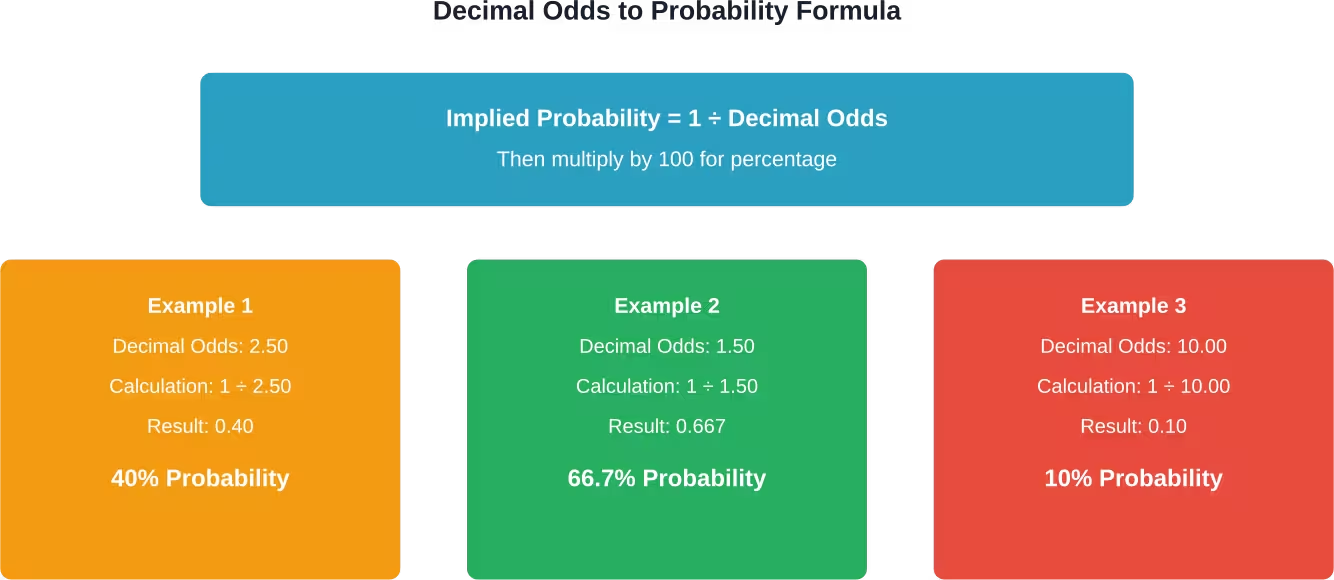
The formula for decimal odds conversion is remarkably simple: divide 1 by the decimal odds.
Implied Probability = 1 / Decimal Odds
For decimal odds of 2.50: 1 / 2.50 = 0.40, which equals 40% probability. The bookmaker believes this outcome has a 40% chance of occurring.
This calculation works universally for any decimal odds. Higher odds equal lower probability, lower odds equal higher probability.
American Odds to Probability
American odds require two different formulas depending on whether the number is positive or negative.
For positive odds (+120, +200, etc.):
- Implied Probability = 100 / (Positive Odds + 100)
For negative odds (-140, -200, etc.):
- Implied Probability = Negative Odds / (Negative Odds + 100)
- With +120 odds: 100 / (120 + 100) = 100 / 220 = 0.4545 or 45.45% probability.
- With -140 odds: 140 / (140 + 100) = 140 / 240 = 0.5833 or 58.33% probability.
Fractional Odds to Probability
Converting fractional odds requires adding the numerator and denominator, then dividing the denominator by that sum.
Implied Probability = Denominator / (Numerator + Denominator)
For 4/1 odds: 1 / (4 + 1) = 1 / 5 = 0.20 or 20% probability.
For 9/2 odds: 2 / (9 + 2) = 2 / 11 = 0.1818 or 18.18% probability.
Probability | Decimal Odds | Fractional Odds | American Odds | $100 Bet Profit |
|---|---|---|---|---|
10% | 10.00 | 9/1 | +900 | $900 |
20% | 5.00 | 4/1 | +400 | $400 |
40% | 2.50 | 3/2 | +150 | $150 |
50% | 2.00 | 1/1 | +100 | $100 |
66.7% | 1.50 | 1/2 | -200 | $50 |
Calculating Basic Gambling Probabilities
Some gambling scenarios involve straightforward probability calculations based on physical outcomes like dice rolls or card draws.
Dice Probability
A standard six-sided die has six equally likely outcomes. The probability of rolling any specific number is 1/6 or approximately 16.67%.
Academic research on gambling probability demonstrates fundamental principles. Rolling a seven in craps occurs with approximately 18% probability because multiple combinations produce that result (1-6, 2-5, 3-4, 4-3, 5-2, 6-1).
Rolling a two requires snake eyes (1-1), appearing in just one of 36 possible two-dice combinations. That’s approximately 2.78% probability.
Card Game Probability
A standard 52-card deck contains four suits with 13 ranks each. Drawing a specific card like the ace of spades has 1/52 probability or 1.92%.
Drawing any ace has 4/52 probability, which reduces to 1/13 or approximately 7.69%. Drawing any heart has 13/52 probability, exactly 25%.
These calculations assume random shuffling and no previous cards removed from the deck.
Identifying Value Bets Through Probability
Value betting occurs when the actual probability of an outcome exceeds the implied probability from the odds. This represents the mathematical edge sophisticated bettors seek.
If decimal odds of 2.50 imply 40% probability, but analysis suggests the true probability is 50%, that’s a value bet. The bookmaker has underestimated the likelihood.
Calculating expected value quantifies this edge. The formula is:
Expected Value = (Probability of Winning × Profit) – (Probability of Losing × Stake)
With $100 bet at 2.50 decimal odds where true probability is 50%:
EV = (0.50 × $150) – (0.50 × $100) = $75 – $50 = $25
A positive expected value indicates a profitable bet over many repetitions. Negative expected value means long-term losses.
The House Edge and Bookmaker Margin
Bookmakers don’t offer true odds. They build in a profit margin called the overround or vigorish.
In a perfect two-outcome event with 50/50 probability, true odds would be 2.00 decimal (even money) for both sides. But bookmakers might offer 1.91 on each side instead.
Converting 1.91 to probability: 1 / 1.91 = 52.36%. Both outcomes together total 104.72% instead of 100%. That extra 4.72% represents the bookmaker’s margin.
This margin ensures profitability regardless of outcomes. Bettors must overcome this edge to achieve long-term profits.
Converting Between Odds Formats
Understanding how to switch between formats helps when comparing odds across different platforms or regions.
Decimal to American
For decimal odds greater than 2.00:
- American Odds = (Decimal Odds – 1) × 100
For decimal odds less than 2.00:
- American Odds = -100 / (Decimal Odds – 1)
- Converting 2.50: (2.50 – 1) × 100 = +150
- Converting 1.50: -100 / (1.50 – 1) = -100 / 0.50 = -200
Fractional to Decimal
Divide the numerator by the denominator, then add 1.
For 4/1: (4 / 1) + 1 = 5.00
For 9/2: (9 / 2) + 1 = 4.50 + 1 = 5.50
American to Decimal
For positive American odds:
- Decimal Odds = (American Odds / 100) + 1
For negative American odds:
- Decimal Odds = (100 / Absolute Value of American Odds) + 1
- Converting +150: (150 / 100) + 1 = 2.50
- Converting -200: (100 / 200) + 1 = 1.50
American Odds | Decimal Odds | Fractional Odds | Implied Probability |
|---|---|---|---|
+100 | 2.00 | 1/1 | 50.0% |
+150 | 2.50 | 3/2 | 40.0% |
+200 | 3.00 | 2/1 | 33.3% |
-150 | 1.67 | 2/3 | 60.0% |
-200 | 1.50 | 1/2 | 66.7% |
Practical Applications and Common Mistakes
Research from Chapman University’s Economic Science Institute examined how gamblers form probability assessments. The study found that gambling frequency actually predicted lower accuracy in Bayesian probability tasks.
Research from Chapman University’s Economic Science Institute examined probability assessment among gamblers. The study found that gambling frequency predicted lower accuracy in Bayesian probability tasks, suggesting that experience alone does not guarantee improved probability assessment skills.
Common calculation errors include:
- Confusing profit with total return when using decimal odds
- Applying the wrong American odds formula for positive versus negative numbers
- Forgetting to add 1 when converting fractional to decimal odds
- Assuming implied probability represents true probability without accounting for bookmaker margin
Real talk: knowing the formulas matters less than understanding what the numbers actually mean. A 20% implied probability doesn’t mean an event happens one in five times—it means the bookmaker priced it that way.
Using Odds Calculators Effectively
Modern betting platforms include built-in odds calculators that automatically convert formats and display potential payouts. These tools handle the arithmetic but understanding the underlying math remains valuable.
When entering odds into calculators, the stake amount and odds format determine the output. American odds centered around $100 scale proportionally for different bet sizes.
But calculators can’t assess value. They show what happens if a bet wins, not whether the bet has positive expected value. That analysis requires independent probability estimation.
FAQ
What’s the easiest way to calculate gambling odds?
Decimal odds provide the simplest calculation method. Just divide 1 by the decimal odds to get implied probability as a decimal, then multiply by 100 for the percentage. For payout, multiply the stake by the decimal odds to see total return including the original bet.
How do bookmakers calculate their odds?
Bookmakers use statistical models, historical data, expert analysis, and market activity to estimate true probabilities. They then adjust these probabilities downward (make odds less favorable) to build in a profit margin, typically 2–10% depending on the market and competition.
What’s the difference between true odds and implied odds?
True odds represent the actual mathematical probability of an outcome occurring. Implied odds are the probability suggested by the betting odds the bookmaker offers, which include their profit margin. True odds of 50% should pay 2.00 decimal, but implied odds might show 1.91 instead.
Can I make money by just calculating odds correctly?
Calculating odds accurately is necessary but not sufficient for profitable gambling. Success requires estimating true probabilities more accurately than bookmakers, identifying value bets with positive expected value, and maintaining disciplined bankroll management over many bets.
Why do different bookmakers offer different odds for the same event?
Bookmakers have different risk assessments, target different customer bases, use varying profit margins, and respond to different betting patterns. Shopping for the best odds across multiple bookmakers can improve long-term returns by 2–5%.
How does the house edge affect my calculations?
The house edge or bookmaker margin means the sum of implied probabilities exceeds 100%. This built-in disadvantage requires finding bets where true probability sufficiently exceeds implied probability to overcome the margin and generate positive expected value.
What’s a break-even percentage in betting?
Break-even percentage represents the win rate needed to avoid losses at given odds. Calculate it using the implied probability formula. At +150 odds (40% implied probability), winning 40% of bets over time breaks even. Winning more than 40% generates profit.
Conclusion
Mastering odds calculation transforms gambling from guesswork into mathematical analysis. The formulas for converting between American, decimal, and fractional formats provide a foundation for understanding probability and expected value.
But here’s the thing—knowing how to calculate odds is just the starting point. The real skill lies in estimating true probabilities more accurately than the market, identifying positive expected value situations, and maintaining discipline across hundreds of bets.
Bookmaker margins ensure the house maintains an edge. Overcoming that edge requires superior probability assessment, not just arithmetic proficiency.
Start applying these calculations to real betting markets. Compare implied probabilities across different bookmakers. Calculate expected value for potential bets. Track results to validate your probability estimates against actual outcomes.
The mathematics doesn’t guarantee wins on individual bets. It reveals which bets offer long-term value—and that’s how consistent profits emerge from calculated risk.
Related Articles

September 30, 2026Is Sports Betting Legal in Brazil? The Full...

September 30, 2026Is Sports Betting Legal in Iran? The Real...