 Nothing found for the request

How to Use a Gambling Strategy: Science-Backed Guide 2026
Sologe April 28, 2026
Share:


Quick Summary
Quick Summary: Using a gambling strategy involves setting clear limits, understanding game odds, and applying structured betting approaches like bankroll management and protective behaviors. Research shows that effective strategies focus on self-control rather than guaranteed wins, since all casino games have a house edge that makes long-term profit mathematically impossible for pure chance games.
Gambling strategies have captivated players for centuries. But here’s the thing—most people misunderstand what a gambling strategy actually is and what it can realistically accomplish.
The truth? No betting system can overcome the house edge in pure games of chance. A strategy won’t guarantee wins at roulette or slots. But that doesn’t mean strategies are worthless.
When used correctly, gambling strategies help manage risk, extend playing time, and make decisions more deliberate. Research published in NIH journals shows that protective behaviors and self-control strategies are associated with reduced gambling problem severity.
This guide breaks down how to use gambling strategies based on evidence, not folklore. It covers what works, what doesn’t, and how to gamble more intelligently.
Understanding What Gambling Strategies Can and Cannot Do
Let’s address the elephant in the room first. Many gamblers believe that betting strategies can transform losing propositions into winning ones.
According to Wikipedia’s article on betting strategies, to be successful, a betting system must change the house edge into a player advantage—which is impossible for pure games of probability with fixed odds, akin to a perpetual motion machine.
Sound familiar? That’s because it’s mathematically proven.
The House Edge Reality
Every casino game has a built-in mathematical advantage for the house. Roulette, slots, craps—they all tilt in the casino’s favor over time. The house edge is permanent and unchangeable through betting patterns alone.
But does that actually work? No betting strategy can eliminate this edge in pure chance games.
That said, strategies can help with:
- Managing bankroll effectively to extend playing sessions
- Reducing impulsive decisions that lead to bigger losses
- Setting clear boundaries for time and money spent
- Making more informed bets based on odds understanding
- Implementing protective behaviors that research shows reduce harm
Where Strategies Actually Matter
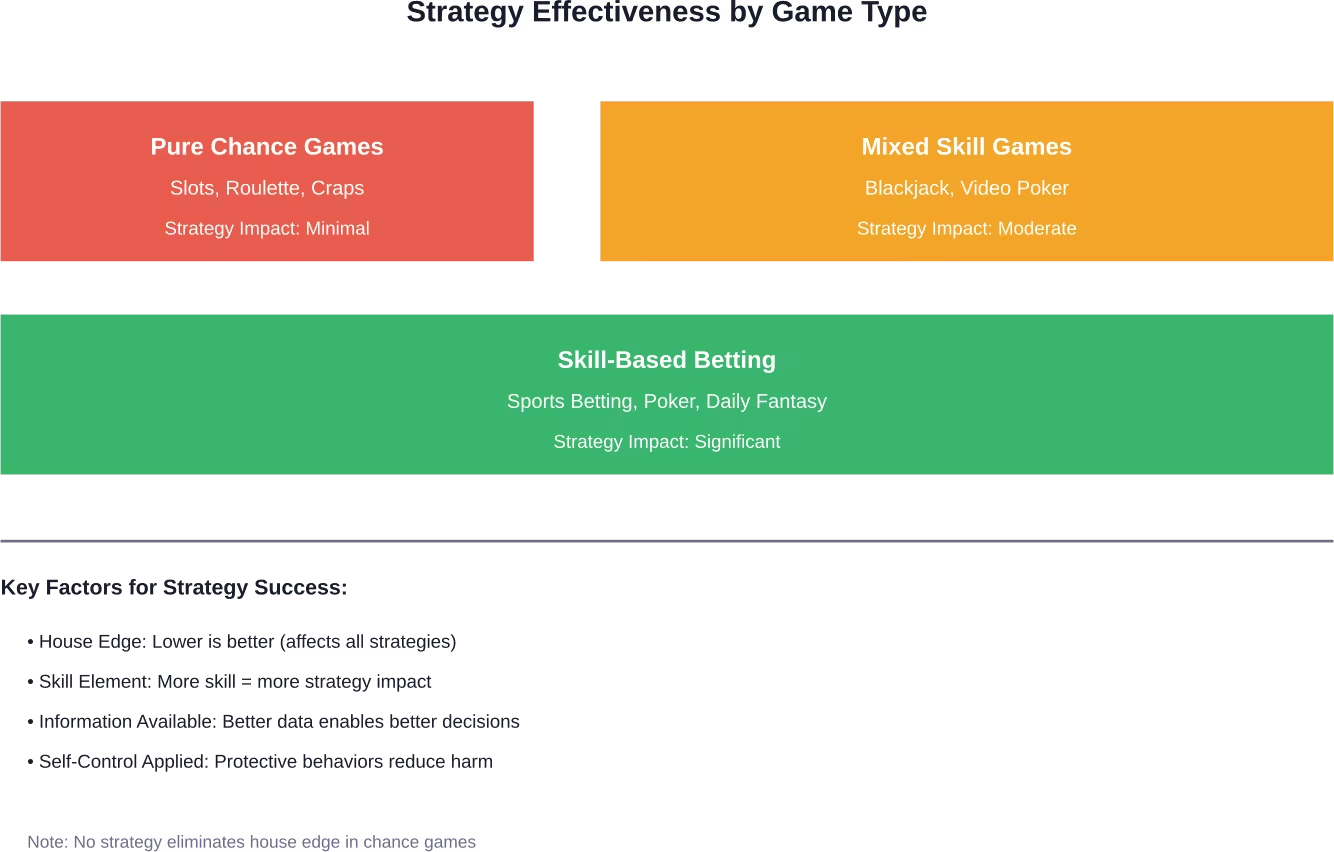
Gambling strategies prove most valuable in games with skill components. Sports betting, poker, and blackjack allow for strategic thinking that can improve outcomes.
Research from Carleton University published in 2025 examining responsible gambling messages found that self-appraisal messages and player segmentation approaches showed promise in encouraging safer gambling behaviors.
The key distinction: strategies should focus on harm reduction and entertainment value, not guaranteed profits.
Publish Gaming Products in One Platform

Sologe provides a space where vendors can upload and manage product listings across multiple gaming categories, all in one place.
Need a Simple Listing Platform?
List with Sologe to:
- publish offers in one marketplace
- organize products by type
- reach users searching for gaming solutions
👉 Get in touch with Sologe to list your product
Core Gambling Strategies That Research Supports
Academic research has identified several approaches that actually help gamblers make better decisions. These aren’t magic formulas—they’re protective behaviors.
Bankroll Management Strategy
This is the foundation. Bankroll management means deciding in advance how much money to allocate for gambling and never exceeding that amount.
Research from the Canadian Centre on Substance Use and Addiction examining gambling self-control strategies identified protective behaviors used to control gambling.
Here’s how to implement it:
- Determine a gambling budget that won’t affect essential expenses
- Divide the bankroll into smaller session amounts
- Never gamble with money needed for bills, food, or housing
- Set a loss limit for each session (typically 5-10% of total bankroll)
- Walk away when the session limit is reached
The math is simple. If gambling with a $500 bankroll and setting a 5% session limit, that’s $25 per session. Losing that amount ends the session immediately.
Time-Based Limits
According to the Journal of Gambling Studies research on protective behaviors, setting time limits helps reduce problem gambling severity among participants.
Many experts suggest using alarms or timers when gambling. Casinos deliberately avoid clocks and windows—time awareness is protective.
Practical implementation:
- Set a phone alarm before starting any gambling session
- Limit sessions to 30-60 minutes for high-intensity games
- Take mandatory 15-minute breaks between sessions
- Track total gambling hours per week
Research from USC examining sports gambling demographics found that the ‘All-Ins’ bettor segment watches an average of 22.38 hours of sports per week.
The Protective Behaviors Framework
NIH research on gambling protective behaviors identified specific actions that correlate with reduced problem gambling. These behaviors form a comprehensive strategy framework.
Protective Behavior | Description | Research Support |
|---|---|---|
Pre-commitment | Deciding limits before gambling begins | Strong evidence for harm reduction |
Avoiding chasing losses | Not trying to win back lost money | Key predictor of problem gambling |
Taking breaks | Regular interruptions during play | Reduces impulsive decision-making |
Avoiding gambling when upset | Not gambling to cope with emotions | Linked to lower problem severity |
Setting win limits | Stopping after reaching profit target | Helps maintain discipline |
These protective behaviors work because they interrupt the cycle of impulsive betting and emotional decision-making.
Popular Betting Systems: What Actually Works
Now, this is where it gets interesting. Numerous betting systems claim to beat the house, but research and mathematics tell a different story.
The Martingale System
The martingale betting strategy involves doubling bets after each loss, theoretically recovering all losses with one win. According to Scientific American, the martingale betting strategy has led many gamblers to ruin.
Here’s why it fails:
Starting with a $1 bet on a 50-50 proposition (like red/black in roulette), a losing streak requires exponential increases. After seven consecutive losses, the eighth bet needs to be $128 to recover the $127 already lost.
Real talk: casinos impose table limits specifically to prevent martingale systems from working. A string of bad luck hits betting limits before recovery becomes possible.
But wait. The mathematics prove that the martingale cannot overcome the house edge. It’s equivalent to attempting a perpetual motion machine—theoretically interesting but practically impossible.
The Kelly Criterion
Scientific American discusses the Kelly criterion as a mathematically sound alternative to the martingale strategy. This strategy calculates optimal bet sizing based on edge and odds.
The Kelly formula: f = (bp – q) / b
Where f is the fraction of bankroll to bet, b is the odds received, p is probability of winning, and q is probability of losing.
The Kelly criterion works when bettors have an actual edge (like in sports betting with superior analysis). It doesn’t create an edge—it optimizes bet sizing when one exists.
Flat Betting Strategy
The simplest approach: bet the same amount every time. Flat betting won’t win more money, but it protects bankroll and extends playing time.
For entertainment-focused gamblers, flat betting at 1-2% of total bankroll per wager provides dozens of bets before exhausting funds.
Game-Specific Strategy Application
Different gambling activities require different strategic approaches. What works for sports betting fails miserably at slot machines.
Sports Betting Strategy
Sports betting offers the best opportunity for strategic advantage because outcomes aren’t purely random. Research shows skilled bettors can identify value in mispriced odds.
Effective sports betting strategies include:
- Line shopping across multiple sportsbooks for best odds
- Specializing in specific sports or leagues for information advantage
- Using statistical models rather than gut feelings
- Avoiding parlays and exotic bets with higher house edges
- Betting only when finding positive expected value
According to research from the University of Chicago examining parlay betting, these multi-leg bets significantly increase risk compared to straight wagers.
Casino Table Games Strategy
Games like blackjack and baccarat have optimal strategies based on mathematics. Blackjack basic strategy charts reduce the house edge to around 0.5% when followed perfectly.
The strategy for table games:
- Learn basic strategy charts for blackjack before playing
- Avoid side bets with higher house edges
- Choose games with favorable rule variations
- Understand that even optimal play doesn’t guarantee wins
Many experts suggest that blackjack offers the best odds for casual gamblers willing to learn basic strategy. But even with perfect play, the house maintains a slight edge.
Slot Machine Reality
Slots require no strategy because outcomes are entirely random and predetermined by RNG (random number generation). The house edge ranges from 2-15% depending on the machine.
The only “strategy” for slots:
- Choose machines with higher RTP (return to player) percentages
- Set strict loss limits before playing
- Treat it as entertainment with expected cost
- Never chase losses on slot machines
Real talk: slot machines are designed to be addictive. The near-misses, frequent small wins, and audiovisual stimulation trigger psychological responses that encourage continued play.
Implementing Self-Control Strategies
Research from the Canadian Centre on Substance Use and Addiction conducted qualitative analysis of gambling self-control strategies used by real gamblers.
The findings? Self-control strategies focus on limiting money spent, frequency of gambling, and time spent gambling. These protective approaches prove more effective than betting systems.
Pre-Commitment Tools
Pre-commitment means making decisions about limits before gambling begins, when judgment isn’t clouded by wins, losses, or emotions.
Effective pre-commitment tactics:
- Withdraw only predetermined cash amounts for gambling
- Leave credit cards and ATM cards at home
- Use casino self-exclusion programs if needed
- Set deposit limits on online gambling accounts
- Tell someone else about gambling plans for accountability
Research from Karolinska Institutet on internet-delivered cognitive behavioral therapy for gambling disorder found that patients receiving iCBT exhibited posttreatment outcomes similar to patients who underwent face-to-face treatment.
Avoiding Emotional Gambling
NIH research on protective behaviors found that avoiding gambling when upset was a significant protective factor against problem gambling.
Emotional states that should trigger gambling avoidance:
- After significant personal or financial stress
- When feeling depressed or anxious
- Following relationship conflicts
- After drinking alcohol or using substances
- When trying to escape problems
Generally speaking, gambling should be a recreational choice, not an emotional coping mechanism.
The Break-Taking Strategy
Research shows that regular breaks during gambling sessions reduce impulsive decision-making and help maintain perspective.
Structured break approach:
- Take a 5-minute break every 30 minutes of play
- Leave the gambling area during breaks
- Check remaining bankroll and time limits during breaks
- Reassess whether to continue or stop
Casinos don’t encourage breaks. That’s precisely why they’re important.
Self-Control Strategy | Implementation Method | Expected Benefit |
|---|---|---|
Cash-only gambling | Leave cards at home, bring predetermined cash | Prevents overspending beyond limits |
Time alarms | Set phone timer before starting | Maintains time awareness |
Session limits | Divide bankroll into session amounts | Extends bankroll lifespan |
Win goals | Stop after reaching profit target | Locks in occasional wins |
Buddy system | Gamble with accountability partner | Reduces impulsive decisions |
Responsible Gambling Messages and Their Effectiveness
Recent research from Carleton University published an evaluation of responsible gambling messages and their effectiveness in changing behavior.
The study found that self-appraisal messages and player segmentation approaches showed promise in encouraging safer gambling behaviors. But here’s the catch—effectiveness varied significantly based on message type and target audience.
What Works in Responsible Gambling
Research examining warning pop-up messages on gambling behavior found that certain interventions can impact decision-making, particularly for vulnerable populations.
Effective responsible gambling approaches:
- Messages that prompt self-appraisal of current gambling behavior
- Reality checks showing time and money spent during sessions
- Personalized feedback based on individual gambling patterns
- Positive framing emphasizing control rather than danger
- Easy access to self-exclusion and limit-setting tools
Generally speaking, fear-based warnings prove less effective than empowering messages that reinforce personal control.
Online Gambling Considerations
Online gambling presents unique challenges. Research highlights that internet gambling features like availability, anonymity, convenience, digital payment, and immersion may impact problem severity.
Strategies specific to online gambling:
- Use deposit limits offered by gambling sites
- Enable reality check features that interrupt play
- Avoid storing payment information on gambling sites
- Set software-based time limits on devices
- Track online gambling separately from in-person play
The research on internet-delivered CBT for gambling disorder showed that online interventions can effectively support behavior change when properly designed.
Common Gambling Strategy Mistakes to Avoid
Even with the best intentions, gamblers often sabotage themselves with strategic errors.
The Gambler’s Fallacy
This is believing that past results influence future outcomes in independent events. After five red results in roulette, black isn’t “due” to hit. Each spin has identical odds regardless of history.
The gambler’s fallacy leads to increasing bets based on false pattern recognition. It’s one of the most costly cognitive errors in gambling.
Chasing Losses
Research consistently identifies loss-chasing as a primary risk factor for problem gambling. It’s the practice of gambling more after losing to recover losses.
But wait. Loss-chasing typically accelerates losses rather than recovering them. It combines increased bet sizing with emotional decision-making.
Overconfidence from Small Wins
Early winning sessions create false confidence that skills or systems are working. This is especially dangerous in games of pure chance.
That said, variance means anyone can have winning sessions. Short-term results don’t validate long-term strategies in negative expectation games.
Misunderstanding Probability
Many gambling strategies fail because users don’t understand basic probability. A 90% win rate doesn’t mean winning 9 out of 10 times in a small sample.
Probability converges to expected values over large sample sizes—sometimes thousands or millions of trials.
When to Seek Help with Gambling
Sometimes gambling strategies aren’t enough. Research indicates that 2% to 5% of the general population in North America develops problem gambling, with other countries showing 0.12–5.8% of the population.
Warning signs include:
- Gambling with money needed for essential expenses
- Lying to family or friends about gambling activities
- Feeling unable to stop despite wanting to quit
- Chasing losses consistently
- Gambling to escape problems or relieve stress
- Borrowing money to gamble
Research from Karolinska Institutet demonstrates that cognitive behavioral therapy, including online interventions, can effectively treat gambling disorder.
Resources are available. Support and treatment resources are available through confidential hotlines and counseling services for problem gambling.
Frequently Asked Questions
Can any gambling strategy guarantee wins?
No gambling strategy can guarantee wins in games with a house edge. Research shows it’s mathematically impossible to turn negative expectation games into profitable ones through betting patterns alone. Strategies can help with bankroll management and decision-making but cannot overcome the built-in advantage casinos hold.
What’s the safest gambling strategy for beginners?
Flat betting with strict bankroll limits is the safest approach. Set aside a specific amount exclusively for gambling, never exceeding 1–2% of that bankroll per bet. Combine this with time limits, regular breaks, and pre-commitment to stop at predetermined loss levels. These behaviors significantly reduce problem gambling risk.
Do betting systems like Martingale work?
The Martingale system fails because table limits and bankroll constraints prevent unlimited doubling. While it may appear effective in short sessions, losing streaks eventually exhaust bankrolls or hit table maximums before recovery occurs. The underlying mathematics do not support long-term success.
How much should I bet per gambling session?
Limiting individual bets to 1–2% of total bankroll helps extend playing time and reduce risk. For example, with a $500 bankroll, bets should be $5–10. Session losses should be capped at 5–10% of the bankroll before stopping. These limits help prevent rapid losses and emotional decisions.
Are there gambling games where strategy makes a difference?
Yes. Skill-based activities like sports betting, poker, and blackjack allow strategy to improve outcomes. For example, blackjack basic strategy can reduce the house edge to around 0.5%. However, even optimal strategies do not eliminate the house advantage entirely.
What are gambling protective behaviors?
Protective behaviors are actions that reduce gambling-related harm. These include setting time and money limits, taking breaks, avoiding gambling when emotionally distressed, not chasing losses, and using pre-commitment tools. Research shows these habits lower the risk of problem gambling.
How do I know if my gambling strategy is working?
Track results over a large sample size—at least 100+ sessions. Focus on whether you stay within limits and maintain control, not just short-term profits. A successful strategy means consistent discipline and adherence to limits. Long-term profits in negative expectation games are typically due to variance, not strategy effectiveness.
Conclusion: The Real Purpose of Gambling Strategies
Here’s the bottom line. Gambling strategies won’t beat the house edge or generate guaranteed income. But that’s not their real purpose.
Research clearly demonstrates that effective gambling strategies focus on protection, not profit. They help maintain control, extend entertainment value, and reduce the risk of problem gambling.
The most successful approach combines several elements: strict bankroll management, time limits, protective behaviors, emotional awareness, and realistic expectations. These create a framework for responsible gambling that maximizes enjoyment while minimizing harm.
For games with skill components like sports betting and poker, strategic thinking can improve outcomes. But even then, success requires discipline, research, and honest self-assessment.
The question isn’t whether a gambling strategy can make someone rich. It’s whether the strategy helps maintain control and gambles responsibly within means.
Start by implementing protective behaviors today. Set clear limits before gambling, take regular breaks, and never chase losses. Track results honestly and adjust when patterns become concerning.
Gambling should be entertainment with a predetermined cost, not a financial strategy. The best gambling strategy is one that keeps it fun, controlled, and sustainable.
Related Articles

September 30, 2026Is Sports Betting Legal in Brazil? The Full...

September 30, 2026Is Sports Betting Legal in Iran? The Real...