 Nothing found for the request
Is Sports Betting Legal in Argentina? The 2026 Answer
Sologe September 30, 2026
Share:


Quick Summary
Yes, sports betting is legal in Argentina, but there’s no single national law that covers the whole country. Instead, each of the 23 provinces plus the Autonomous City of Buenos Aires (CABA) decides whether to regulate online and retail betting, issues its own licenses, and sets its own rules. As of 2026, more than half of these jurisdictions have active frameworks, so legality genuinely depends on where a bettor is physically located when placing a wager.
Short answer first: betting on football, tennis, horse racing, and pretty much every other sport is perfectly legal in Argentina. Longer answer? It’s complicated, and the complication is the whole story here.
Argentina doesn’t run gambling the way most countries do. There’s no single regulator sitting in Buenos Aires handing out one license that covers the entire nation. Instead, the power to regulate gambling sits with the provinces themselves, a setup baked into the country’s constitution. That means a sportsbook can be fully licensed and legal in Mendoza while operating in a legal gray zone — or outright banned — in a neighboring province. For anyone trying to figure out whether they can legally place a bet, the real question isn’t “is it legal in Argentina” but “is it legal in this specific province.”
The Legal Foundation: Why Argentina Doesn’t Have One National Betting Law
Argentina is a federal republic, and under its constitutional framework, gambling regulation was never delegated to the national government. It stayed with the provinces. So each of the 23 provinces, along with the Autonomous City of Buenos Aires, acts as its own sovereign authority when it comes to authorizing, licensing, and taxing gambling activity within its borders.
The general legal principle that governs the whole system is simple, even if the practical outcome isn’t: gambling and gaming are prohibited unless expressly authorised by a competent authority. That phrase shows up again and again in legal summaries of Argentine gambling law, and it’s the key to understanding everything else. Nothing is automatically legal. A province has to actively pass legislation, create a regulator, and issue licenses before betting becomes lawful there.
Historically, sports wagering — particularly the old-school “quiniela” style pools and horse racing bets — was overseen through the Lotería Nacional and the national Sport Forecasting framework (Prode). That legacy system still matters for horse racing and certain lottery-style products, but it’s the newer wave of provincial online licensing that’s reshaped the market over the last several years.
Which Provinces Have Regulated Online Sports Betting?
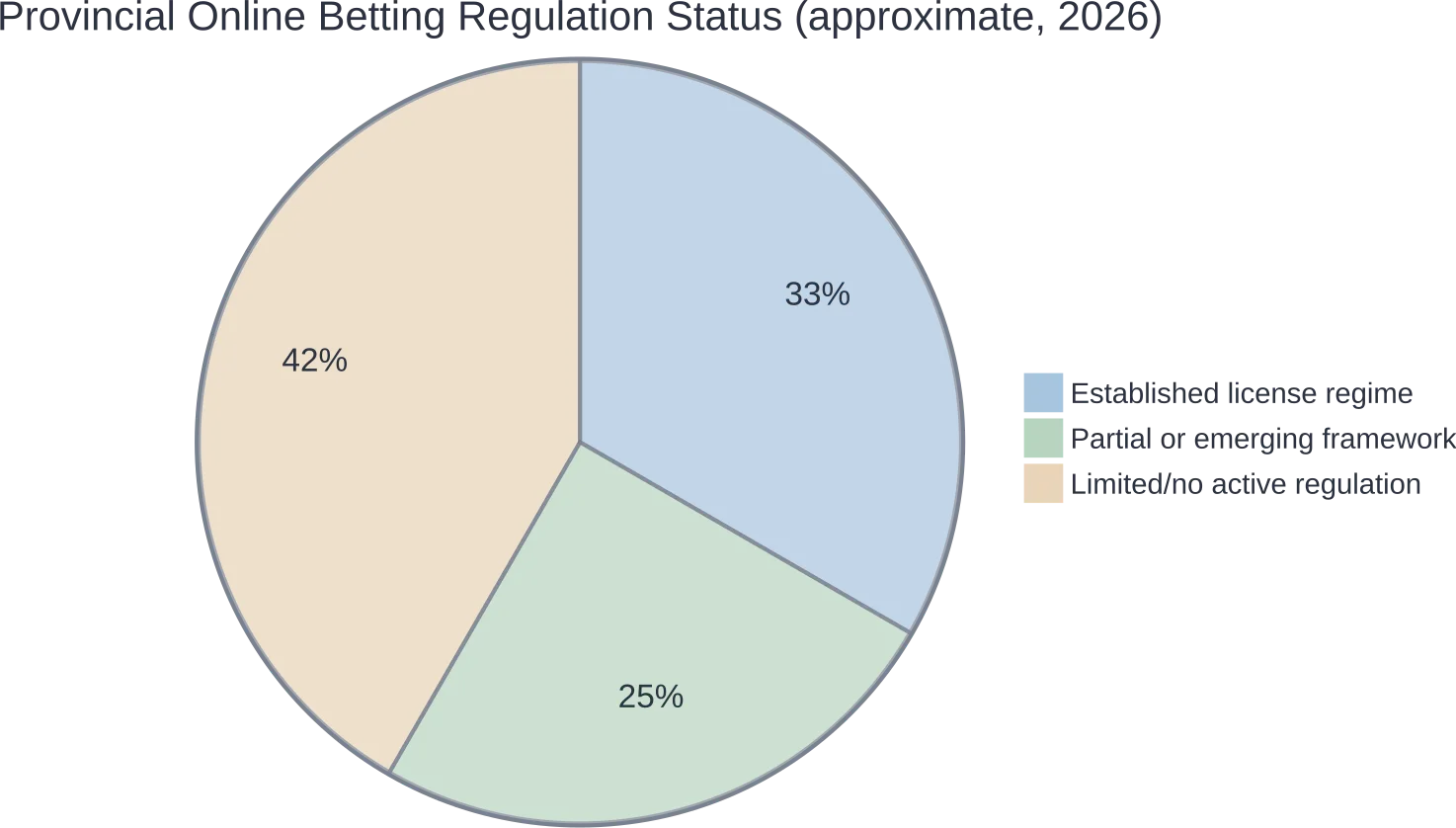
More than half of Argentina’s 24 jurisdictions have now put a regulatory framework in place, though the pace and quality of implementation varies a lot. Some provinces run mature, well-supervised markets with real technical requirements. Others have laws on the books but not much active enforcement yet, and a handful haven’t moved on online betting at all.
Jurisdictions generally considered to have clearer, more established online licensing regimes include Buenos Aires Province, the City of Buenos Aires (CABA), Córdoba, Mendoza, and Santa Fe. Meanwhile, provinces such as Catamarca, Corrientes, Formosa and La Pampa have been slower to build mature private-operator markets, while Jujuy and Misiones already license specific online operators even if their regimes are narrower than those in CABA or Buenos Aires Province, which doesn’t necessarily mean betting is banned there — it often just means the legal picture is murkier and enforcement is inconsistent.
Province status | What it means for bettors | Examples |
|---|---|---|
Established online license regime | Locally licensed sites, .bet.ar domains, active regulator | Buenos Aires Province, CABA, Córdoba, Mendoza, Santa Fe |
Partial or emerging framework | Some legal basis exists, but rules are still developing | Chubut, La Rioja, San Juan |
Limited or emerging private-operator market | Legal basis exists, but fewer operators or tighter state control | Catamarca, Formosa, La Pampa |
Here’s the thing though — this table is a snapshot, not a permanent map. Provincial legislatures update their gambling laws fairly often, and a jurisdiction that looks unregulated today could pass a licensing law next year. Anyone serious about betting legally should check the current status of their specific province through its official lottery or gaming authority before assuming anything.
How to Tell If a Betting Site Is Actually Licensed
Since 2021, Argentina has required all legally licensed operators to use the .bet.ar domain extension. This was designed specifically to cut through the confusion caused by province-by-province rules — a bettor can look at a site’s URL and get an immediate signal about whether it holds a legitimate Argentine license, rather than being an offshore operator advertising illegally into the market.
That said, the domain rule only tells part of the story. A site can be legally licensed in one province and still be off-limits to a bettor sitting in another. Local licenses are jurisdictional, not national, so the .bet.ar badge confirms the operator is licensed somewhere in Argentina, not necessarily in the bettor’s home province.
- Check for the .bet.ar domain as a baseline signal of legitimacy.
- Confirm the operator is licensed in the province where the bettor is physically located.
- Look up the provincial gaming authority’s official list of authorized operators (most publish one).
- Be wary of offshore international sportsbooks advertising heavily without local licensing — they operate in a legal gray area for Argentine residents.
What Sports Can Argentines Legally Bet On?
Football dominates, unsurprisingly. Argentina’s football culture runs deep, and domestic league matches along with international competitions make up the bulk of betting volume. Horse racing holds its own historical importance too, tracing back to the Lotería Nacional’s original oversight of racing wagers long before online sportsbooks existed.
Beyond those two, licensed operators typically offer markets on tennis, basketball, boxing, motorsport, and increasingly esports. Casino games and poker are usually bundled into the same provincial licenses as sports betting, so a licensed operator in, say, CABA or Buenos Aires Province will often offer a full suite — sportsbook, casino, and poker — under one roof.

Reach Sports Betting Buyers with Sologe
AtSologe, we help sportsbook and iGaming vendors present platforms, payment solutions, software, services, and other products in one industry marketplace. Our goal is to make it simpler for relevant buyers to find your offer while they are already researching providers.
Looking to Get Your Product in Front of More Buyers?
With Sologe, you can:
- list your solution in a marketplace built around iGaming
- place it in the most relevant category
- show buyers clearly what your company provides
- create another route for potential partners to discover your offer
👉Contact us to list your product on Sologe.
Taxes, Advertising, and the Rules Operators Actually Follow
National-Level Compliance Requirements
Even though licensing sits at the provincial level, a few things function more like national baseline rules. Anti-money-laundering requirements, data protection obligations, and certain indirect taxes apply broadly across the country regardless of which province issued the license.
Advertising Rules Vary by Province
Advertising still varies by province, but it is no longer purely local: national consumer-protection rules now impose mandatory health and +18 warnings on online gambling ads across media and digital platforms, while each jurisdiction can add stricter limits of its own.
Why the Patchwork Creates Confusion
This fragmented system creates real friction for both bettors and operators. A promotion that’s perfectly acceptable in one province might violate the rules in another.
It also means bettors can sometimes see advertising from sites that are not actually authorized to accept their wagers locally. An operator may be licensed to advertise in one province while the same campaign still reaches viewers across provincial borders.
Is There a Push for a National Framework?
Yes, and it comes up regularly in industry discussions. Some voices in the gambling sector argue Argentina would benefit from a unified national system — one license, one set of rules, one regulator overseeing the whole country. Proponents say it would simplify compliance and reduce the confusion that leaves bettors unsure whether a given site is actually legal for them.
But provincial officials tend to push back on that idea. Their argument: the current system, fragmented as it looks from the outside, actually gives operators legal certainty because jurisdictional licenses come with clear rules and solid agreements at the provincial level. Given that gambling regulation is constitutionally reserved to the provinces, any shift toward a truly national system would likely require broad political consensus that doesn’t currently exist. So for now, and probably for the foreseeable future, the province-by-province model is what bettors and operators have to work with.
Practical Steps for Bettors Who Want to Stay Legal
- Identify the province where you’ll physically be placing bets — legality follows location, not citizenship.
- Search for that province’s official lottery or gaming authority website and look for its licensed operator list.
- Confirm any sportsbook you’re considering carries a .bet.ar domain and a license matching your province.
- Avoid sites that only accept cryptocurrency or unusual payment routes with no local licensing — that’s a common red flag for unauthorized offshore books.
- Re-check the rules periodically. Provincial gambling law changes more often than people expect.
FAQ: Sports Betting Legality in Argentina
Is online sports betting legal in Argentina?
Yes, in most of the country’s jurisdictions. More than half of Argentina’s 23 provinces plus CABA have passed laws authorizing and regulating online sports betting, though the framework and enforcement quality differ from one to the next.
Do I need to check my specific province before betting?
It’s a good idea, yes. Since gambling regulation is handled provincially rather than nationally, legality genuinely depends on where you’re located. A site that’s fully licensed in Córdoba isn’t automatically authorized to take bets from someone in a province with no regulatory framework.
What is the .bet.ar domain and why does it matter?
It’s a mandatory domain extension that legally licensed Argentine operators must use. Seeing .bet.ar in a site’s URL is a quick way to confirm it holds an Argentine gambling license, though it doesn’t guarantee that license covers your specific province.
Is horse racing betting treated differently from sports betting?
Horse racing has its own long regulatory history tied to the Lotería Nacional, predating the modern online licensing wave. It remains a legal and culturally significant betting category, often bundled alongside sports betting products by licensed operators.
Can foreign or offshore betting sites legally operate in Argentina?
Not without a local license. Offshore sportsbooks that advertise into Argentina without holding a provincial license are operating outside the legal framework, even if they aren’t always actively blocked. Betting through them carries more risk since there’s no local regulatory protection.
Is Argentina expected to create one national gambling law?
Possibly eventually, but not imminently. Industry voices have floated the idea of a unified federal system, but provincial authorities generally favor keeping regulation local, and constitutional constraints make a quick national overhaul unlikely.
Are casino games and poker also legal alongside sports betting?
Generally yes. Provinces that license sports betting typically bundle casino games and poker into the same licensing regime, so a legally operating sportsbook in a regulated province will often offer all three under one license.
The Bottom Line
Sports betting is legal in Argentina — that much is settled. What takes more digging is figuring out exactly where and how, since the country’s provincial system means legality is a moving target depending on location rather than a single fixed national rule. The good news is that the tools to check are readily available: the .bet.ar domain requirement, published provincial operator lists, and a growing base of well-regulated markets in provinces like Buenos Aires, CABA, Córdoba, and Mendoza. Before placing a single peso on a match, it’s worth spending five minutes confirming that the operator holds a valid license for the exact province where the bet is being placed. That small step is really the difference between betting legally and stepping into a gray area that offers no real protection if something goes wrong.
Related Articles

September 30, 2026Is Sports Betting Legal in Brazil? The Full...

September 30, 2026Is Sports Betting Legal in Iran? The Real...