 Nothing found for the request

Is Lottery Gambling? Definition & Facts (2026)
Sologe April 28, 2026
Share:


Quick Summary
Quick Summary: Yes, the lottery is gambling. It meets all legal and technical definitions of gambling: participants pay money, outcomes are determined by chance, and prizes are awarded. Recognized as gambling by medical researchers, regulatory bodies, and the DSM-5 (which classifies gambling disorder), lotteries represent one of the most widespread forms of legalized gambling worldwide.
The question seems simple enough. But the answer reveals something fascinating about how societies classify risk, reward, and chance-based activities.
Here’s the thing: millions participate in lotteries without considering it “gambling” in the traditional sense. Yet medical researchers, regulatory agencies, and legal frameworks worldwide classify lotteries definitively as gambling. So what’s the disconnect?
This article breaks down the legal definitions, medical research, and practical distinctions that answer this question conclusively.
The Legal Definition: What Makes Something Gambling?
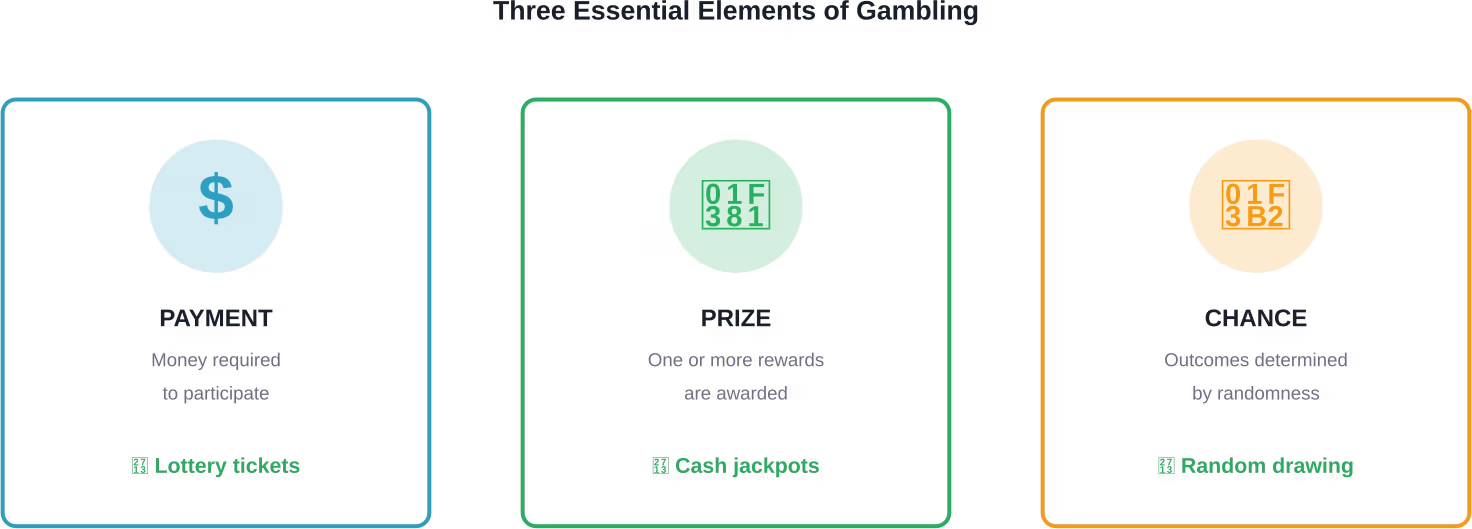
According to the Gambling Commission, gambling requires three essential elements:
- Payment is required to participate
- One or more prizes are awarded
- Those prizes are awarded by chance
Lotteries check every single box. Participants purchase tickets, prizes range from small amounts to millions, and winners are selected through random number drawing. The outcome depends entirely on chance, not skill.
Legal frameworks distinguish between two lottery types: simple lotteries and complex lotteries. Simple lotteries involve a single process where prizes are allocated by chance. Complex lotteries may involve multiple stages, but at least one stage relies on chance for prize allocation.
Both qualify as gambling under statutory definitions across jurisdictions.
How Governments Classify Lotteries
Texas law considers lottery participation a form of wagering. State penal codes typically define gambling as making bets on outcomes determined by chance—a definition lotteries satisfy completely.
The taxation structure further confirms this classification. Lottery revenues face specific tax treatments, and winnings are taxed as gambling income in most jurisdictions.
Medical Research: Lottery as Gambling Behavior
Medical literature leaves no ambiguity. Research published in the Journal of Gambling Studies explicitly categorizes lottery purchasing as gambling behavior.
According to the National Institutes of Health, an estimated 49% of individuals over age 14 in the United States reported past-year lottery gambling. In Europe, research shows 9.9% of high-school adolescents participated in offline lotteries, with 7.6% engaging in online lottery gambling.
These aren’t casual observations. The studies track lottery participation alongside other gambling activities to understand behavioral patterns, addiction risks, and demographic trends.
The DSM-5 Classification
The Diagnostic and Statistical Manual of Mental Disorders, Fifth Edition (DSM-5) reclassified gambling disorder within the addictions category. This represents a significant shift in understanding behavioral addictions.
Lottery gambling specifically falls under this diagnostic framework. Individuals who develop problematic relationships with lottery participation can be diagnosed with gambling disorder using DSM-5 criteria.
Research examining online lottery gambling tracked behavioral indicators, net losses, voluntary self-exclusion, and problem gambling classifications. The study identified five distinct profiles of lottery gamblers, with varying levels of activity and risk.
That’s medical science treating lottery participation as gambling behavior worthy of clinical attention and intervention.
Why the Lottery Feels Different from "Gambling"
So why do so many people mentally separate lotteries from gambling? Several factors create this perception gap.
Government operation normalizes lotteries. State-run lottery systems carry official legitimacy that casino gambling often lacks. When governments promote lottery participation through advertising and retail partnerships, the activity gains social acceptance.
The time delay matters. Traditional lottery formats involve purchasing tickets days or weeks before drawings. This extended timeframe contrasts sharply with casino gambling, where outcomes arrive within seconds or minutes.
According to research on gambling mechanics, the less time between wagering and outcome, the more participants become drawn into continued play. Lotteries’ slower pace reduces the immediate reinforcement cycle that characterizes slot machines or table games.
Low entry costs create accessibility. A lottery ticket might cost two dollars, making participation feel trivial rather than serious gambling. But frequency matters—those small purchases accumulate.
The Revenue Reality
Americans spend more than $100 billion annually on lottery tickets. That exceeds combined spending on cigarettes, music, sports tickets, movie tickets, books, and video games.
Households with incomes below $50,000 spend an estimated 30% more on lottery tickets than households with incomes above $100,000. This creates what researchers identify as a regressive financial burden disproportionately affecting lower-income populations.
Knowledge at Wharton research indicates behavioral biases, including financial illiteracy, drive lottery purchasing decisions. The odds of winning major prizes stand at astronomically low probabilities, yet ticket sales continue growing.
Characteristic | Traditional Lotteries | Casino Gambling |
|---|---|---|
Operator | Government-run or licensed | Private or tribal entities |
Time to outcome | Days to weeks | Seconds to minutes |
Entry cost | $1-$20 per ticket | Varies widely |
Social perception | Socially acceptable | More stigmatized |
Tax treatment | Gambling income | Gambling income |
Addiction potential | Lower immediate reinforcement | Higher immediate reinforcement |
Lottery Types and Gambling Classification
Different lottery formats all qualify as gambling, though their specific mechanics vary.
Traditional draw lotteries involve purchasing numbered tickets before a scheduled drawing. Winners are selected by random number generation or mechanical ball selection. Powerball and Mega Millions represent this category’s most recognized examples.
Instant lotteries, commonly called scratch-offs or scratch cards, provide immediate results. Participants reveal symbols or numbers that immediately indicate win or loss status. The instant gratification more closely resembles casino gambling patterns.
Online lottery platforms represent the fastest-growing segment. Digital lottery participation allows continuous access through websites and mobile applications. Research tracking online lottery gambling shows distinct behavioral profiles emerging from this format’s convenience and accessibility.
Raffle-style lotteries sell numbered tickets with winners drawn from the total sold. Prize structures often include a 50-50 split, where organizers promise 50% of revenue as the prize pool.
Every format shares the fundamental gambling characteristics: payment, chance-based outcomes, and prizes.
The Odds and Mathematical Reality
Lottery gambling carries negative expected returns by design. The mathematical structure ensures operators retain a significant portion of revenue.
Major lottery games feature odds exceeding 1 in 300 million for jackpot prizes. Even smaller prizes carry odds that guarantee most participants lose money over time.
This isn’t hidden information. Lottery operators publish odds transparently. Yet behavioral economics research shows cognitive biases override rational financial calculation.
People overweight small probabilities, mistaking “possible” for “plausible.” The availability heuristic makes jackpot winners memorable, distorting perception of actual winning likelihood. And the sunk cost fallacy encourages continued participation after losses.
Regulatory Framework and Legal Treatment
Lottery regulation falls under gambling oversight in virtually every jurisdiction. State gaming commissions, gambling control boards, and similar agencies maintain authority over lottery operations.
Licensing requirements mirror those for other gambling activities. Operators must demonstrate financial stability, implement responsible gambling measures, and submit to regular auditing.
Age restrictions apply universally. Minimum ages for lottery participation typically match those for casino gambling—18 or 21 depending on jurisdiction. These restrictions acknowledge lottery as gambling that minors should not access.
Advertising standards often require responsible gambling messaging. Lottery advertisements must include odds disclosures and problem gambling helpline information in many regions.
Taxation as Gambling Revenue
Tax codes treat lottery winnings as gambling income. Winners pay taxes on prizes above threshold amounts, with withholding requirements for large jackpots.
Some jurisdictions apply different tax rates to lottery revenues versus other gambling activities, but the fundamental classification remains consistent. Lottery operations generate gambling tax revenue for governments.
The Social and Economic Impact
Treating lottery as gambling has policy implications. Critics argue state-operated lotteries exploit cognitive biases and disproportionately burden low-income populations.
Research modeling optimal lottery design suggests that current implicit tax rates approximate economically efficient levels. But that efficiency calculation doesn’t account for social costs associated with problem gambling behaviors.
Problem gambling treatment programs recognize lottery participation as a pathway to gambling disorder. Clinical interventions address lottery gambling alongside casino games, sports betting, and other forms.
The National Research Council’s examination of pathological gambling includes lottery participation in its analysis of gambling-related harms. The committee found that lottery availability contributes to overall gambling prevalence rates.
Common Misconceptions About Lottery and Gambling
Several persistent myths obscure the lottery-gambling relationship:
- Myth: Government operation makes lotteries different from gambling.
- Reality: Regulatory authority doesn’t change the underlying activity. Government-run casinos exist in many jurisdictions, and they’re still gambling operations.
- Myth: Low ticket prices mean lotteries aren’t serious gambling.
- Reality: Aggregate spending tells a different story. Frequent small purchases accumulate into substantial gambling expenditures over time.
- Myth: Supporting education or public programs makes lottery participation charitable rather than gambling.
- Reality: Designated fund allocation doesn’t alter the transaction’s nature. Participants purchase tickets hoping to win prizes based on chance—that’s gambling regardless of where profits go.
- Myth: Lottery winners demonstrate that playing is worthwhile.
- Reality: Survivorship bias makes winners visible while millions of losers remain anonymous. The mathematical expectation remains negative.
Find Verified iGaming Partners for Lottery

Lottery sits inside the broader gambling ecosystem, but behind the scenes it’s still about systems, providers, and integrations. Sologe is a marketplace where operators and businesses go to find those exact partners – from software to full platforms – without relying on scattered contacts or short-term exposure.
Get Qualified Suppliers and Real Deals in One Place
Here’s what you actually get when using Sologe:
- Direct access to vendors across lottery and wider iGaming categories
- Structured product listings, not random outreach
- Ongoing visibility instead of one-time campaigns
- Direct communication with companies already active in the market
If you’re working with lottery products or entering the space, contact Sologe and start a real conversation with companies that are ready to move.
Frequently Asked Questions
Is buying a lottery ticket considered gambling?
Yes. Buying a lottery ticket involves paying for a chance to win a prize determined by random outcomes, which meets the legal definition of gambling.
Why do governments allow lottery gambling but restrict casino gambling?
Many governments operate or regulate lotteries as controlled revenue sources. Policy decisions are often based on economic, political, and historical factors rather than fundamental differences between lottery and casino gambling.
Can playing the lottery lead to gambling addiction?
Yes. While often perceived as low-risk, lottery participation can contribute to problematic gambling behavior in some individuals. It is included within broader definitions of gambling disorder.
Are scratch-off tickets different from traditional lottery gambling?
Scratch-off tickets are still gambling. They differ mainly in format by providing instant results, but they involve the same elements of payment, chance, and potential reward.
Do lottery odds make it worse than other gambling?
Lottery games often have extremely low odds of winning large prizes compared to many other forms of gambling. However, overall risk depends on how often and how much someone plays.
Is lottery gambling legal everywhere?
No. Laws vary by country and region. Some jurisdictions allow lotteries widely, while others restrict or prohibit them entirely.
What makes lottery gambling different from investing in stocks?
Investing involves owning assets with potential long-term growth, while lottery participation relies purely on chance with typically negative expected returns. The underlying purpose and risk structure are fundamentally different.
Conclusion: Understanding Lottery as Gambling
The evidence is unambiguous. Lotteries are gambling by every meaningful measure—legal definition, medical classification, regulatory treatment, and mathematical structure.
Government operation, social acceptance, and charitable fund allocation don’t change this fundamental reality. When participants pay for a chance to win prizes determined by random outcomes, they’re gambling.
Understanding this classification matters for personal financial decisions, public policy debates, and recognizing potential gambling-related harms. The lottery’s widespread accessibility and social normalization can obscure risks that deserve honest acknowledgment.
Whether to participate in lottery gambling remains a personal choice. But making informed decisions requires a clear understanding of what that participation actually represents.
Know the odds. Recognize mathematical reality. And if lottery gambling becomes problematic, remember that treatment resources exist specifically for this form of gambling behavior.
Related Articles

September 30, 2026Is Sports Betting Legal in Brazil? The Full...

September 30, 2026Is Sports Betting Legal in Iran? The Real...