 Nothing found for the request

Nigeria Betting Regulation News: 2026 Updates & Licensing
Sologe June 8, 2026
Share:


Quick Summary
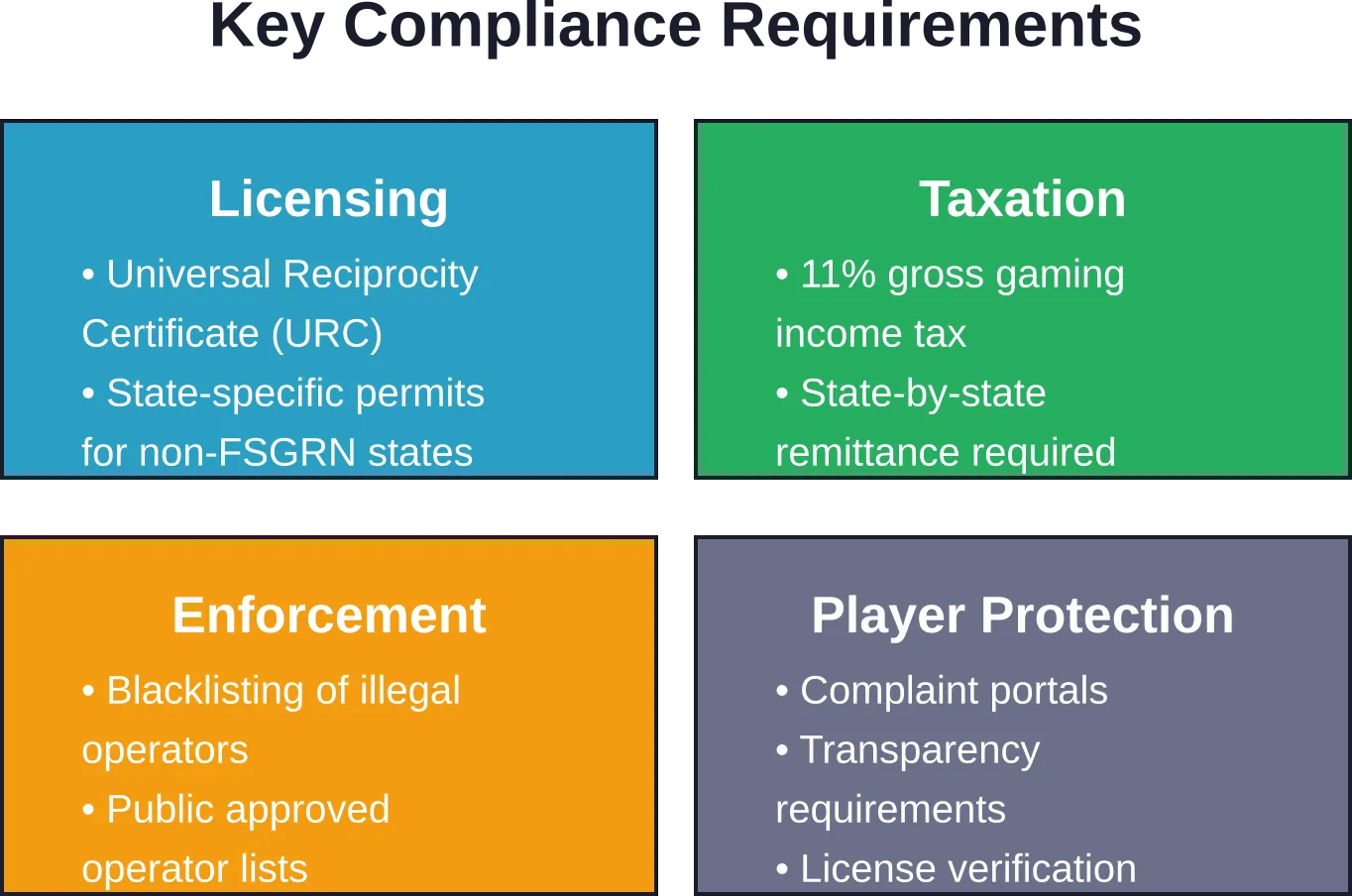
Quick Summary: Nigeria’s betting regulation landscape underwent a major shift following the November 2024 Supreme Court ruling that decentralized gaming oversight to state governments. The Federation of State Gaming Regulators of Nigeria (FSGRN) introduced a reciprocity licensing framework in 2025, allowing operators to obtain a Universal Reciprocity Certificate (URC) valid across member states. Cross River State and the FCT have intensified enforcement against unlicensed operators while publishing approved operator lists.
Nigeria’s gaming and betting sector entered uncharted territory after the Supreme Court ruling of November 2024 nullified the National Lotteries Act, stripping the National Lottery Regulatory Commission (NLRC) of its nationwide authority. The decision confirmed that state governments hold exclusive power to regulate gaming operations within their territories.
This regulatory earthquake created immediate challenges. Operators who’d already paid substantial fees for NLRC licenses suddenly faced the prospect of securing multiple state permits. The specter of 36 separate licensing processes threatened to throttle the industry.
But here’s where it gets interesting—state regulators moved quickly to prevent chaos.
The FSGRN Reciprocity Framework Changes Everything
The Federation of State Gaming Regulators of Nigeria (FSGRN) formally signed the Subnational Reciprocity Licensing Framework, marking what industry observers call a historic milestone. This system allows operators to obtain a single license that grants operational authority across all FSGRN member states.
Under this framework, betting companies receive a Universal Reciprocity Certificate (URC) authorizing them to conduct online sports betting, online casino operations, public online lottery services, and promotional competitions across participating jurisdictions.
Cross River State’s Lottery and Gaming Agency (CRSLGA) joined FSGRN in May 2025, adopting the reciprocity licensing system. Director-General Hon. Micheal Eja projects that these measures will generate billions in shared revenue while streamlining compliance burdens that previously threatened to fragment the market.
Federal Government Rejects Centralized Control
In December 2025, President Bola Ahmed Tinubu rejected the Central Gaming Bill, which would have re-established centralized regulation under a national commission. The rejection signaled federal acceptance of the Supreme Court’s position favoring state-level oversight.
Logifuture CMO Ben Cove called for common sense to prevail in February 2026, expressing hope that regulatory tension between state and federal authorities would ease throughout the year. The industry remains cautiously optimistic that the FSGRN model will prove stable enough to attract continued investment.
Cross River Intensifies Crackdown on Illegal Operators
The Cross River State government launched a fresh clampdown on illegal and non-compliant online lotteries and sports betting operators in October 2025. The Director-General of the Cross River State Lottery and Gaming Agency announced the initiative as part of efforts to sanitize the sector and protect players.
The state is preparing to blacklist operators who continue running without proper authorization. This enforcement wave reflects a broader pattern across Nigeria—states are asserting their regulatory authority with real consequences for non-compliance.
Real talk: the days of operating in regulatory gray zones are over.
FCT Publishes Approved Operators Lists
The FCT Lottery Regulation Office maintains publicly accessible lists of verified, licensed, and compliant operators across multiple gaming categories. These transparency measures allow consumers to verify an operator’s legitimacy before placing bets.
As of October 2025, the FCT recognized multiple lottery schemes including Derby Lotto (valid until 14th Feb 2032), Lucky9ja Lotto’s iLot (31st May 2031), YellowDot Africa Nigeria Limited’s Chop Lotto (17th Apr 2034), International Gaming & Entertainment Limited’s MegaMillions Naija (25th Apr 2034), Morrich Lotto (23rd Jun 2034), First Equity Global Investment Limited’s GoLotto (15th Dec 2034), and Emeralds Distribution Limited’s Lotto Billions (19th Nov 2034).
The FCT approved gaming and trivia schemes with permits running through mid-to-late 2026 or 2027, covering brain scholarship competitions, trivia games, agricultural engagement schemes, and empowerment programs.
Operator Category | Active Licenses (FCT) | Typical Validity Period |
|---|---|---|
Lottery Schemes | 7 | 7-9 years |
Gaming/Trivia Schemes | 7 | 1 year |
Sports Betting Operators | Multiple (list maintained) | 5 years |
Casino Gaming Operators | Multiple (including BetKing, Waje) | Varies by permit |
Casino Gaming and Remote Operator Permits
The FCT requires a non-refundable application and processing fee of ₦2,000,000.00 (Two Million Naira) for Casino Gaming Permits. The detailed requirements span multiple stages, including submission to the National Lottery Regulatory Commission (which continues to process certain application types despite losing nationwide enforcement authority).
Remote/offshore operators—those operating their gaming business outside Nigeria while seeking to provide facilities to Nigerian players—must obtain a Remote Operator Permit (ROP) if they already hold a valid gaming license from a foreign regulator.
The FCT Casino Gaming Permit requires a non-refundable application and processing fee of ₦2,000,000.00 and a five-year permit fee of ₦100,000,000.00. Operators should verify current fee schedules with their specific state regulator, as costs vary by jurisdiction.
Tax Framework Remains Consistent
Despite the regulatory decentralization, the tax structure has remained relatively stable. Gaming operators face an 11% tax rate on gross gaming income across participating states. This consistency provides some predictability for financial planning, even as licensing requirements fragment.
The reciprocity framework doesn’t eliminate state-level taxation—operators still remit taxes to each state where they have active customers. But the URC at least prevents the nightmare scenario of maintaining 36 separate compliance teams.
Player Protection Measures Strengthen
The FCT Lottery Regulation Office operates a complaint portal where players can report issues with licensed operators. The system requires detailed personal information and allows file attachments up to 5 MB, with promises to review complaints and respond promptly.
These consumer protection mechanisms represent a silver lining in the regulatory transition. State regulators have strong incentives to maintain robust oversight—they benefit directly from gaming tax revenue and face immediate political pressure from constituents harmed by bad actors.
The decentralized model may actually improve enforcement responsiveness compared to the previous system where the NLRC struggled to monitor operators across Nigeria’s vast geography.
Find Regulation-Ready Vendors With Sologe

Nigeria betting regulation news matters most when businesses need to adjust licensing, payments, reporting, or operational processes. Sologe helps companies look at the supplier side of regulated iGaming. Its marketplace includes providers across sportsbook software, platforms, payments, analytics, marketing, affiliate tools, licensing-related services, and business support. That makes it useful for teams reviewing market rules and planning vendor conversations.
Sologe gives businesses a way to:
- find providers linked to regulated iGaming operations
- compare payment, reporting, and platform service options
- review business suppliers before entering a market
- present their own services to operators and vendors
- contact relevant companies without extra layers
Contact Sologe to find regulation-ready iGaming vendors or list your company for businesses looking for industry partners.
What This Means for Betting Operators in 2026
Operators face a clear path forward, provided they stay within FSGRN member states. The Universal Reciprocity Certificate streamlines what could have been an impossible compliance burden into a manageable process.
For states that haven’t joined FSGRN, individual licensing remains necessary. Operators must make strategic decisions about which markets justify the overhead of separate permits. Lagos and Rivers—two of Nigeria’s largest gaming markets—will likely command attention regardless of their FSGRN status.
Remote operators targeting Nigerian players from offshore locations need to secure ROP permits and demonstrate existing foreign regulatory approval. The FCT explicitly requires these permits for anyone operating outside Nigeria while serving Nigerian customers through online or remote communication channels.
Application fees have risen substantially under the new regime. The ₦2,000,000.00 casino gaming permit application fee represents just the entry cost—successful applicants face additional capitalization requirements and ongoing compliance expenses.
Industry Outlook and Remaining Uncertainties
Will the FSGRN framework hold? That’s the billion-naira question.
The system depends on continued cooperation among state regulators who technically have no obligation to honor reciprocity agreements. If major states defect or impose additional requirements beyond the URC, the framework could fragment.
Ben Cove’s February 2026 comments about hoping for resolution suggest industry leaders remain concerned about stability. The rejection of the Central Gaming Bill eliminated one source of uncertainty—there won’t be a sudden return to federal control—but it also removed the possibility of a unified national standard.
Some operators may prefer regulatory fragmentation if it creates arbitrage opportunities between states with different requirements. Others will struggle with the complexity and potentially exit smaller markets entirely.
What seems certain: enforcement will continue intensifying. Cross River’s October 2025 crackdown signals that states take their newfound authority seriously. Operating without proper licensing now carries reputational and legal risks that weren’t present during the transitional uncertainty of late 2024.
Frequently Asked Questions
What is the Universal Reciprocity Certificate?
The Universal Reciprocity Certificate (URC) is a single license issued through the FSGRN that allows betting operators to conduct online sports betting, online casinos, lottery services, and promotional competitions across all FSGRN member states without obtaining separate permits in each jurisdiction.
How much does a betting license cost in Nigeria?
Costs vary by license type and state. The FCT charges a ₦2,000,000.00 non-refundable application fee for Casino Gaming Permits. The five-year permit requires a fee of ₦100,000,000.00, though operators should verify current pricing with their specific state regulator.
Can offshore operators legally serve Nigerian customers?
Yes, but offshore operators must obtain a Remote Operator Permit (ROP) from relevant state authorities. Applicants must demonstrate they hold a valid gaming license from a foreign regulator and comply with Nigerian tax and reporting requirements while serving Nigerian players.
What happened to the National Lottery Regulatory Commission?
The Supreme Court nullified the National Lotteries Act in November 2024, stripping NLRC of nationwide enforcement authority. While NLRC continues processing certain applications, actual regulatory power now rests with individual state governments under Nigeria’s constitutional framework.
How can players verify if an operator is licensed?
State regulatory offices maintain public lists of approved operators. The FCT Lottery Regulation Office publishes verified operator lists on its official website (lro.abj.gov.ng). Players should check with their state’s regulatory authority or verify URC status through FSGRN member state resources.
What is the tax rate on betting operations?
Gaming operators face an 11% tax rate on gross gaming income. This rate has remained consistent across FSGRN member states, though operators must remit taxes separately to each state where they have active customers.
Which states have joined the FSGRN reciprocity system?
Cross River State joined FSGRN in May 2025. The FCT maintains active participation in the framework. Other member states continue to join, though operators should verify current FSGRN membership status when planning expansion strategies.
Conclusion
Nigeria’s betting regulation landscape has stabilized around a state-based system with reciprocity provisions that prevent the worst-case fragmentation scenarios. The FSGRN framework provides a workable path for legitimate operators while states assert enforcement authority against unlicensed competitors.
The November 2024 Supreme Court ruling created short-term chaos but may ultimately deliver a more responsive regulatory environment where states compete to provide efficient licensing while maintaining player protections.
Operators must prioritize compliance, verify their licensing status matches current requirements, and monitor FSGRN membership as states continue joining or potentially departing the reciprocity framework. Players gain from increased transparency through approved operator lists and formal complaint mechanisms.
Stay current with state regulator official announcements and verify operator credentials before placing bets. The regulatory framework continues evolving—what worked six months ago may not satisfy today’s requirements.
Related Articles
September 30, 2026Is Sports Betting Legal in Brazil? The Full...
September 30, 2026Is Sports Betting Legal in Iran? The Real...