 Nothing found for the request
Nigeria Tax on Sports Betting Winnings 2026: Full Guide
Sologe June 8, 2026
Share:


Quick Summary
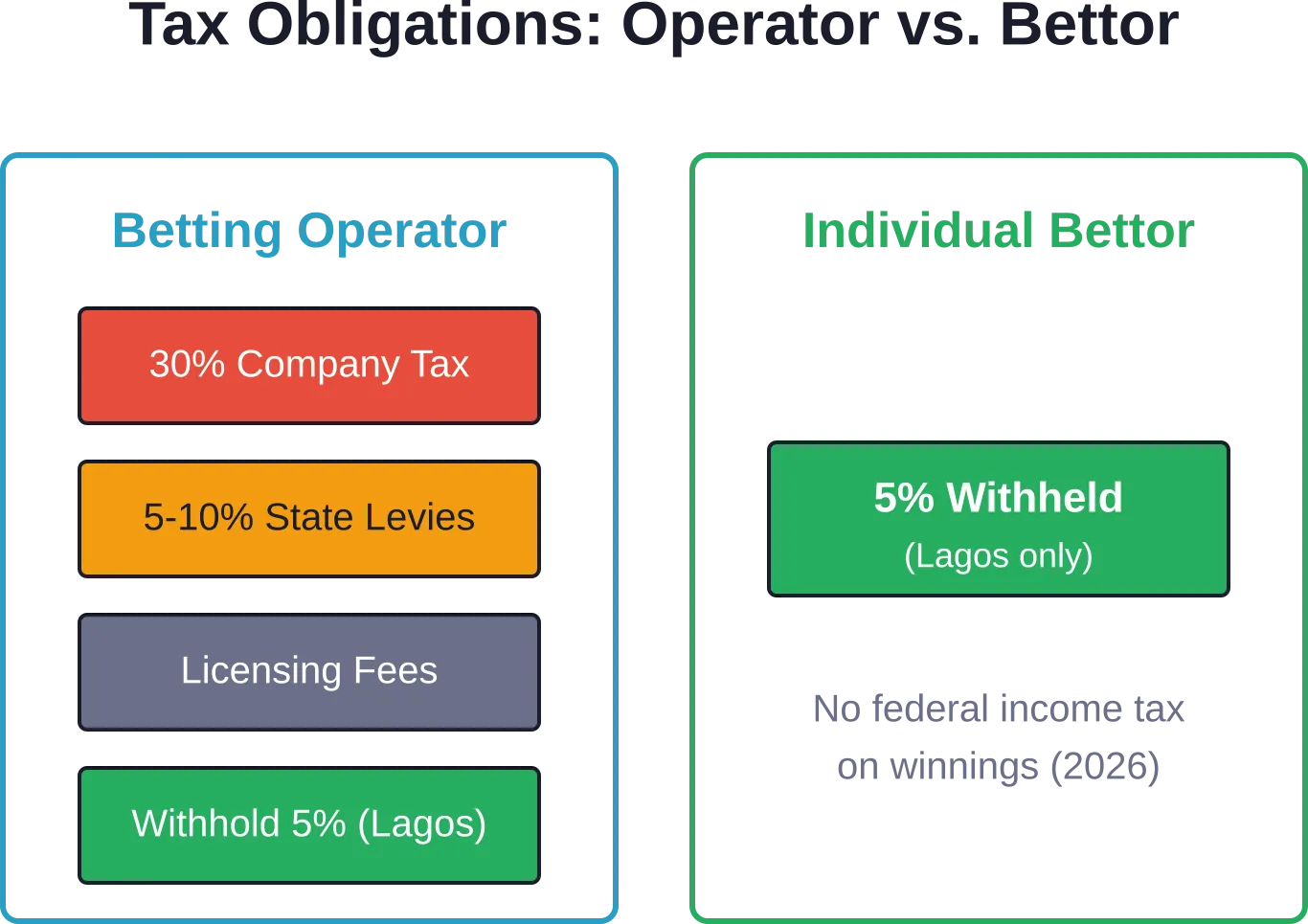
Quick Summary: Nigeria does not levy a direct federal tax on individual sports betting winnings as of 2026. However, betting operators must withhold 5% tax on payouts in Lagos State and remit it to authorities. Winnings are generally treated as gifts or windfalls rather than assessable income for individual bettors, though operators face company income tax at 30% on profits and levies to gaming regulators.
Sports betting has exploded across Nigeria over the past decade, with millions of Nigerians placing wagers daily on football, basketball, and other events. But as the industry grows, so does government scrutiny—and tax policy has become a hot topic.
The big question? Will the tax man come after your sports betting winnings?
The short answer is nuanced. While federal law doesn’t directly tax individual betting winnings, new regional rules—especially in Lagos State—have introduced a 5% withholding tax on payouts. And the Nigerian Tax Act 2025 has reshaped how betting companies themselves are taxed, which indirectly affects the entire ecosystem.
Here’s everything you need to know about Nigeria’s tax landscape for sports betting in 2026.
Federal Tax Treatment of Betting Winnings in Nigeria
At the federal level, Nigeria’s tax system doesn’t explicitly classify sports betting winnings as taxable income for individuals. The Personal Income Tax Act (PITA) doesn’t list gambling proceeds among the categories of assessable income like employment salaries, business profits, or rental income.
This means that if you win ₦500,000 on a weekend accumulator bet, the Federal Inland Revenue Service (FIRS) won’t send you a bill. Your winnings are treated more like a gift or windfall—similar to lottery prizes—rather than earned income subject to tax brackets.
That said, there’s a catch.
The absence of explicit federal taxation doesn’t mean your winnings are entirely outside the tax net. State governments and the operators themselves now play a bigger role in the tax equation, especially after the reforms introduced in 2024 and codified in the Nigerian Tax Act 2025.
The Legal Grey Zone
Nigeria’s tax code has historically been silent on gambling winnings, creating what some experts call a “benign neglect” situation. While FIRS hasn’t pursued individual bettors, the rapid digitalization of the betting industry—and the vast sums changing hands—has prompted policymakers to rethink this hands-off approach.
Some legal analysts suggest that technically, large, consistent betting winnings could be construed as business income if a bettor operates in a professional, systematic manner. But in practice, this hasn’t been enforced. The tax authorities have instead focused on the operators themselves, where the revenue collection is far simpler and more lucrative.
Lagos State's 5% Withholding Tax on Winnings
Now, this is where it gets interesting.
Lagos State introduced a 5% withholding tax on betting winnings. The policy took effect and remains in force as of mid-2026.
Here’s how it works: when you win a bet with a licensed operator in Lagos, the betting company automatically deducts 5% of your payout and remits it to the Lagos State Internal Revenue Service (LIRS). You receive the remaining 95%.
So if you win ₦100,000, you’ll actually get ₦95,000 credited to your account. The operator withholds and pays the ₦5,000 to Lagos State on your behalf.
Winning Amount | 5% Withholding Tax | Net Payout to Bettor |
|---|---|---|
₦10,000 | ₦500 | ₦9,500 |
₦50,000 | ₦2,500 | ₦47,500 |
₦200,000 | ₦10,000 | ₦190,000 |
₦1,000,000 | ₦50,000 | ₦950,000 |
Who’s Affected?
The Lagos withholding tax applies to all bets placed within Lagos State, regardless of whether the operator’s headquarters are elsewhere. In practice, major betting platforms apply the 5% deduction to customers with Lagos addresses or IP addresses.
Online betting dominates Nigeria’s market, so geolocation and user registration details determine whether the tax is withheld. If you’re physically in Lagos when you place and win a bet, expect the 5% cut.
Is This Tax Final?
Yes, it’s a final withholding tax. That means once the operator deducts and remits the 5%, you have no further tax obligation on that winning—at least under Lagos State law. You don’t need to file a separate return or pay additional tax on the same income.
However, some tax professionals caution that if FIRS ever decides to assert federal jurisdiction over large, systematic winnings, the Lagos withholding might not fully offset a federal assessment. But as of mid-2026, there’s no indication this will happen.
The Nigerian Tax Act 2025 and Gaming Companies
While bettors face relatively light direct taxation, the betting operators themselves are under significantly more pressure since the Nigerian Tax Act (NTA) 2025 came into force.
The NTA introduced a dedicated tax regime for gaming and lottery businesses, marking the first time Nigeria has had comprehensive, unified tax rules for the sector. Before this, regulation was fragmented across the National Lottery Act and various state laws, creating compliance headaches and enforcement gaps.
Key Provisions for Gaming Companies
Under the NTA 2025, betting and gaming companies are subject to:
- Company Income Tax (CIT) at 30%: Like other Nigerian businesses, gaming operators pay 30% tax on their assessable profits. This is the same rate as banks, manufacturers, and tech companies.
- Specific allowable deductions: Operators can deduct amounts paid out as winnings or prizes, agency commissions to licensed agents, and levies paid to regulators. This is crucial—it means the gross revenue (total stakes) isn’t taxed, only the profit after paying winners and costs.
- Regulatory levies: Separate from income tax, operators must pay licensing fees and levies to state gaming commissions and the National Lottery Regulatory Commission. These vary by state but typically range from 5% to 10% of gross gaming revenue.
The NTA also deleted the fiscal provisions of the National Lottery Act 2017, consolidating all tax matters under the Tax Act. This eliminates conflicting rules and clarifies that gaming taxation is now solely governed by the NTA and state tax laws.
What This Means for Bettors
Higher taxes on operators don’t directly appear on your bet slip, but they shape the ecosystem. When companies face a 30% CIT plus state levies plus withholding obligations, those costs often get passed on indirectly through:
- Lower odds or tighter margins
- Higher minimum stakes
- Stricter bonus terms
- Reduced promotions and free bets
Industry observers note that some smaller operators have struggled with the compliance burden, leading to market consolidation. The big players have the infrastructure to handle the tax complexity, but startups find it harder to compete.
Find Tax-Ready iGaming Vendors With Sologe

Sports betting winnings tax in Nigeria should be reviewed through proper legal, payment, and reporting processes. Sologe helps iGaming businesses connect with suppliers that support the operational side of regulated markets. For teams researching tax-related solutions, the platform can be useful for finding vendors around payments, analytics, platform setup, licensing-related services, and business support.
Use Sologe to approach tax planning from the vendor side:
- review providers connected to payment processing
- compare reporting and analytics tools
- find platform suppliers for structured iGaming operations
- explore licensing-related service categories
- contact B2B vendors serving gaming companies
👉Contact Sologe to find iGaming vendors that support compliant business operations or list your company for industry buyers.
Other States: Will They Follow Lagos?
Lagos State’s 5% withholding tax has sparked debate across Nigeria. Will other states adopt similar measures?
As of mid-2026, no other state has officially implemented a comparable withholding tax on individual winnings. But several—Rivers, Kano, Oyo—are reportedly exploring similar policies. The appeal is obvious: betting is a massive, largely informal cash economy, and a withholding tax is an easy revenue grab that requires minimal enforcement.
The betting industry has pushed back, arguing that multiple state-level withholding taxes create a compliance nightmare and fragment the national market. An operator serving customers in 36 states plus the FCT would need to track different rates, remittance schedules, and registration requirements for each jurisdiction.
Regulatory Fragmentation
Nigeria’s gaming sector already suffers from regulatory fragmentation. Each state has its own gaming commission with distinct licensing rules, and operators must hold separate licenses for each state where they operate. Adding variable withholding tax rates on top of that compounds the complexity.
Industry groups have called for federal harmonization—a single, nationwide framework—but so far, the political will hasn’t materialized. States jealously guard their revenue prerogatives, and betting taxes are too lucrative to cede to Abuja.
International Comparison: How Nigeria Stacks Up
To put Nigeria’s approach in context, it’s worth looking at how other countries tax sports betting winnings.
Country | Tax on Individual Winnings | Tax on Operators |
|---|---|---|
Nigeria | 0% federal; 5% withholding (Lagos only) | 30% CIT + state levies |
United States | 10% to 37% federal income tax (wins over $600 reported) | Varies by state; gross revenue tax |
United Kingdom | 0% (winnings tax-free) | 15% gross profit tax on operators |
Ghana | 0% for individuals | 7% tax on net proceeds (effective 2026) |
Nigeria’s federal stance—no direct tax on individual winnings—aligns with the UK model, which prioritize taxing operators rather than bettors. But Lagos’s 5% withholding nudges Nigeria closer to a hybrid approach.
In the United States, gambling winnings are fully taxable as ordinary income. For larger wins—typically over $600—the sportsbook will issue a Form W-2G, and federal income tax rates range from 10% to 37% depending on total income. Many U.S. states also levy additional state income taxes on winnings, creating a much heavier burden than Nigeria’s system.
The UK’s zero-tax approach for bettors is often cited as the gold standard, though the UK compensates by imposing a hefty 15% gross profit tax on operators, which funds public services and problem gambling initiatives.
Practical Advice for Nigerian Bettors in 2026
So what should you, as a bettor, actually do about all this?
Keep Records
Even though federal tax on winnings isn’t currently enforced, it’s smart to keep records of your betting activity—stakes, wins, losses, and net position. If tax policy shifts, having documentation will protect you. Plus, if you’re ever audited for unrelated reasons, large unexplained deposits could trigger questions.
Understand Your State’s Rules
If you’re in Lagos, accept that 5% withholding is automatic. Factor it into your betting strategy—don’t be surprised when your ₦50,000 win becomes ₦47,500. If you’re in another state, stay alert for policy changes; follow local news and operator announcements.
Don’t Try to Dodge
Some bettors wonder if they can use VPNs or fake addresses to avoid Lagos withholding. Bad idea. Operators are legally required to verify user identities and locations, and providing false information violates their terms of service—grounds for account suspension and forfeiture of winnings. Plus, if caught, you could face legal penalties.
Bet Responsibly
Taxes aside, the most important advice is to bet within your means. The house edge, volatility, and risk of loss far outweigh any tax considerations. Betting should be entertainment, not a livelihood strategy.
What's Next for Nigeria's Betting Tax Landscape?
Betting taxation in Nigeria is still evolving. The NTA 2025 brought clarity to operator taxation, but the question of individual winnings remains in flux.
Expect more states to watch Lagos’s experiment closely. If the withholding tax proves lucrative and enforceable without triggering major backlash, Rivers, Kano, and others will likely follow suit. Conversely, if bettors migrate to offshore, unlicensed platforms to avoid the tax, states may rethink the approach.
There’s also the possibility—albeit remote—that FIRS could issue new guidance asserting federal jurisdiction over large, systematic winnings. But given the political and administrative challenges, that’s unlikely in the near term.
The betting industry itself will continue lobbying for regulatory harmonization and lighter taxation, arguing that excessive taxes drive activity underground and reduce formal sector growth. Whether policymakers listen remains to be seen.
Frequently Asked Questions
Do I have to pay federal tax on my sports betting winnings in Nigeria?
No, as of 2026, Nigeria’s federal government does not tax individual sports betting winnings. The Personal Income Tax Act doesn’t classify gambling proceeds as assessable income, so FIRS won’t pursue you for tax on your bets. However, Lagos State imposes a 5% withholding tax on payouts, which the operator deducts automatically.
How does the 5% withholding tax in Lagos State work?
When you win a bet with a licensed operator in Lagos, the betting company automatically withholds 5% of your winnings and remits it to the Lagos State Internal Revenue Service. You receive the remaining 95%. For example, a ₦100,000 win results in ₦95,000 credited to your account and ₦5,000 paid as tax. This is a final tax—you don’t owe anything more on that winning.
Will other Nigerian states introduce betting taxes like Lagos?
It’s possible. As of mid-2026, no other state has officially implemented a withholding tax on betting winnings, but several are reportedly exploring similar measures. States see it as an easy revenue source, though the betting industry warns that fragmented state-level taxes could create compliance chaos and push bettors toward unlicensed offshore platforms.
How are betting companies taxed under the Nigerian Tax Act 2025?
Betting and gaming operators pay 30% Company Income Tax on their assessable profits, the same rate as other Nigerian businesses. They can deduct amounts paid as winnings, agency commissions, and regulatory levies when calculating taxable profit. Operators also pay separate state levies (typically 5-10% of gross gaming revenue) and licensing fees to gaming commissions.
Can I claim my betting losses as a tax deduction?
No. Since betting winnings aren’t classified as taxable income under Nigerian law, betting losses aren’t deductible either. You can’t offset losses against other income or carry them forward. The tax system treats betting as outside the scope of income taxation entirely—at least at the federal level.
What happens if I don’t pay tax on my winnings?
For individual bettors, there’s currently nothing to pay at the federal level. If you’re in Lagos, the 5% withholding is automatic—the operator handles it, not you. You don’t file a separate return or make a payment. The only risk arises if you provide false information to evade withholding, which violates operator terms and could lead to account suspension or legal penalties.
Are offshore betting sites taxed differently?
Offshore, unlicensed betting sites operate in a legal grey zone in Nigeria. They don’t withhold Lagos tax or remit anything to Nigerian authorities, which might seem attractive—but using them carries risks. You have no consumer protection, no recourse if the site refuses to pay out, and technically, facilitating or using unlicensed gambling platforms can violate Nigerian law. Licensed, domestic operators are the safer, legal choice.
Conclusion
Nigeria’s approach to taxing sports betting winnings in 2026 is a study in contrasts. Individual bettors face minimal direct taxation federally, with only Lagos State imposing a 5% withholding—far lighter than the burden in countries like the United States. But betting operators shoulder significant taxes: 30% company income tax, state levies, and regulatory fees.
This dual-track system reflects Nigeria’s broader fiscal strategy: extract revenue from companies rather than chasing individual consumers. It’s administratively simpler and politically safer. But as betting continues to grow and states search for revenue, expect the landscape to shift.
For now, Nigerian bettors can enjoy a relatively tax-friendly environment compared to many global peers. Just keep an eye on state-level developments, maintain good records, and above all, bet responsibly.
Have questions about your specific situation or need clarity on regional rules? Consult a qualified Nigerian tax professional who understands gaming taxation. And if you’re operating a betting business, ensure full compliance with the NTA 2025 and state regulations—penalties for non-compliance are steep and enforcement is tightening.
Related Articles

September 30, 2026Is Sports Betting Legal in Brazil? The Full...

September 30, 2026Is Sports Betting Legal in Iran? The Real...