 Nothing found for the request

What Is a Payout in Gambling? 2026 Guide
Sologe April 28, 2026
Share:


Quick Summary
Quick Summary: A payout in gambling refers to the total amount of money a player receives when they win a bet or game, which includes both their original stake and any profits earned. The payout amount depends on the odds or payout percentage, the size of the wager, and the type of gambling activity—whether sports betting, casino games, or lottery winnings.
When someone places a wager, understanding what happens when they win is fundamental. The term “payout” gets thrown around constantly in gambling circles, but what does it actually mean?
At its core, a payout represents the total money returned to a winning player. This includes the original stake plus any profit generated from the bet. The excitement in gambling stems largely from these payouts—they’re the tangible reward for a correct prediction or a lucky spin.
But here’s the thing: payouts work differently depending on whether someone’s betting on sports, playing casino games, or buying lottery tickets. The calculation methods vary, the terminology shifts, and understanding these differences matters for anyone who wants to gamble responsibly.
Understanding Payouts in Sports Betting
Sports betting payouts depend entirely on which type of odds are being used. Different regions and bookmakers display odds in various formats, and each format requires its own calculation method.
The payout consists of two components: the original stake (the amount wagered) and the winnings (the profit earned from a successful bet). When someone says they received a payout, they’re talking about the total amount returned to their account or handed to them at the betting window.
How American Odds Work
American odds use a plus-and-minus system that confuses many newcomers. But once decoded, it’s straightforward.
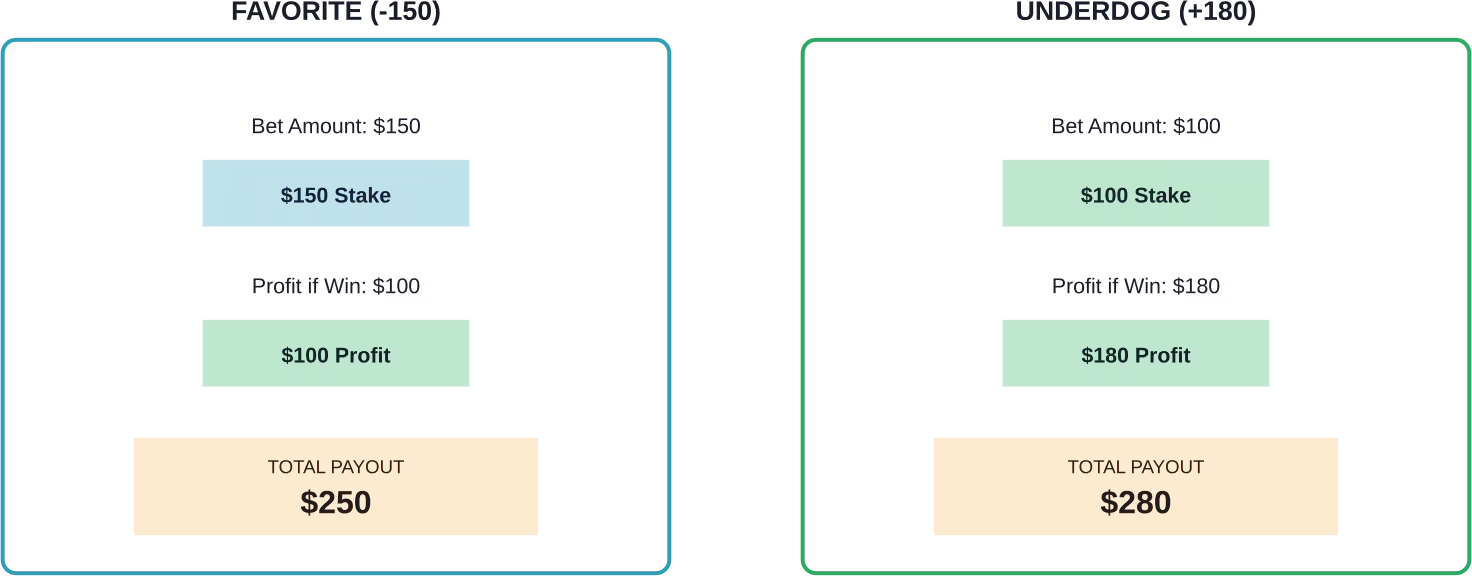
Favorites display odds with a minus sign (like -150). This number tells bettors how much they need to wager to win $100. So at -150, someone would need to bet $150 to win $100, for a total payout of $250.
Underdogs show odds with a plus sign (like +180). This indicates how much profit a $100 bet would generate. At +180, a $100 wager returns $180 in profit, for a total payout of $280.
This system dominates North American sports betting markets. The minus odds reflect higher probability outcomes, while plus odds represent less likely scenarios.
Decimal and Fractional Odds Systems
Decimal odds (popular in Europe and Australia) make payout calculations simpler. The odds number represents the total payout per dollar wagered, including the stake.
With decimal odds of 2.50, a $100 bet returns $250 total (the stake multiplied by the odds). The profit equals $150, and the original $100 stake comes back too.
Fractional odds (common in UK betting markets) show the profit relative to the stake. Odds of 5/1 mean that for every $1 wagered, the bettor wins $5 in profit. A $10 bet at 5/1 returns $50 profit plus the $10 stake, for a $60 total payout.
Odds Format | Example | $100 Bet Payout | Calculation Method |
|---|---|---|---|
American (Favorite) | -150 | $166.67 | Stake + (Stake ÷ 1.50) |
American (Underdog) | +180 | $280 | Stake + (Stake × 1.80) |
Decimal | 2.50 | $250 | Stake × Odds |
Fractional | 5/1 | $600 | Stake + (Stake × 5) |
Use a Marketplace Built for Gaming Vendors

Sologe helps companies publish and manage gaming products in one place. It focuses on simple listing and clear structure for easier browsing.
Want to Publish Your Product?
List with Sologe to:
- create listings for gaming products
- group them by category
- present them to marketplace users
👉 Get in touch with Sologe to start listing
Casino Payouts and Return to Player
Casino payouts operate on a completely different principle than sports betting. Instead of odds determined by competition, casino games have fixed payout structures based on mathematical probabilities.
The term “payout rate” or “payout percentage” refers to the proportion of wagered money that a casino game returns to players over time. This metric is often called Return to Player (RTP).
What RTP Actually Means
Research has examined how gamblers understand RTP information, finding that many players consistently misunderstand these percentages.
When a game advertises a 95% RTP, this doesn’t mean someone who bets $100 will get $95 back. Rather, it indicates that over millions of spins and across all players, the game will pay out 95% of all money wagered.
According to research from the University of Bergen analyzing video lottery terminal behavior, payout percentages significantly influence gambling patterns. Research analyzing gaming sessions showed that the number of bets is positively associated with payback percentage.
Individual sessions vary wildly. Someone might lose their entire bankroll or hit a jackpot worth thousands of times their bet—both scenarios occur within the same RTP framework.
House Edge vs. Payout Percentage
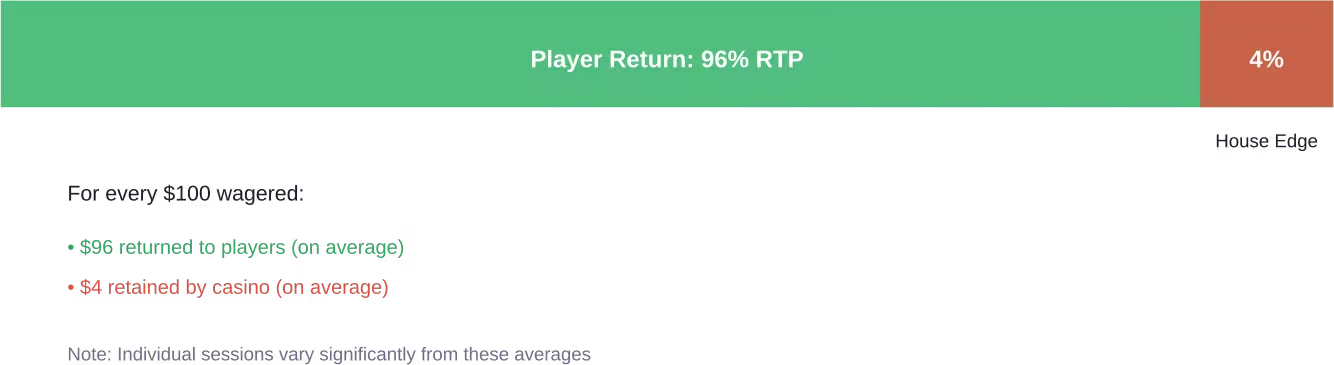
These terms represent opposite sides of the same coin. The house edge equals 100% minus the payout percentage.
A game with a 96% RTP has a 4% house edge. This 4% represents the casino’s mathematical advantage and expected profit over time. Games with lower house edges provide better long-term value for players, though short-term results remain unpredictable.
Calculating Your Potential Winnings
Knowing how to calculate potential payouts before placing a wager helps with bankroll management and betting strategy.
For sports betting with American odds, the formulas are:
- Negative odds: Payout = Stake + (Stake ÷ (|Odds| ÷ 100))
- Positive odds: Payout = Stake + (Stake × (Odds ÷ 100))
Real talk: most bettors don’t calculate manually anymore. Online betting platforms automatically display potential payouts when building a bet slip. But understanding the underlying math helps recognize value and avoid mistakes.
For casino games, predicting individual session outcomes isn’t possible due to randomness. Volatility—a measure of risk and payout frequency—plays a major role.
Research examining video poker simulations demonstrated how volatility affects winning patterns. Games with higher volatility produce more winning players in the short term but shorter winning streaks overall.
Payout Methods and Options
How winnings get paid out depends on the gambling venue and the amount won.
Most online betting platforms and casinos process withdrawals through the same method used for deposits. This might include bank transfers, e-wallets, prepaid cards, or cryptocurrency. Processing times range from instant (for some e-wallets) to several business days (for bank transfers).
Land-based casinos typically pay smaller winnings in cash immediately. Larger wins might require tax documentation and can be paid via check or bank transfer.
Large Casino Winnings: Annuity vs. Lump Sum
Jackpot lottery winners and some large casino progressive jackpot winners face a choice between two payout structures.
A lump sum payment provides the entire winning amount upfront, though typically reduced from the advertised jackpot (often 50-60% of the stated amount). An annuity spreads payments over 20-30 years in annual installments, ultimately paying the full advertised amount.
Each option has tax implications and financial planning considerations. The lump sum offers immediate access and investment control but results in substantial immediate tax liability. Annuity payments spread the tax burden over time but provide less flexibility.
Payout Option | Advantages | Disadvantages |
|---|---|---|
Lump Sum | Immediate access to funds; investment control; no inflation risk | Reduced total amount; large immediate tax hit; requires discipline |
Annuity | Full advertised amount; spread tax burden; guaranteed income stream | No immediate access; inflation erodes value; less flexibility |
Common Payout Misconceptions
Several widespread misunderstandings about gambling payouts lead to poor decisions.
- One major confusion: the difference between payout and profit. The payout includes the original stake. If someone bets $50 and receives a $150 payout, their profit is $100, not $150.
- Another misconception involves RTP and expected returns. Research has highlighted that participants shown RTP information reported believing they were more likely to win than those shown no information at all. This reflects a fundamental misunderstanding—RTP describes long-term statistical distribution, not individual outcome probability.
- Gamblers also often misestimate their spending and winnings. Research from behavioral tracking studies noted that people struggle with mental accounting when gambling money comes from multiple sources or spreads across various activities, making it difficult to accurately estimate expenditure and payouts received.
Responsible Gambling and Payout Understanding
Understanding how payouts work connects directly to gambling responsibly. Realistic expectations about winning frequency and amounts help prevent problematic behavior.
The Unlawful Internet Gambling Enforcement Act (Pub. L. No. 109–347, 120 Stat. 1952, codified at 31 U.S.C. §§ 5361-5367) regulates certain aspects of payment processing for online gambling in the United States. This federal legislation prohibits businesses from knowingly accepting payments to settle unlawful internet gambling debts.
Knowing that casino games have built-in house edges and that sports betting requires consistent accuracy to profit long-term helps frame gambling as entertainment rather than income generation.
Setting loss limits, understanding that “chasing losses” to recoup money rarely works, and recognizing when gambling stops being fun—these practices matter more than any payout calculation.
Frequently Asked Questions
Does the payout amount include my original bet?
Yes, payout includes both the original stake and any profit earned. For example, if you bet $100 and earn $150 in profit, the total payout is $250. The profit is $150, but the amount returned is the full $250.
Why do casinos advertise high payout percentages if the house always wins?
High payout percentages (such as 96–98% RTP) mean the casino retains only a small portion of all wagers. However, across a large volume of bets, even a small edge generates consistent profit. Individual players may win or lose, but the statistical advantage ensures long-term profitability for the casino.
How long does it take to receive a payout from online gambling sites?
Processing times vary by method. E-wallets can process within hours, bank transfers typically take 3–5 business days, and cryptocurrency withdrawals can be nearly instant. First-time withdrawals may take longer due to identity verification requirements.
Are gambling winnings taxable?
In many jurisdictions, yes. For example, in the United States, gambling winnings are considered taxable income and must be reported. Casinos may issue tax forms for large winnings. Always check local tax laws or consult a professional for guidance.
What’s the difference between payout percentage and hit frequency?
Payout percentage (RTP) reflects how much money is returned to players over time. Hit frequency measures how often wins occur. A game can offer frequent small wins (high hit frequency) but still have a lower overall return, or infrequent large wins with a higher RTP.
Can casinos change payout percentages on slot machines?
Casinos can configure slot machines within regulator-approved ranges, but they cannot change payout percentages arbitrarily or during gameplay. Adjustments typically require regulatory approval and physical access to the machine.
Do better odds always mean a better payout?
No. Better odds increase the probability of winning but usually result in lower profit. For example, a strong favorite pays less than an underdog. The value of a bet depends on whether the odds accurately reflect the true probability of the outcome.
Final Thoughts on Gambling Payouts
Understanding what a payout means in gambling contexts—whether sports betting, casino games, or lottery prizes—provides the foundation for informed participation.
Payouts represent the total return when winning, encompassing both the original wager and any profit generated. Calculation methods vary across betting formats, with American, decimal, and fractional odds each requiring different approaches. Casino payouts operate on fixed mathematical percentages that guarantee house profitability over time while still providing entertainment value and occasional significant wins for players.
The key takeaway? Gambling should never be viewed as a reliable income source. The mathematics ensure that, on average, the house maintains an edge. But with proper understanding of how payouts work, realistic expectations, and responsible bankroll management, gambling can remain an enjoyable recreational activity.
Before placing any wagers, take time to understand the specific payout structure for that betting market or game. Check current odds, verify RTP percentages for casino games, and calculate potential returns. Most importantly, never bet more than comfortable losing, regardless of how attractive the potential payout might seem.
Related Articles

September 30, 2026Is Sports Betting Legal in Brazil? The Full...

September 30, 2026Is Sports Betting Legal in Iran? The Real...