 Nothing found for the request

Where Is Gambling Illegal? 2026 Global Laws & Bans
Sologe April 28, 2026
Share:


Quick Summary
Quick Summary: Gambling is illegal in several countries and jurisdictions worldwide, with complete bans enforced in nations like North Korea, Brunei, Cambodia, and the United Arab Emirates, often due to religious or moral considerations. In the United States, states like Utah and Hawaii maintain complete gambling prohibitions. Most countries fall somewhere between complete legalization and total bans, with varying restrictions on online gambling, sports betting, and casino gaming based on cultural, religious, and regulatory frameworks.
The global gambling landscape presents a complex patchwork of laws, regulations, and outright bans. While some countries embrace gambling as a revenue source and entertainment industry, others prohibit it entirely based on religious beliefs, moral objections, or social concerns.
Understanding where gambling is illegal becomes increasingly important as online betting platforms expand globally and travelers move between jurisdictions with vastly different legal frameworks.
This guide examines the countries, states, and regions where gambling faces complete prohibition or severe restrictions, explores the reasons behind these bans, and clarifies what activities are considered illegal in different parts of the world.
Understanding Gambling Prohibition: The Legal Framework
Gambling laws exist on a spectrum. Some jurisdictions implement total bans on all forms of wagering, while others permit certain activities like lotteries or horse racing but prohibit casinos and sports betting.
The definition of what constitutes “gambling” also varies significantly. Some legal frameworks distinguish between games of skill and games of chance, allowing poker or fantasy sports while banning slot machines and roulette.
Religious doctrine shapes gambling legislation in many regions. Islamic law prohibits gambling under Sharia principles, directly impacting legal frameworks across Muslim-majority nations. According to medical research on gambling in Malaysia, gambling is forbidden under Islamic law (Sharia law), which influences policy in countries where Islam is the predominant religion.
The Three Categories of Gambling Regulation
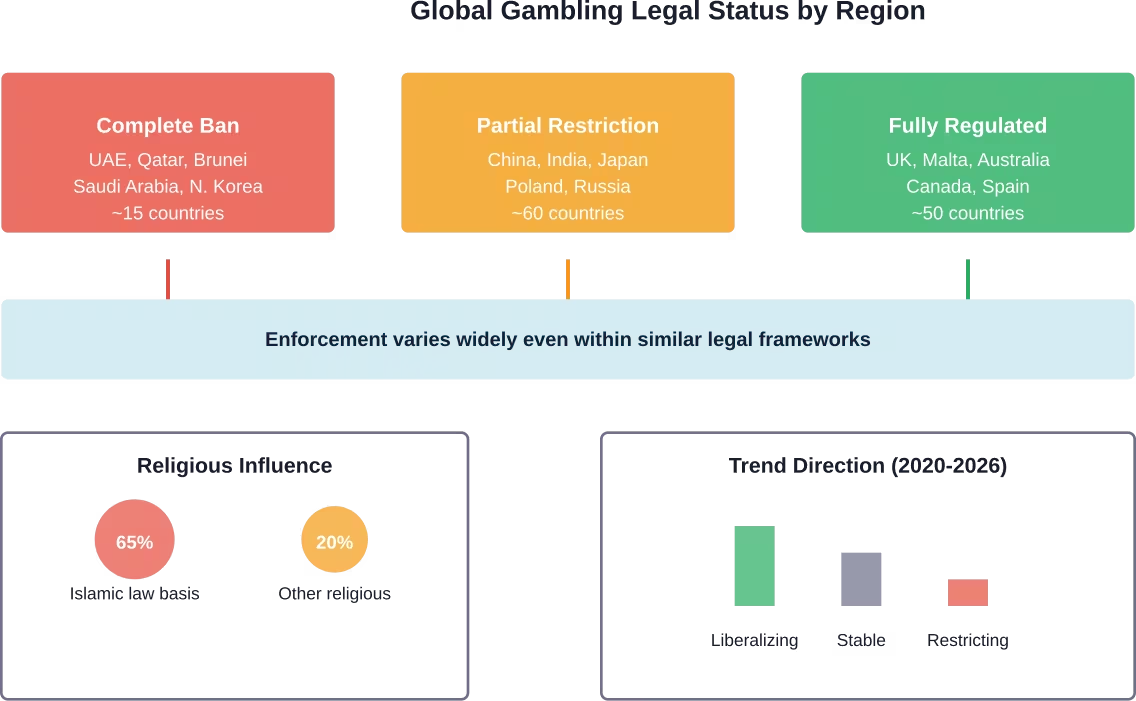
Gambling regulations generally fall into three categories:
- Complete prohibition: All forms of gambling are illegal, with criminal penalties for operators and sometimes participants
- Partial regulation: Certain forms like state lotteries are permitted while commercial casinos and online betting remain illegal
- Full legalization: Comprehensive frameworks allow most gambling activities under licensing and regulatory oversight
The boundaries between these categories shift constantly as governments reassess their approaches to gambling revenue, problem gambling concerns, and enforcement challenges.
Countries Where Gambling Is Completely Illegal
Several nations maintain absolute prohibitions on gambling activities. These complete bans typically stem from religious doctrine, authoritarian governance, or deeply rooted cultural opposition to wagering.
Middle Eastern and Islamic Nations
The United Arab Emirates enforces strict gambling prohibition aligned with Islamic law. All forms of betting, casino gaming, and wagering are illegal for citizens and residents, with penalties including imprisonment and deportation for expatriates.
Qatar maintains similar restrictions, prohibiting all gambling activities without exception. The nation’s preparation for hosting major sporting events hasn’t changed these fundamental legal positions.
Saudi Arabia, Kuwait, and Bahrain also maintain complete gambling bans rooted in Sharia law. These prohibitions extend to online gambling, with authorities actively blocking access to international betting websites.
Asian Countries With Total Bans
Brunei enforces a complete gambling prohibition based on its adoption of Sharia law. The sultanate imposes strict penalties on anyone caught participating in gambling activities.
Cambodia technically permits gambling for foreigners in licensed casinos, but Cambodian citizens face complete prohibition from participating in any gambling activities.
North Korea maintains a total ban on gambling for its citizens, though the country operates a casino near the Chinese border that exclusively serves foreign tourists.
Other Nations With Complete Prohibitions
Cyprus prohibits most forms of gambling for its citizens, though this landscape is evolving with discussions around online gambling regulation.
Several smaller nations and territories maintain complete bans, often influenced by religious majorities or colonial-era legislation that was never reformed.
U.S. States Where Gambling Is Illegal
The United States presents one of the most fragmented gambling regulatory landscapes globally. Federal law permits states to determine their own gambling policies, creating massive variation across the country.
Utah: The Most Restrictive State
Utah maintains the strictest gambling prohibition in the United States. The state constitution explicitly bans all forms of gambling, reflecting the values of its predominant religious population.
According to competitor analysis, gambling is illegal in Utah because more than half (55%) of its population practices Mormonism, which opposes gambling on moral grounds.
Utah doesn’t permit state lotteries, commercial casinos, tribal gaming, sports betting, or even charitable bingo and raffles. The prohibition is comprehensive and shows no signs of changing.
Hawaii: Island-Wide Prohibition
Hawaii stands as the only other U.S. state with a complete gambling ban comparable to Utah’s prohibition. The state permits no casinos, no lottery, no sports betting, and no tribal gaming facilities.
The ban extends to social gambling, making even home poker games technically illegal under Hawaii law, though enforcement of these provisions remains rare.
Hawaii’s tourism-dependent economy makes this prohibition particularly notable. Despite potential revenue from gambling establishments, legislators have consistently resisted legalization efforts.
States With Partial Restrictions
Many states don’t ban gambling entirely but impose significant restrictions on certain activities:
- Texas prohibits commercial casinos and maintains strict limitations on most gambling forms. The state allows charitable bingo, a state lottery, and horse racing, but sports betting and casino gaming remain illegal.
- Tennessee recently legalized online sports betting but continues to prohibit land-based casinos and commercial gaming establishments.
- Alaska permits limited charitable gaming and pull-tabs but prohibits commercial casinos and doesn’t operate a state lottery.
- New Hampshire has gradually expanded gambling options but historically maintained conservative restrictions compared to neighboring states.
The Evolution of State-Level Prohibition
State gambling laws are evolving rapidly. The 2018 Supreme Court decision overturning the federal sports betting prohibition (PASPA) triggered a wave of legalization across previously restrictive states.
But some states remain firmly opposed. The combination of religious influence, concern about social costs, and political resistance to change keeps prohibition in place despite neighboring states generating substantial tax revenue from legalized gambling.
State | Commercial Casinos | Tribal Gaming | Sports Betting | State Lottery |
|---|---|---|---|---|
Utah | Illegal | Illegal | Illegal | No |
Hawaii | Illegal | Illegal | Illegal | No |
Texas | Illegal | Limited | Illegal | Yes |
Alaska | Illegal | Illegal | Illegal | No |
Tennessee | Illegal | Illegal | Legal (online only) | Yes |
Georgia | Illegal | Illegal | Illegal | Yes |
Online Gambling Prohibition: A Global Challenge
Online gambling presents unique enforcement challenges. Traditional brick-and-mortar gambling bans are relatively straightforward to enforce, but preventing citizens from accessing international online betting sites proves far more difficult.
Countries That Block Online Gambling
China maintains sophisticated internet filtering systems that block access to international gambling websites. The government prohibits online gambling for Chinese citizens, though enforcement focuses primarily on operators rather than individual bettors.
According to medical research on gambling regulation, many countries struggle to balance gambling access with harm prevention strategies.
Turkey actively blocks online gambling sites and prosecutes operators who target Turkish citizens. The government regularly updates its banned website lists to include new gambling platforms.
Russia implemented strict online gambling restrictions in 2009, permitting only limited land-based gambling in designated zones while blocking online casinos.
The European Patchwork
European countries display enormous variation in online gambling regulation. Some nations like the United Kingdom and Malta have created comprehensive licensing frameworks that welcome operators, while others maintain prohibitive stances.
Poland restricts online gambling to state-controlled monopolies, effectively prohibiting international operators from serving Polish customers legally.
Germany recently overhauled its gambling laws to create a unified federal framework, replacing the previous state-by-state system that created regulatory confusion.
Enforcement Realities
Here’s the thing though—enforcing online gambling prohibition proves extremely difficult. Virtual private networks (VPNs) and cryptocurrency payments allow determined bettors to circumvent geographic restrictions.
Most jurisdictions focus enforcement efforts on operators and payment processors rather than individual gamblers. Prosecuting individual online bettors is resource-intensive and politically unpopular.
According to FinCEN correspondence with the American Gaming Association (published 2014-12-24), financial institutions play a critical role in enforcement, and regulators work with banks and payment processors to identify and block gambling-related transactions in prohibited jurisdictions.
Religious and Cultural Foundations of Gambling Bans
Religious doctrine drives gambling prohibition in numerous countries. Understanding these foundations helps explain why certain regions maintain strict bans while neighboring jurisdictions embrace legalization.
Islamic Law and Gambling Prohibition
Sharia law explicitly prohibits gambling (maisir) as a form of unearned wealth that causes social harm. This prohibition extends to all games of chance where money is wagered.
In Malaysia, despite gambling being forbidden under Islamic law, the country permits licensed casinos and lotteries that serve non-Muslim populations. According to research on Swiss gambling policy, around 46.6% of the Swiss population are believed to gamble each year. In Malaysia, Islam is the predominant religion (61.3%), and gambling is forbidden under Islamic law, which influences gambling behavior among Muslim populations.
This creates complex regulatory frameworks in Muslim-majority countries with significant non-Muslim populations. Some nations like Malaysia and Indonesia permit limited gambling for non-Muslims, while others like Saudi Arabia and Iran enforce universal prohibition regardless of religion.
Christian Perspectives on Gambling
Mormon theology strongly opposes gambling, directly influencing Utah’s comprehensive prohibition. The Church of Jesus Christ of Latter-day Saints teaches that gambling is morally wrong and socially destructive.
Some evangelical Christian denominations maintain similar opposition, influencing gambling policy in regions where these religious communities hold political influence.
But Christian perspectives on gambling vary widely. Many predominantly Christian nations in Europe and Latin America have embraced legal gambling frameworks without significant religious opposition.
Buddhist and Hindu Approaches
Buddhist teachings generally discourage gambling as a cause of suffering and financial ruin, though this hasn’t translated into universal prohibition in Buddhist-majority countries.
Thailand maintains gambling prohibition influenced partly by Buddhist values, though illegal gambling remains widespread.
Hindu perspectives vary, with no universal prohibition. India’s gambling laws reflect this diversity, with some states permitting casinos and others maintaining strict bans.
Sports Betting: Special Restrictions and Bans
Sports betting faces unique legal treatment in many jurisdictions. Even countries that permit casinos and lotteries often maintain specific prohibitions on wagering on sporting events.
The Integrity Argument
Legislators frequently cite sports integrity concerns when justifying sports betting bans. The fear that legal betting could facilitate match-fixing and corruption in professional sports drives prohibition in numerous countries.
Japan historically prohibited most sports betting despite operating legal horse racing and motor sports wagering. Recent legislation has created pathways for limited sports betting, but restrictions remain more severe than for other gambling forms.
South Korea permits limited sports betting through government-controlled operators but prohibits international online sports betting platforms.
The American Evolution
The United States maintained a federal sports betting prohibition (PASPA) from 1992 until 2018, when the Supreme Court ruled the law unconstitutional. This decision transformed the American sports betting landscape.
Now each state decides independently whether to legalize sports betting. As of 2026, roughly two-thirds of U.S. states have legalized some form of sports wagering, but significant holdouts remain.
Figures are unverifiable but it is estimated that about Rs. 2,500 crore (nearly $375 million) was bet on one cricket match (India versus West Indies) in 2016 and that Rs. 30,000 crore (nearly $4.4 billion) was bet on the 2016 T-20 Cricket World Cup—demonstrating the massive scale of sports betting demand even in markets where it’s officially prohibited.
European Sports Betting Frameworks
European countries generally permit sports betting under regulated frameworks, though approaches vary significantly.
The United Kingdom operates a comprehensive licensing system that permits domestic and international operators to serve UK customers legally.
France maintains a state-controlled sports betting system that restricts competition and limits betting options compared to more open markets.
Spain created a federal licensing framework that replaced previous regional regulation, though some autonomous regions maintain additional restrictions.
India's Complex Gambling Legal Landscape
India presents one of the world’s most complicated gambling regulatory frameworks. Federal and state laws interact to create a patchwork of prohibition, partial regulation, and legal ambiguity.
The Federal Framework
The Public Gambling Act of 1867—colonial-era legislation still in effect—prohibits operating gambling houses. But the law grants states authority to regulate gambling within their borders, creating massive regional variation.
The law distinguishes between games of skill and games of chance, a distinction that has created endless legal debate. Games considered skill-based, like certain card games and fantasy sports, often receive different legal treatment than pure chance-based gambling.
State-Level Variation
Goa and Sikkim permit licensed casinos, both land-based and floating establishments. These states have created regulated frameworks that generate tax revenue while most other Indian states maintain prohibition.
According to research on gambling legalization in India, there’s ongoing debate about whether national legalization would reduce illegal gambling activity or exacerbate gambling-related harms.
Kerala strictly prohibits all forms of gambling and has prosecuted online gambling operators and participants.
Maharashtra maintains gambling prohibition but permits horse racing at licensed tracks.
Online Gambling’s Legal Gray Zone
Online gambling exists in legal limbo across most of India. No federal law explicitly addresses internet gambling, and state laws predate the internet era.
This ambiguity has allowed international operators to serve Indian customers, though payment processing challenges and occasional enforcement actions create uncertainty for both operators and bettors.
The massive popularity of cricket creates enormous demand for sports betting. The scale of illegal betting on cricket matches demonstrates that prohibition doesn’t eliminate gambling activity—it simply pushes it into unregulated markets.
Partial Gambling Bans: Countries With Selective Prohibition
Most countries don’t ban gambling entirely or permit it completely. Instead, they create frameworks that allow certain activities while prohibiting others.
Japan: Pachinko Versus Casinos
Japan maintained casino prohibition for decades while operating a massive pachinko industry that exists in a legal gray area. Pachinko parlors technically don’t offer gambling because players exchange winnings for prizes rather than cash, though adjacent establishments convert prizes to money.
Recent legislation has created a framework for integrated resort casinos, representing a significant shift in Japanese gambling policy. But restrictions remain extensive, with tight limits on casino locations and access for Japanese citizens.
Australia: No Online Casinos
Australia permits extensive land-based gambling, including casinos, sports betting, and widespread poker machines. But the Interactive Gambling Act prohibits online casino gaming for Australian residents.
Online sports betting is legal and extremely popular, but online slots, table games, and live dealer casino games remain prohibited for operators serving Australian customers.
This creates the paradoxical situation where Australians can legally bet on sports online but must visit physical venues to play pokies or table games.
Switzerland’s Modernization Efforts
Switzerland recently reformed gambling laws to modernize regulation and address online gambling. The new Swiss Federal Act on Gambling entered into force in January 2019 following a public vote.
According to research on Swiss gambling policy, around 46.6% of the Swiss population are believed to gamble each year (73.6% within their lifetime). The new legislation aimed to modernize and harmonize previous law and open the market for online casinos.
The framework eliminates previous master license and sub-licensing systems, creating more direct regulatory oversight of gambling operators.
Brazil’s Evolving Framework
Brazil is undergoing significant gambling law reform. Historically, most gambling was prohibited, though the state lottery and horse racing remained legal.
Brazil has fully regulated online sports betting and online casinos through Law No. 14.790/2023, signed in December 2023. The regulated market officially launched in early 2025, with licensed operators now paying taxes and following federal consumer protection rules.
Country | Land Casinos | Online Casinos | Sports Betting | State Lottery |
|---|---|---|---|---|
Japan | Limited (new) | Prohibited | Limited | Yes |
Australia | Legal | Prohibited | Legal | Yes |
India | State-dependent | Legal gray zone | Mostly illegal | State-dependent |
China | Macau only | Prohibited | State-controlled | Yes |
Russia | Designated zones | Prohibited | Limited | Yes |
Brazil | Prohibited | Prohibited | Legalizing | Yes |
Enforcement Challenges and Black Market Gambling
Prohibition doesn’t eliminate gambling—it drives it underground. Countries with strict gambling bans often struggle with extensive illegal gambling operations.
The Chinese Underground Market
Despite comprehensive gambling prohibition, China harbors one of the world’s largest illegal gambling markets. Estimates of the underground gambling economy range into the hundreds of billions of dollars annually.
Proximity to Macau creates additional challenges. Chinese citizens travel to Macau—the only part of China where casinos are legal—to gamble legally, but many also participate in illegal gambling operations within mainland China.
The government periodically launches crackdowns on illegal gambling, but the enormous scale of demand ensures these operations persist.
Cross-Border Gambling Operations
Countries with gambling prohibition often see citizens traveling to nearby jurisdictions where gambling is legal. This creates de facto legalization for those with resources to travel.
Thai citizens cross into Cambodia to access casinos despite gambling being illegal in Thailand. Malaysian Muslims travel to Singapore despite religious prohibitions.
These patterns demonstrate that prohibition creates geographic arbitrage rather than eliminating gambling behavior.
Cryptocurrency and Enforcement Evasion
Cryptocurrency gambling platforms pose enormous enforcement challenges for countries attempting to maintain gambling prohibition. Traditional enforcement relies heavily on blocking payment processors and financial institutions from processing gambling transactions.
Cryptocurrency payments bypass these controls entirely. Bettors in prohibited jurisdictions can access international gambling platforms using Bitcoin and other cryptocurrencies without financial intermediaries that regulators can pressure.
According to FinCEN enforcement actions, regulators are developing new approaches to track cryptocurrency gambling transactions, but the decentralized nature of these payment systems makes enforcement significantly more difficult than traditional payment blocking.
Economic Arguments: Tax Revenue Versus Social Costs
The debate over gambling prohibition often centers on economic considerations. Proponents of legalization emphasize tax revenue potential, while opponents highlight social costs from problem gambling.
The Revenue Argument
Jurisdictions that legalize and tax gambling generate substantial government revenue. Nevada, the United Kingdom, and Macau demonstrate how gambling taxation can contribute significantly to public finances.
States like New Jersey and Pennsylvania have generated hundreds of millions in annual tax revenue from legal sports betting and online casino gaming since legalization.
This revenue argument becomes particularly compelling during economic downturns when governments seek new revenue sources without raising income or sales taxes.
Social Cost Concerns
Research consistently demonstrates that gambling accessibility correlates with problem gambling rates. Countries considering legalization must weigh tax revenue against increased social costs from gambling addiction.
Treatment costs, lost productivity, family disruption, and crime associated with problem gambling create substantial social expenses that may offset or exceed gambling tax revenue.
Medical research on gambling regulation suggests that the public health approach to gambling regulation requires balancing revenue generation with harm minimization strategies.
The Tourism Dimension
Some jurisdictions maintain gambling prohibition partly to preserve tourism strategies that don’t emphasize casino gambling. Hawaii’s decision to maintain prohibition reflects concerns that casino legalization would fundamentally alter the islands’ tourism character.
Conversely, regions like Macau and Las Vegas have built entire economic ecosystems around gambling tourism, demonstrating how legalization can drive economic development.
The Future of Gambling Prohibition: Trends and Predictions
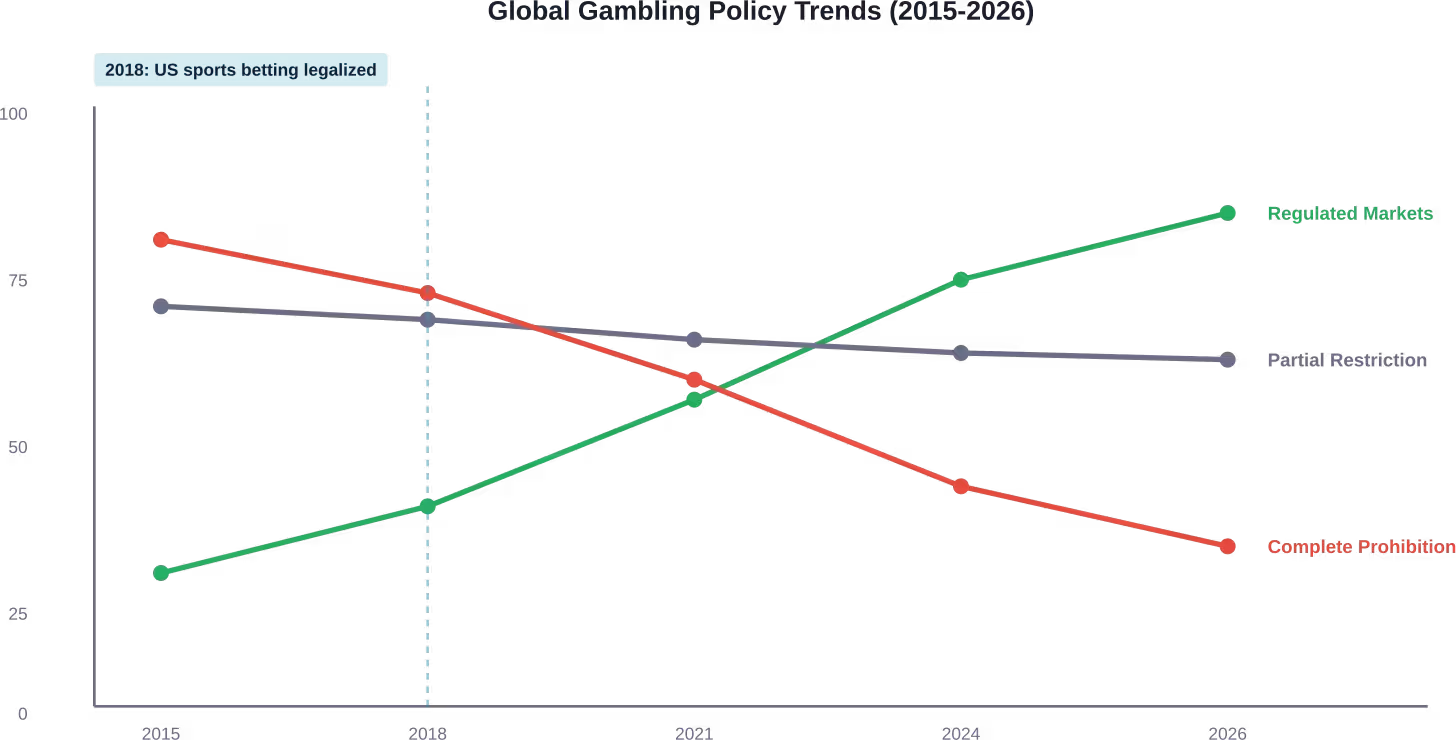
Gambling laws are evolving rapidly worldwide. Several clear trends are reshaping where gambling is prohibited and how prohibition is enforced.
The Legalization Wave
The overall global trend moves toward legalization and regulation rather than prohibition. Countries increasingly recognize that prohibition creates illegal markets without eliminating demand.
Sports betting legalization has accelerated particularly rapidly. The global legal gambling market—including lotteries, bingo, casino, gaming machines, and sports betting—continues expanding as previously prohibitive jurisdictions create regulated frameworks.
Online gambling presents the strongest pressure for reform. The impossibility of effectively blocking internet gambling access pushes countries toward regulation rather than futile prohibition efforts.
Persistent Prohibition
Despite liberalization trends, religious and cultural opposition ensures gambling will remain illegal in certain regions indefinitely. Islamic countries show no signs of abandoning Sharia-based gambling prohibition.
Utah’s gambling ban appears similarly permanent given the state’s religious composition and consistent political opposition to legalization.
Regulatory Innovation
Countries are developing more sophisticated regulatory approaches that fall between complete prohibition and wide-open legalization. These frameworks emphasize harm reduction, consumer protection, and responsible gambling requirements.
Sweden’s licensing system, which combines relatively open market access with strict consumer protection requirements, represents this middle-path approach that may influence future regulatory models.
Mandatory deposit limits, self-exclusion programs, and algorithmic detection of problem gambling behavior are becoming standard features in modern gambling regulation.
Find Compliant iGaming Partners Effortlessly

Global gambling bans show how uneven the regulatory landscape really is. For companies, this means every partnership decision matters. Sologe is a dedicated B2B marketplace where operators search for suppliers and vendors present their products in a controlled environment built specifically for iGaming. It replaces scattered sourcing with a single place focused on real business connections.
Choose Partners That Fit Your Market
Sologe helps companies to work across different regions in multiple ways:
- Accessing a curated marketplace of iGaming products and services
- Identifying partners already active in specific markets
- Maintaining continuous visibility without relying on events
- Starting direct communication with relevant companies
If you need partners that match your market conditions or want to be found by the right businesses, contact Sologe and start the conversation.
Frequently Asked Questions
Which countries have the strictest gambling laws?
Countries like the United Arab Emirates, Qatar, Brunei, and North Korea enforce some of the strictest gambling prohibitions. These bans typically cover all forms of wagering and may carry severe penalties, often rooted in religious law or strict government control.
Can I gamble online if I’m in a country where it’s illegal?
No. Accessing online gambling platforms from jurisdictions where gambling is prohibited generally violates local laws. Even if enforcement varies, using tools like VPNs to bypass restrictions can create legal risks, and winnings may not be legally protected.
Why is gambling legal in some U.S. states but not others?
Gambling regulation in the United States is determined at the state level. Each state sets its own laws based on local political views, cultural factors, economic considerations, and historical context, leading to significant differences across the country.
Is sports betting illegal everywhere gambling is banned?
Not always. Some regions allow specific types of betting, like sports wagering, while prohibiting others. Laws vary widely, with each jurisdiction creating its own mix of permitted and restricted gambling activities.
What happens if gambling becomes legal after I bet illegally?
Legalization does not retroactively legalize past illegal activity. Any actions taken before legalization remain subject to the laws that were in place at the time, though enforcement priorities may change afterward.
Are there any countries planning to ban gambling in 2026?
There are no widely reported major countries planning new comprehensive gambling bans. The global trend generally favors regulation and consumer protection rather than full prohibition.
How do countries enforce online gambling bans?
Governments use methods such as blocking gambling websites, restricting financial transactions, regulating operators, and occasionally enforcing penalties. Effectiveness varies, and enforcement typically focuses more on operators than individual users.
Conclusion: Navigating the Complex World of Gambling Prohibition
The question “where is gambling illegal?” has no simple answer. Legal frameworks range from complete prohibition to comprehensive regulation, with endless variations between these extremes.
Religious doctrine, particularly Islamic law, drives prohibition in numerous countries across the Middle East and parts of Asia. Cultural opposition rooted in Mormonism keeps gambling illegal throughout Utah. Social concern about gambling harm influences restrictive policies in countries from Australia to Switzerland.
But the overall global trend moves toward regulation rather than prohibition. Governments increasingly recognize that gambling demand persists regardless of legal status, and that prohibition creates unregulated black markets without eliminating the activity or its associated harms.
Online gambling accelerates this shift. The practical impossibility of blocking internet access to international gambling sites pushes countries toward creating licensed frameworks that generate tax revenue and enable consumer protection rather than maintaining futile prohibition.
For travelers, expats, and online bettors, understanding local gambling laws is essential. Penalties for violating gambling prohibition range from minor fines to serious criminal charges, particularly in countries where religious doctrine shapes the legal framework.
Look, the gambling legal landscape will continue evolving. Countries that maintain prohibition today may legalize tomorrow, and vice versa. Staying informed about local laws and emerging regulatory changes is the only way to navigate this complex, constantly shifting terrain.
Before participating in any gambling activity, check current local laws, understand the specific activities that are permitted or prohibited, and recognize that legal status can vary dramatically between neighboring jurisdictions—or even between states or provinces within the same country.
Related Articles

September 30, 2026Is Sports Betting Legal in Brazil? The Full...

September 30, 2026Is Sports Betting Legal in Iran? The Real...