 Nothing found for the request
Who Invented Gambling? Ancient Origins Revealed
Sologe April 28, 2026
Share:


Quick Summary
Quick Summary: No single person invented gambling. Archaeological evidence from Native American sites in Colorado shows dice games existed over 12,000 years ago, while ancient civilizations in Mesopotamia, Egypt, and China developed their own gambling traditions independently between 3000-2000 B.C. Gambling emerged organically across multiple cultures as humans discovered the thrill of wagering on uncertain outcomes.
The question of who invented gambling doesn’t have a simple answer. There’s no patent holder, no single inventor who can claim credit for creating games of chance.
Instead, gambling evolved across multiple continents, emerging independently as human societies developed. Recent archaeological discoveries have pushed the timeline back thousands of years further than scholars previously believed.
The Earliest Evidence: Native American Dice From 12,000 Years Ago
According to research from Colorado State University published in April 2026 (libarts.source.colostate.edu), the earliest known dice in human history were made and used by Native American hunter-gatherers on the western Great Plains more than 12,000 years ago. That’s right at the end of the last Ice Age.
These dice, found at the Lindenmeier site in Northern Colorado, predate any other known gambling implements by roughly six millennia. The discovery fundamentally reshapes what scholars understood about gambling’s origins.
Here’s what makes this finding remarkable: it places the exploration of randomness and probability in North America, not in the Middle East or Asia where historians long assumed organized gambling began.
The historical and ethnographic records provide another interesting detail. When European observers documented Native American dice games centuries later, they noted that approximately 70% of players were women. Whether this gender distribution held true 12,000 years ago remains unknown, but it challenges assumptions about who participated in early gambling activities.
Ancient Civilizations and the Birth of Organized Gambling
While Native Americans were rolling dice during the Ice Age, other civilizations developed their own gambling traditions independently.
Mesopotamia and the Earliest Betting Culture
Ancient Mesopotamia, often called the cradle of civilization, shows evidence of gambling dating back to around 3000 BC. The region’s inhabitants created some of the first known games involving wagering.
These early games weren’t just entertainment. Many scholars believe gambling originated from divinatory practices—casting marked sticks or objects to predict the future and understand divine intentions.
Egypt’s Gaming Legacy
In 1930, British anthropologist Sir Flinders Petrie discovered objects in an Egyptian child’s grave resembling balls and pins used in skittles. The tomb’s contents dated to 3200–3000 B.C.
Between 4000 and 3000 BC, ancient Egyptians bet on dice games, board games, and feats of skill like chariot racing and fencing. They also played early forms of bocce with polished rocks around 5000 BC.
But the Egyptian authorities didn’t always approve. Ancient Egyptian law sometimes sentenced inveterate gamblers to forced labor in the quarries.
China’s Contribution to Gaming History
China developed its own rich gambling culture. Playing cards appeared in 9th century China, according to the National Library Service for the Blind and Print Disabled.
The country also contributed various dice games and early forms of lottery-style games. Ancient Chinese laws, like those in Rome and as prescribed in the Jewish Talmud, typically regulated gambling strictly—which usually meant severe curtailment of gambling activities.
The Evolution of Gambling Across Cultures
Ancient Rome’s Gambling Obsession
Romans took gambling seriously. Betting on games and races was commonplace throughout the Roman Empire.
Chariot races drew enormous wagers. Romans also bet heavily during gladiatorial contests and various athletic competitions.
The authorities periodically outlawed gambling in ancient Rome, but exceptions were consistently made for holidays. During festivals, gambling was not just permitted but embraced as part of the celebrations.
The Ancient Olympics and Sports Betting
Betting on sports took place during the ancient Olympic Games, around 800 to 700 BC. Athletes competed while spectators wagered on outcomes.
This tradition established a pattern that continues today: wherever organized competition exists, betting follows.
Religious and Legal Perspectives on Gambling
Gambling wasn’t just regulated by secular authorities. Major religious traditions developed specific positions on wagering.
Islam and Buddhism both established prohibitions against gambling. The Jewish Talmud addressed gambling practices with detailed regulations.
These religious restrictions reflected broader concerns about gambling’s social impact. Ancient authorities recognized that excessive gambling could destabilize families and communities.
Medieval Europe: Lotteries and the Spread of Card Games
Medieval Europe saw gambling evolve in new directions. Lotteries emerged as a distinct form of wagering during this period.
In 1566, Queen Elizabeth I granted a charter for the first English State Lottery, which was drawn in 1569.
Card games spread throughout Europe during the medieval period. By the 1500s, card sharps—professional cheaters—had become common enough that artists like Caravaggio painted them.
The Codification of Game Rules
Edmond Hoyle changed gambling’s landscape in the 18th century. He began by tutoring British high society in card games but went on to codify rules and write manuals.
His treatises on various games were collected in 1748, making his name synonymous with playing by the rules. The edition of Hoyle included in reference materials covers more than two hundred fifty games.
Gambling in the Americas: Three Waves of Legalization
British settlers brought their passion for gambling to North America. The first racetrack was established in 1665 on Long Island in New York.
Horse racing maintained a constant presence in the United States since at least 1665—an anomaly among regulated forms of gambling that survived various prohibition efforts.
Professor I. Nelson Rose identified three distinct waves of legalized gambling in the United States:
Period | Characteristics | How It Ended |
|---|---|---|
1787 to Mid-1830s | Gambling largely outlawed except lotteries for revenue; both public and private organizations operated lotteries | Numerous lottery scandals; some drawings never occurred; state constitutions banned lotteries |
1840s to 1890s | Post-Civil War lottery revival to fund Reconstruction; westward expansion popularized casino gambling and poker | Louisiana lottery scandal involving alleged legislative bribery; formal city governments outlawed casino gambling |
1900s to Present | State lottery reemergence (1964); Nevada and Atlantic City casinos; expansion to many states | Ongoing; 48 states now have some legal gambling as of 2022 |
Lotteries Fund American Development
Lotteries played a vital role in America’s development. Many of the country’s first public buildings, colleges, roads, canals, and religious buildings received funding through both public and private lotteries.
In 1776, the First Continental Congress started a lottery in the 13 colonies to fund the Revolutionary War. The connection between gambling and public infrastructure became deeply embedded in American governance.
The Louisiana Lottery Scandal
The Louisiana lottery stood at the center of the biggest gambling scandal of the late 1800s. Lottery operators were accused of attempting to pay off the state legislature.
This scandal effectively ended the second wave of legalized gambling in the United States and reinforced prohibitions that would last decades.
The Rise of State-Run Gambling Operations
According to research published in JSTOR Daily, starting in the 1960s, politicians established state lotteries hoping to replace illegal gambling operations.
In the 1920s, Black communities in Harlem and other urban areas had developed numbers games—informal lotteries that brought jobs and revenue to marginalized communities.
New York provides a clear example of this transition. When the state lottery began numbers sales in the fall of 1970, it directly competed with these community-based operations.
Within four years, the state lottery’s sales rose 300 percent, finally making it the successful revenue source supporters had promised. But this success came at the expense of informal gambling operations that had provided economic opportunities in communities often excluded from mainstream business.
Gambling in Elizabethan England
Gambling permeated Elizabethan society, particularly among gentlemen. Historical records show bonds worth £200—substantial sums—wagered on games and other contests.
Letters from the period, including correspondence by John Chamberlain dated January 1602/03, document the extent of gambling among the aristocracy.
The Crisis of the Aristocracy, a historical study, places gambling debt as a significant factor in the financial troubles experienced by noble families during this era.
The Evolution of Dice: From Imbalanced to Fair
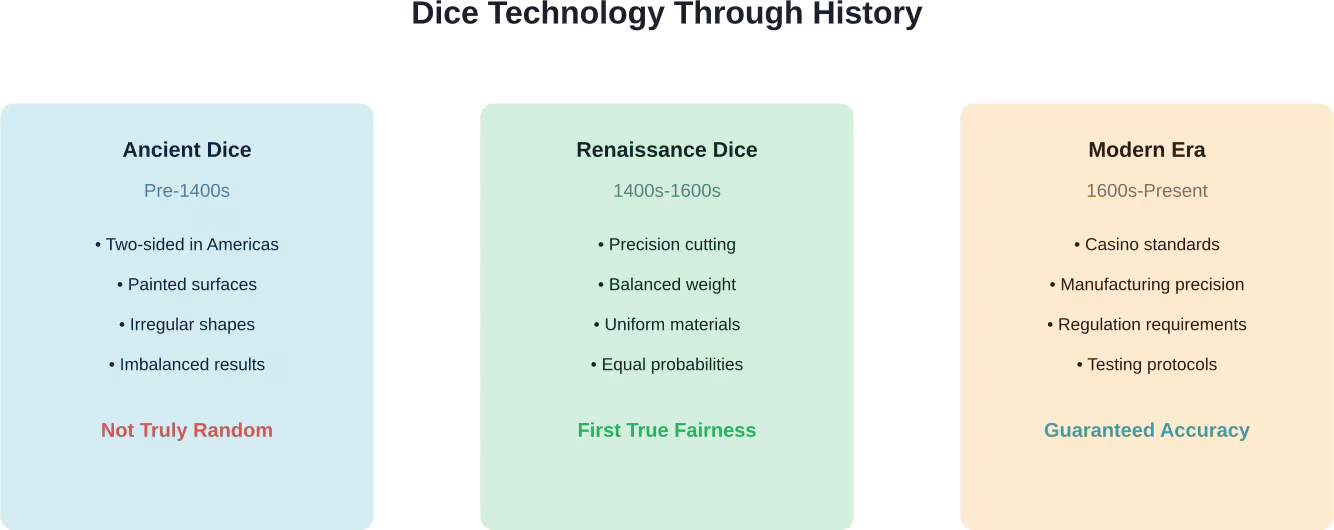
A fascinating study of dice reveals that truly balanced dice didn’t exist until the Renaissance. Before this period, dice were inherently imbalanced.
In pre-colonial Americas, dice were typically two-sided and painted on each surface. The irregular construction meant outcomes weren’t truly random by modern standards.
How pre-Renaissance people viewed their games’ fairness is difficult to determine. But the lack of balanced dice suggests that pure randomness wasn’t the primary goal—divination and entertainment mattered more than statistical fairness.
The Casino Era: From Monaco to Las Vegas
The modern casino emerged in 19th-century Europe. Monte Carlo became synonymous with glamorous gambling, attracting wealthy Europeans to elaborate gaming establishments.
Nevada legalized casino gambling in the early 20th century, but Las Vegas didn’t truly explode until after World War II. The city transformed from a desert railroad stop into the world’s gambling capital.
Atlantic City, New Jersey, followed with casino legalization in the late 1970s. This marked the beginning of casino expansion beyond Nevada.
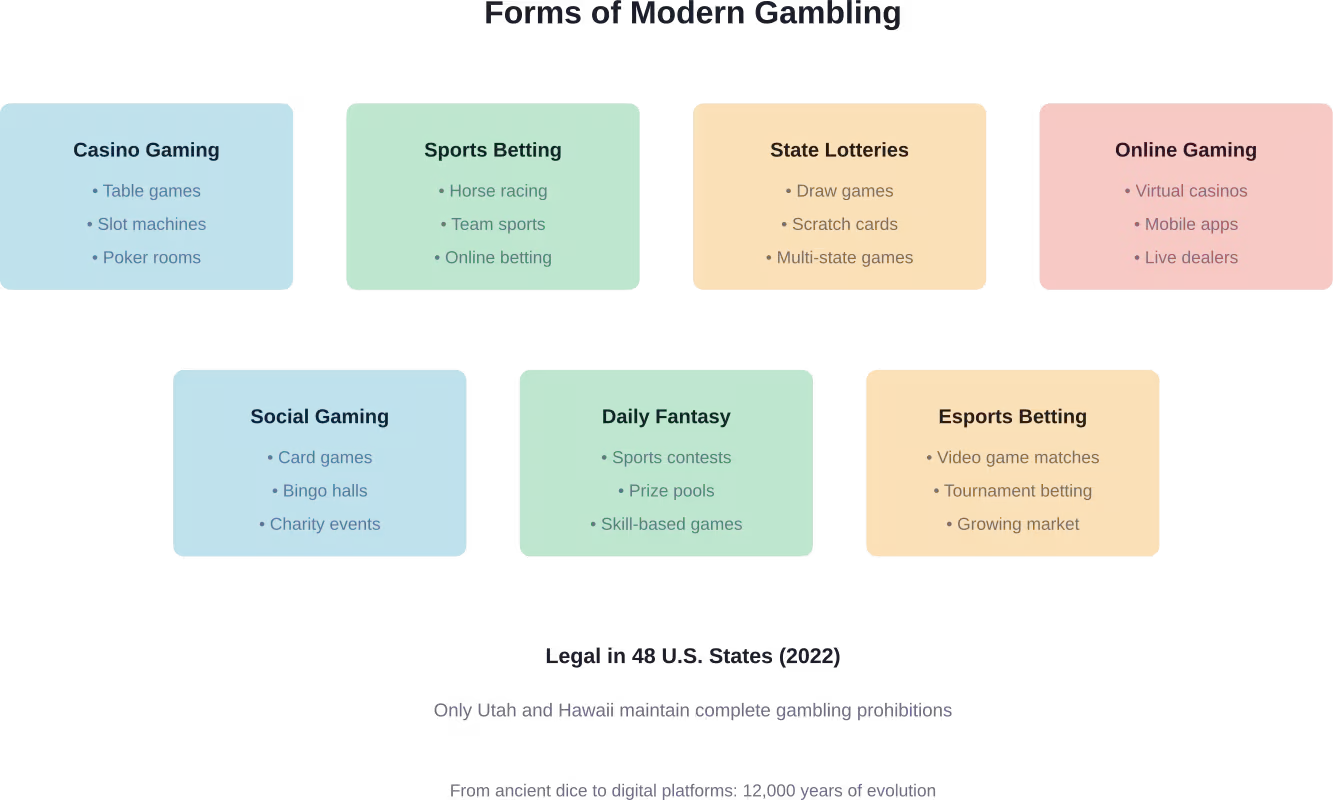
As of 2022, all but two states—Utah and Hawaii—have some form of legal gambling. Despite recognized harms associated with gambling, many states view revenue benefits as outweighing the risks.
Global Gambling Traditions: A Worldwide Phenomenon
Gambling isn’t uniquely Western or American. Nearly every culture developed its own gambling traditions.
Fantan in South China
Research on gambling in China during the early 20th century documents fantan, a traditional Chinese gambling game popular in South China.
The game involved betting on remainders after dividing buttons or coins. Its popularity demonstrated how gambling permeated Chinese society despite official restrictions.
Britain’s Long Gambling History
Britain maintained continuous gambling traditions from medieval times through the present. The long 18th century (roughly 1680-1830) saw particularly intense gambling activity among all social classes.
Horse racing became deeply embedded in British culture. The sport combined aristocratic tradition with working-class enthusiasm for betting.
The Internet Revolution: Online Gambling
The internet fundamentally transformed gambling in ways that previous technological advances never could.
Online gambling expanded significantly in the 1990s onward. Suddenly, gamblers could access thousands of games from home without traveling to physical casinos.
Sports betting expanded dramatically online. Mobile devices made wagering possible anywhere, anytime.
This accessibility created new regulatory challenges. How do governments control gambling when servers exist in foreign jurisdictions? How do they protect vulnerable populations from constant gambling access?
These questions remain partially unresolved even today.
Modern Gambling: Current State of the Industry
Today’s gambling industry bears little resemblance to ancient dice games played by Ice Age hunter-gatherers.
All but two states—Utah and Hawaii—have some form of legal gambling as of 2022. The revenue generated runs into billions of dollars annually.
Gaming has become a preferred euphemism, used partly to circumvent negative associations with “gambling.” This linguistic shift reflects ongoing tensions about how society views wagering activities.
Take Your iGaming Business Into the Modern Market

Gambling did not start as an industry, but over thousands of years it became one. Today, behind every platform, payment system, software product, or service, there are companies trying to find the right business connections. Sologe is a B2B iGaming marketplace built for that modern stage – a place where operators can search for suppliers, and vendors can present their products to companies already working in the market.
Grow Through a Dedicated iGaming Marketplace
Sologe helps companies move from scattered contacts to structured business discovery:
- List products and services in a focused iGaming environment
- Help operators find suppliers for real business needs
- Give vendors year-round visibility beyond events and cold outreach
- Start direct conversations with relevant industry companies
Contact Sologe to discuss how your company can be found by the right iGaming partners or find the suppliers it needs.
Why Gambling Persists: The Psychology Behind Wagering
Why has gambling survived for over 12,000 years? The answer lies partly in human psychology.
The urge to play games isn’t restricted to any particular time or place. Games provide entertainment, social connection, and the thrill of uncertainty.
Gambling adds stakes to these activities. The possibility of winning something valuable intensifies the emotional experience.
But this same mechanism creates risks. Some individuals develop gambling problems that damage their financial stability and personal relationships.
From Divination to Entertainment: The Changing Purpose
The origin of gambling is considered by many scholars to be divinatory. Ancient peoples cast marked objects to understand divine will and predict future events.
This spiritual purpose gradually transformed into entertainment and competition. The element of chance remained, but the religious significance faded.
Modern gambling retains traces of this original purpose. People still talk about “luck” and “fate” when discussing gambling outcomes, echoing ancient beliefs about supernatural forces governing random events.
Frequently Asked Questions
Who exactly invented gambling?
No single person invented gambling. It developed independently across different cultures worldwide. Evidence shows early gambling activities among Native Americans over 12,000 years ago, while ancient civilizations in Mesopotamia, Egypt, and China created their own forms between 3000–2000 BC.
What is the oldest form of gambling?
The oldest known gambling tools are dice discovered at the Lindenmeier site in Colorado, dating back more than 12,000 years. These are among the earliest physical evidence of chance-based games.
When did gambling become legal in the United States?
Gambling legality evolved in stages. Early America used lotteries (late 1700s–early 1800s), followed by widespread bans. The modern era began in the mid-20th century with the reintroduction of state lotteries. Today, most states allow some form of legal gambling.
Did ancient civilizations have casinos?
Ancient societies did not have casinos as we know them today, but they had designated areas for gambling activities. For example, Romans placed bets at chariot races and public gatherings. Modern casinos emerged in Europe during the 19th century.
Why was gambling originally practiced?
Gambling likely began as a form of divination. Early humans used objects like bones or stones to predict outcomes or interpret divine will. Over time, these practices evolved into entertainment and competitive activities involving chance.
When were truly fair dice invented?
Fair, balanced dice became possible during the Renaissance, when improved manufacturing techniques allowed for precise shaping and uniform materials. Earlier dice were often uneven, affecting the randomness of outcomes.
Which countries have the longest gambling traditions?
China, Egypt, and Mesopotamia have well-documented gambling histories spanning 3,000–5,000 years. However, evidence from North America suggests even older traditions, with Native American dice games dating back over 12,000 years.
The Enduring Appeal of Gambling
So who invented gambling? The evidence points to multiple origins across different continents and eras.
Native Americans were rolling dice while glaciers still covered much of North America. Egyptians buried gaming equipment with their dead 7,000 years ago. Mesopotamians developed betting cultures alongside the first writing systems. Chinese civilization contributed playing cards and unique dice games.
Each culture discovered gambling independently, suggesting something fundamental in human nature draws us toward games of chance.
From those ancient bone dice found in Colorado to sophisticated online betting platforms, gambling has evolved dramatically while maintaining its core appeal: the thrill of uncertainty and the hope of winning.
Understanding gambling’s deep history helps explain why it persists despite periodic prohibitions and recognized harms. This isn’t a recent invention or passing fad—it’s woven into human culture across 12 millennia.
Whether gambling’s future follows the pattern of previous waves—expansion followed by scandal and restriction—or whether modern regulations successfully balance access with protection remains to be seen. But one thing seems certain: gambling isn’t disappearing anytime soon.
Want to learn more about how ancient practices shape modern entertainment? Explore the fascinating connections between historical gaming traditions and today’s billion-dollar gambling industry.
Related Articles

September 30, 2026Is Sports Betting Legal in Brazil? The Full...

September 30, 2026Is Sports Betting Legal in Iran? The Real...